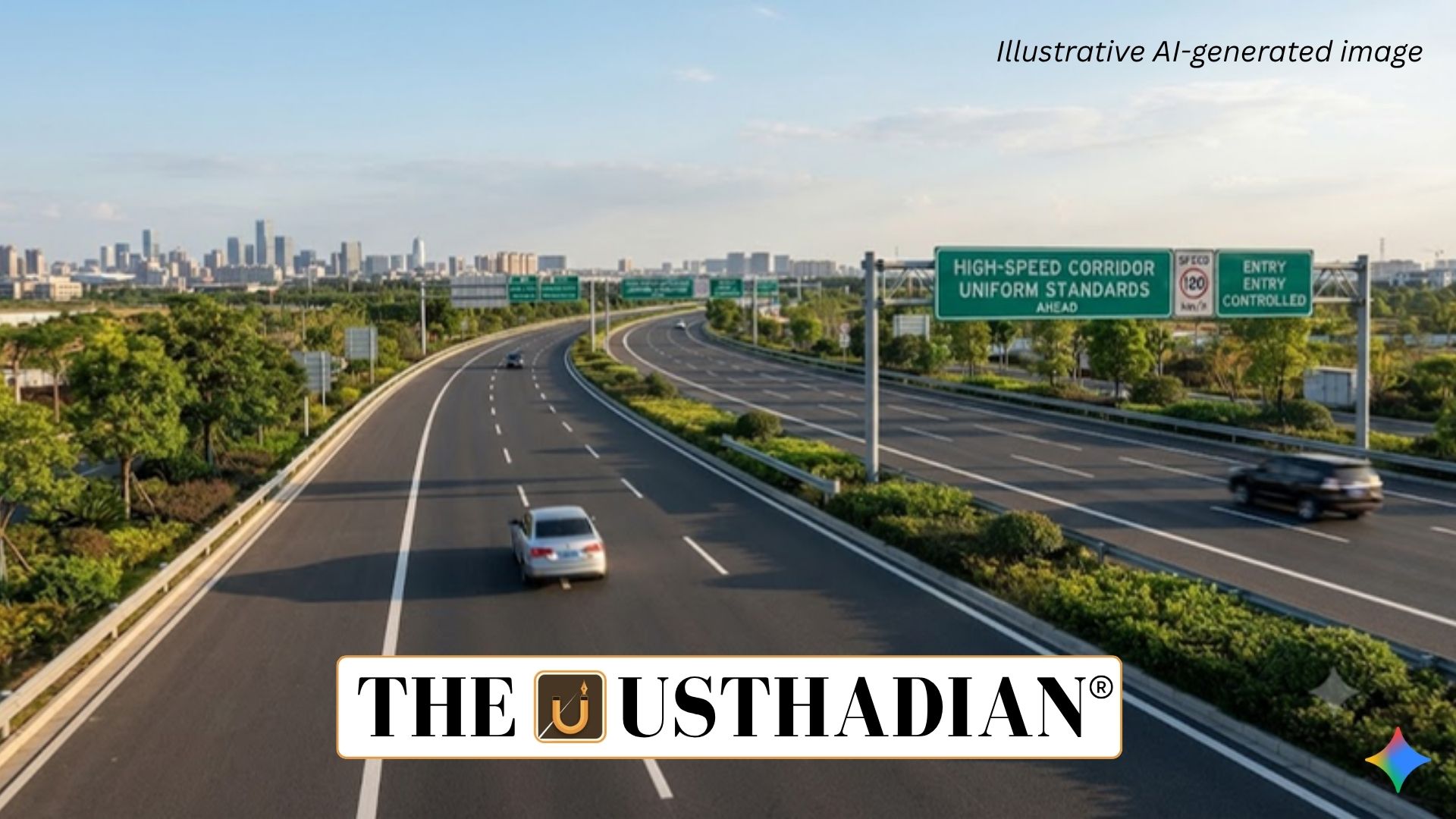
NHAI Standardises High Speed Corridor Design
NHAI Sets Uniform Standards for High Speed Corridors: The National Highways Authority of India (NHAI) has introduced comprehensive standards for developing high-speed corridors, including access-controlled national highways and expressways. The guidelines aim to bring consistency in project planning, design and construction.
Earlier, Detailed Project Reports (DPRs) prepared by different consultants could follow varying technical approaches. The new framework seeks to establish common requirements for traffic studies, lane planning, access control, signage, tolling and environmental measures.
Static GK fact: NHAI was established under the National Highways Authority of India Act, 1988, and became operational in 1995. It functions under the Ministry of Road Transport and Highways.
Vision 2047 and Corridor Expansion
The standardisation assumes importance amid India’s long-term infrastructure plans. The country has set a target of developing around 50,000 km of high-speed corridors by 2036–37 under the broader Vision 2047 framework.
As of December 2025, India’s high-speed corridor network was approximately 3,052 km. These corridors are designed to provide uninterrupted movement for long-distance traffic while restricting direct access from local roads.
Scientific Traffic Assessment
The new NHAI framework requires traffic projections to consider multiple categories, including existing, generated, induced and diverted traffic. Proper traffic modelling must support decisions on corridor capacity and future expansion.
Freight-growth estimates are also expected to reflect broader economic development. Traffic information must be cross-checked using secondary sources such as toll transaction records, while freight traffic and Vehicle Damage Factor (VDF) assessments can use information from GST portals, mining departments and other relevant databases.
This approach is intended to align lane capacity with actual and projected demand rather than relying on uniform assumptions.
Access Control and Road Safety
A fundamental feature of these corridors is access control. The guidelines prohibit at-grade intersections with the project highway and require entry and exit through appropriately designed ramps at designated locations.
In areas where heavy agricultural machinery such as harvesters and loaded tractors operates frequently, underpasses may have a height of 4.50 metres. Built-up and urban stretches are also required to have service roads, along with drain-cum-footpath arrangements.
Static GK Tip: An access-controlled highway restricts entry and exit to designated points, reducing conflicts between through traffic and local road users.
Signage and Tolling
NHAI has prescribed specific standards for advance directional signage. Full overhead gantries are to be positioned 5 km and 2 km before an exit, while cantilever gantries are planned at 1 km and 500 metres.
Lane and other road markings are specified at 150 mm, while edge-lane markings are 200 mm wide.
The guidelines also require provision for Multi-Lane Free Flow (MLFF) tolling. This barrier-less system enables vehicles to pass through tolling points without conventional stopping.
Sustainable Corridor Planning
Protection of the Right of Way is another component. A 1-metre-high RCC boundary wall is prescribed along the outer edge of the ROW to reduce unauthorised access and encroachment.
Environmental measures are incorporated at the planning stage itself. Drip irrigation is proposed for median plantations, while tree plantation must form part of the DPR rather than being treated as a later activity.
Static Usthadian Current Affairs Table
NHAI Sets Uniform Standards for High Speed Corridors:
| Fact | Detail |
| Implementing authority | National Highways Authority of India |
| High-speed corridor target | 50,000 km by 2036–37 |
| Existing network | 3,052 km as of December 2025 |
| Traffic categories | Existing, generated, induced and diverted |
| Underpass height | Up to 4.50 metres where required for heavy farm machinery |
| Overhead gantries | 5 km and 2 km before exits |
| Cantilever gantries | 1 km and 500 metres before exits |
| MLFF | Barrier-less Multi-Lane Free Flow tolling |
| Boundary wall | 1 metre RCC wall along outer ROW |
| Sustainability measures | Median drip irrigation and planned tree plantation |