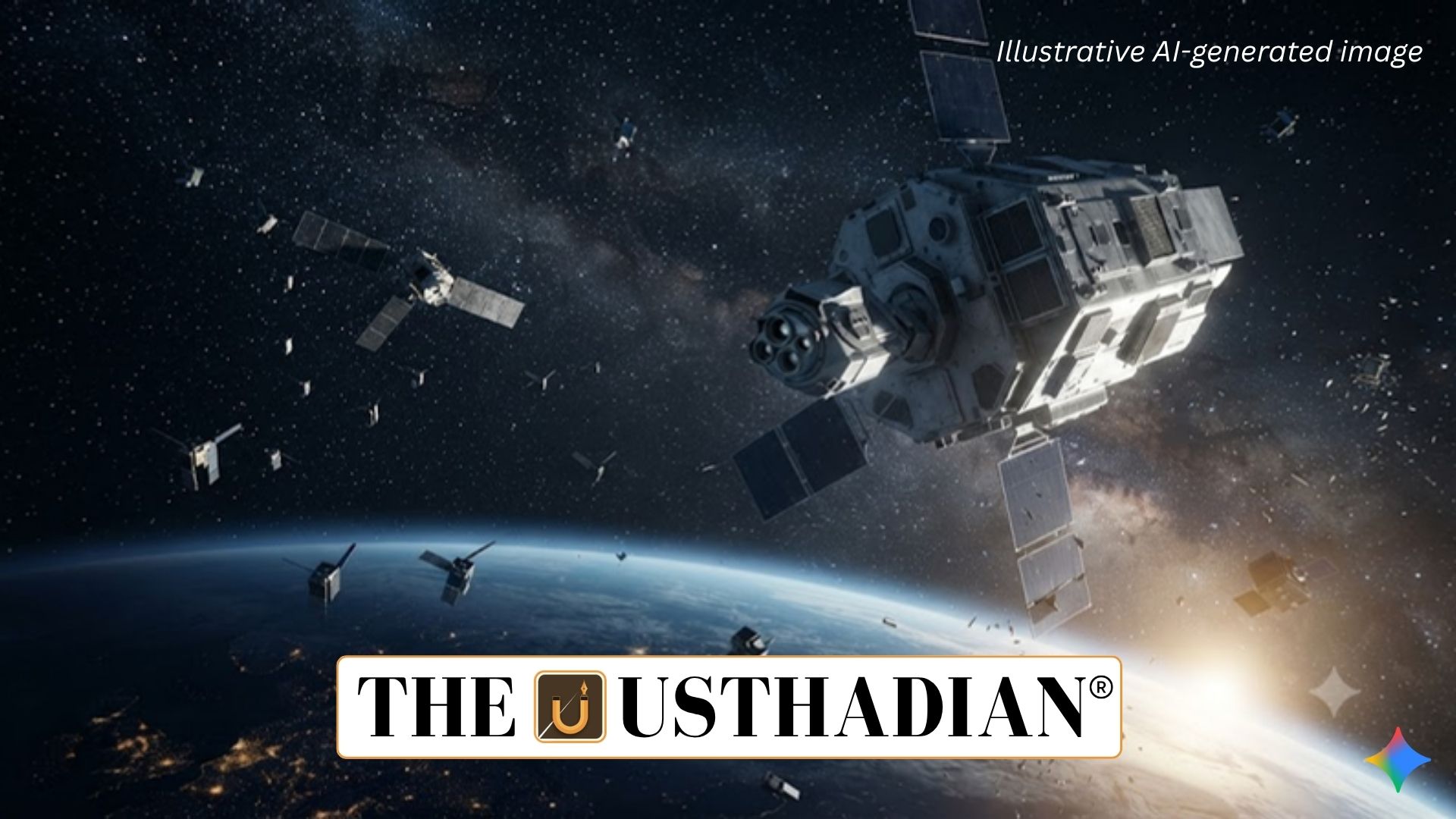
US Acknowledges Weapons in Orbit
Space Weapons Expose Gaps in Global Space Law: The United States has publicly acknowledged that it possesses active on-orbit space control weapons, marking a significant development in the debate over the militarisation of outer space. The US Air Force Secretary stated that these systems can help protect joint forces against hostile actions, but their exact nature and deployment timeline have not been disclosed.
The announcement has renewed international attention on the absence of comprehensive rules governing conventional weapons in space.
Static GK fact: The US Space Force was established in 2019 during Donald Trump’s first presidential term as a separate branch of the US armed forces.
China and Russia Respond
China called on the United States to stop expanding military capabilities and preparing for conflict in outer space. Russia similarly advocated keeping space free from weapons and urged greater international cooperation towards the demilitarisation of outer space.
At the same time, Washington has accused both China and Russia of developing counterspace capabilities capable of monitoring, disrupting or targeting US space assets.
Types of Space Weapons
Space-based military capabilities can operate across three broad directions. Earth-to-space systems can attack satellites from the ground, space-to-Earth systems can target terrestrial assets, while space-to-space weapons can engage other objects in orbit.
The recently acknowledged American systems have not been publicly classified into any of these categories.
Space warfare also includes non-kinetic capabilities. Jamming satellite communications, disrupting navigation signals and conducting cyberattacks against networks controlling space infrastructure can damage an adversary without physically destroying a satellite.
ASAT Tests Demonstrate Military Capability
The clearest public demonstrations of space weapons have been Anti-Satellite (ASAT) tests. Four countries—the United States, Russia, China and India—have conducted such tests, generally targeting their own non-functional satellites.
Non-kinetic operations have also demonstrated the vulnerability of space-based services. Before Russia’s invasion of Ukraine in February 2022, hackers reportedly compromised ground infrastructure associated with the Viasat satellite network. Russia has also been reported to have attempted GPS interference in the conflict zone.
Outer Space Treaty Has Major Gaps
The Outer Space Treaty of 1967 remains the principal international legal framework governing activities in outer space. It prohibits placing nuclear weapons and other weapons of mass destruction in orbit or stationing them in outer space.
However, the treaty does not expressly prohibit conventional weapons, anti-satellite systems or many forms of cyber and electronic warfare. It also does not comprehensively address Earth-to-space weapons.
Static GK Tip: The Outer Space Treaty was opened for signature in 1967 and entered into force on 10 October 1967.
Global Efforts Remain Incomplete
China and Russia proposed the Prevention of the Placement of Weapons in Outer Space (PPWT) treaty around 2008. However, the proposal did not become a binding international treaty and did not comprehensively address ground-launched anti-satellite weapons.
At the UN Conference on Disarmament, discussions under PAROS—Prevention of an Arms Race in Outer Space—have also failed to produce a legally binding agreement.
Artemis Accords and India
The Artemis Accords, led by NASA and the US State Department, provide voluntary principles for peaceful and cooperative space exploration. More than 70 countries, including India, have joined the framework.
However, the Accords do not constitute a comprehensive arms-control treaty and do not prohibit countries from possessing or deploying weapons in space.
India and Space Security
India demonstrated its ASAT capability through Mission Shakti in 2019, making space security an important strategic concern. With India’s growing satellite infrastructure and participation in international space cooperation, protecting space assets while supporting stronger international norms remains significant.
Static Usthadian Current Affairs Table
Space Weapons Expose Gaps in Global Space Law:
| Fact | Detail |
| US space weapons admission | Active on-orbit space control weapons acknowledged |
| US Space Force | Established in 2019 |
| Major space weapon categories | Earth-to-space, space-to-Earth, space-to-space |
| ASAT-capable countries | United States, Russia, China and India |
| Outer Space Treaty | Adopted in 1967 |
| Treaty prohibition | Nuclear weapons and other WMDs in outer space |
| PPWT | Proposed treaty to prevent placement of weapons in outer space |
| PAROS | UN framework for preventing an arms race in outer space |
| Artemis Accords | Voluntary framework for peaceful space exploration |
| India ASAT test | Mission Shakti, 2019 |