Supreme Court Examines EVM Totaliser Proposal
EVM Totaliser Could Strengthen Voter Anonymity and Secrecy: The Supreme Court, led by Chief Justice Surya Kant along with Justices Joymalya Bagchi and V. Mohana, has asked the Central government to examine the introduction of totaliser machines for counting votes recorded through Electronic Voting Machines (EVMs).
The proposed system aims to protect booth-level voting secrecy by preventing individual polling stations from being associated with specific voting patterns. This could help address concerns that voters might face intimidation or retaliation based on their booth’s electoral preferences.
Static GK fact: EVM stands for Electronic Voting Machine, while VVPAT stands for Voter Verifiable Paper Audit Trail.
What Is an EVM Totaliser?
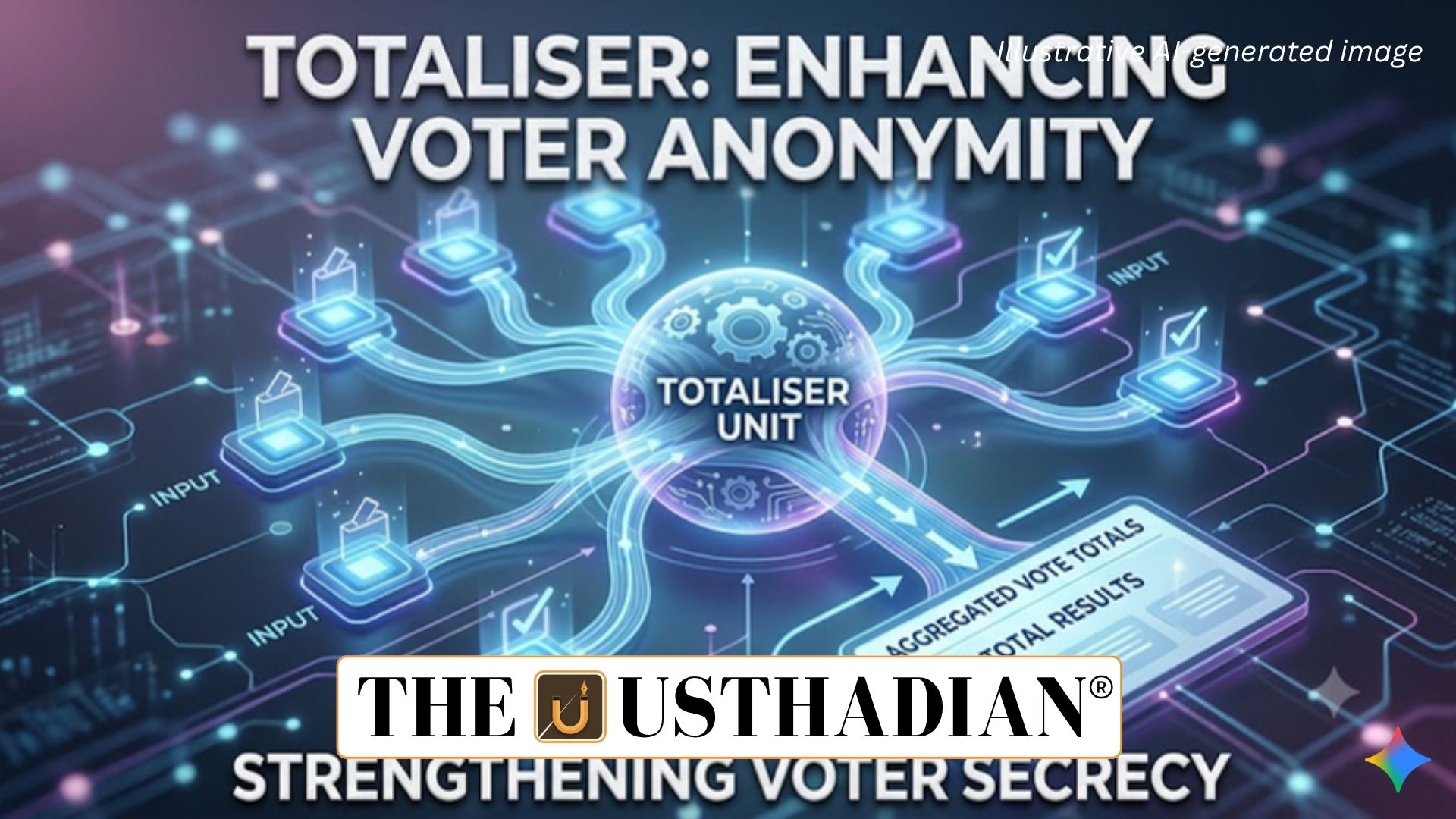
A totaliser is a device designed to combine votes recorded at multiple polling booths before the results are displayed. Under the proposed system, votes from around 14 polling booths would be counted together instead of revealing the result of every booth separately.
The technology has been developed by Bharat Electronics Limited (BEL), Bengaluru, and Electronics Corporation of India Limited (ECIL), Hyderabad.
The totaliser functions as an interface connected to the control units of a cluster of 14 EVMs. When the result button is activated, it provides the combined vote count for every candidate across the entire group without disclosing the booth-wise distribution.
How the Totaliser Debate Began
The legal dispute dates back to 2014, when Yogesh Gupta and Imran Khan filed a public interest petition seeking the mixing of votes from different polling stations within a constituency.
The petitioners argued that booth-wise results could potentially enable political candidates to identify areas that had not supported them and could contribute to voter intimidation. The petition referred to an alleged incident involving former Maharashtra Deputy Chief Minister Ajit Pawar in the Baramati constituency.
Centre’s Reservations on Totalisers
The Central government has historically opposed the introduction of totalisers.
In 2017, the Centre argued that access to booth-wise results would not necessarily cause voter intimidation and could instead help candidates identify areas where their support was weak and increase their efforts there.
A Law Ministry affidavit referred to the conclusions of a Group of Ministers headed by then Home Minister Rajnath Singh, which considered large-scale voter intimidation unlikely in an era of media activism.
In 2018, the Additional Solicitor General also raised concerns that introducing a totaliser could create possibilities of data breaches before counting. The Centre has more recently repeated concerns about potential EVM data leaks before counting.
Election Commission Supports the Proposal
The Election Commission of India (ECI) has supported the totaliser concept for many years. It first proposed the idea to the UPA government in 2008.
In a 2018 submission to the Supreme Court, the ECI stated that the time had come to introduce totalisers for vote counting. During the latest proceedings, the Commission again supported protecting voter anonymity while highlighting practical and legal questions concerning booth-wise verification and VVPAT.
Static GK Tip: The Election Commission of India is a constitutional body responsible for supervising and conducting elections to Parliament, state legislatures, and the offices of President and Vice-President.
Supreme Court Seeks Clear Positions
The Supreme Court has asked the Central government to clearly explain whether there are any legal or practical impediments to introducing totalisers and whether the system could have any adverse impact.
The ECI has also been asked to submit its formal proposal to the Union government. The Centre has raised specific data-security concerns, for which the Court has given the Election Commission time to respond.
Why the Totaliser Matters
The debate highlights an important balance between the constitutional principle of secret voting and the usefulness of booth-level electoral data.
A totaliser could provide greater anonymity by showing consolidated results across multiple booths. However, concerns regarding data security, transparency, booth-wise verification and VVPAT reconciliation must also be addressed before such a system can be implemented.
Static Usthadian Current Affairs Table
EVM Totaliser Could Strengthen Voter Anonymity and Secrecy:
| Fact | Detail |
| Issue | Introduction of EVM Totalisers |
| Supreme Court Concern | Protecting voter anonymity |
| Votes Combined | Around 14 polling booths |
| Totaliser Developers | BEL and ECIL |
| BEL Headquarters | Bengaluru |
| ECIL Headquarters | Hyderabad |
| Case Began | 2014 |
| Petitioners | Yogesh Gupta and Imran Khan |
| ECI First Proposed Totaliser | 2008 |
| ECI Submission Supporting Totaliser | 2018 |
| Major Verification Concern | VVPAT |
| Major Centre Concern | Data security and possible breaches |
| Core Democratic Principle | Secret ballot |
| Current Court Action | Centre and ECI asked to clarify positions |