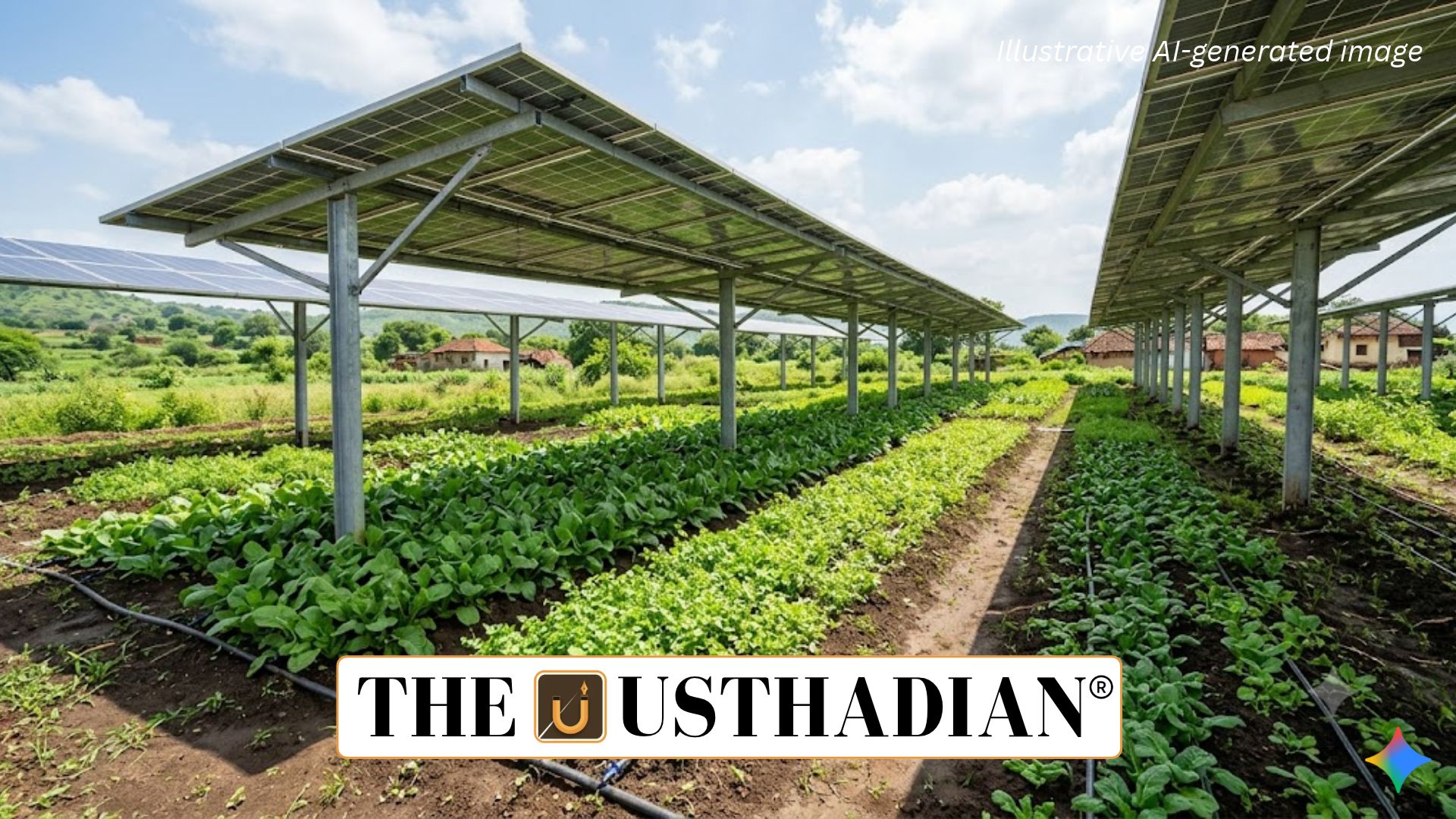
India Promotes Agrivoltaics
Agrivoltaics in India Combines Farming with Solar Energy: The Government of India announced plans to introduce agri-photovoltaics (agrivoltaics) under the second phase of PM-KUSUM at the Agrivoltaics World Conference 2026, held in New Delhi on 25 October 2026, according to the supplied report.
Agrivoltaics combines agricultural cultivation with solar electricity generation on the same land. The approach aims to provide farmers with an additional income source while supporting renewable energy expansion without completely displacing farming.
What Is Agrivoltaics
Agrivoltaics, also known as agri-PV, involves installing photovoltaic panels above agricultural land on elevated structures. Farmers can continue growing crops underneath while the panels generate electricity.
Unlike conventional ground-mounted solar projects, agrivoltaic systems require additional structural infrastructure to maintain sufficient space for farming operations. According to the supplied report, the Ministry of New and Renewable Energy (MNRE) recommends panel heights of approximately 3.5–4 metres to facilitate agricultural activities and machinery movement.
Static GK fact: Photovoltaic technology converts sunlight directly into electricity using solar cells. The same basic technology is used in conventional solar installations and agrivoltaic systems.
Connection with PM-KUSUM
The Pradhan Mantri Kisan Urja Suraksha evam Utthaan Mahabhiyan (PM-KUSUM) promotes solar energy in agriculture, including solar-powered irrigation and decentralised renewable power generation.
Agrivoltaics complements this objective by enabling farmers to use agricultural land for both food production and electricity generation. If implemented appropriately, it could diversify farm income and reduce competition between solar projects and agricultural land use.
Solar Energy Potential in Agricultural Land
According to the supplied report, nearly 30% of India’s 160 million hectares of cropland could be suitable for agrivoltaic installations. The estimated technical potential is around 1–2 terawatts (TW), equivalent to 1,000–2,000 gigawatts (GW).
This potential could support India’s renewable energy ambitions, particularly in regions where non-agricultural land for large solar installations is limited. However, actual deployment would depend on crop suitability, local climate, land ownership, infrastructure and economic feasibility.
Crop Suitability and Project Costs
Agrivoltaics is not equally suitable for every crop. Government assessment findings cited in the report indicate potential suitability for fruits and leafy vegetables, while crops such as rice and sugarcane have not been found suitable under the assessed conditions.
Agrivoltaic projects may cost around 25–30% more than conventional ground-mounted solar projects because of the elevated structures and additional civil works. These higher initial costs could restrict adoption, especially among small and marginal farmers.
Protecting Farmers and Agricultural Productivity
Most Indian agrivoltaic projects remain at the pilot stage, making careful evaluation necessary before large-scale implementation. Policy measures must protect crop yields, soil health, farmers’ land rights and long-term agricultural livelihoods.
According to the supplied report, Union Agriculture Minister Shivraj Singh Chouhan highlighted the need to ensure that the model benefits farmers rather than primarily serving large solar developers.
More than 85% of India’s farmers are classified as small and marginal, with an average landholding of approximately 0.96 hectares, as cited in the report. Therefore, equitable access to financing, transparent agreements and safeguards against loss of agricultural control will be essential for inclusive implementation.
Static GK Tip: Small and marginal farmers are generally defined in India by operational landholding size: marginal farmers operate less than 1 hectare, while small farmers operate 1–2 hectares.
Static Usthadian Current Affairs Table
Agrivoltaics in India Combines Farming with Solar Energy:
| Fact | Detail |
| Technology | Agrivoltaics or agri-PV |
| Core concept | Combining crop cultivation and solar power generation |
| Relevant scheme | PM-KUSUM |
| Reported conference date | 25 October 2026 |
| Recommended panel height | 3.5–4 metres, as reported |
| Estimated suitable cropland | Around 30% of 160 million hectares |
| Estimated potential | 1–2 TW or 1,000–2,000 GW |
| Additional project cost | Approximately 25–30% |
| Potentially suitable crops | Fruits and leafy vegetables, according to the report |
| Key policy concern | Protecting crop production, land rights and farmer livelihoods |