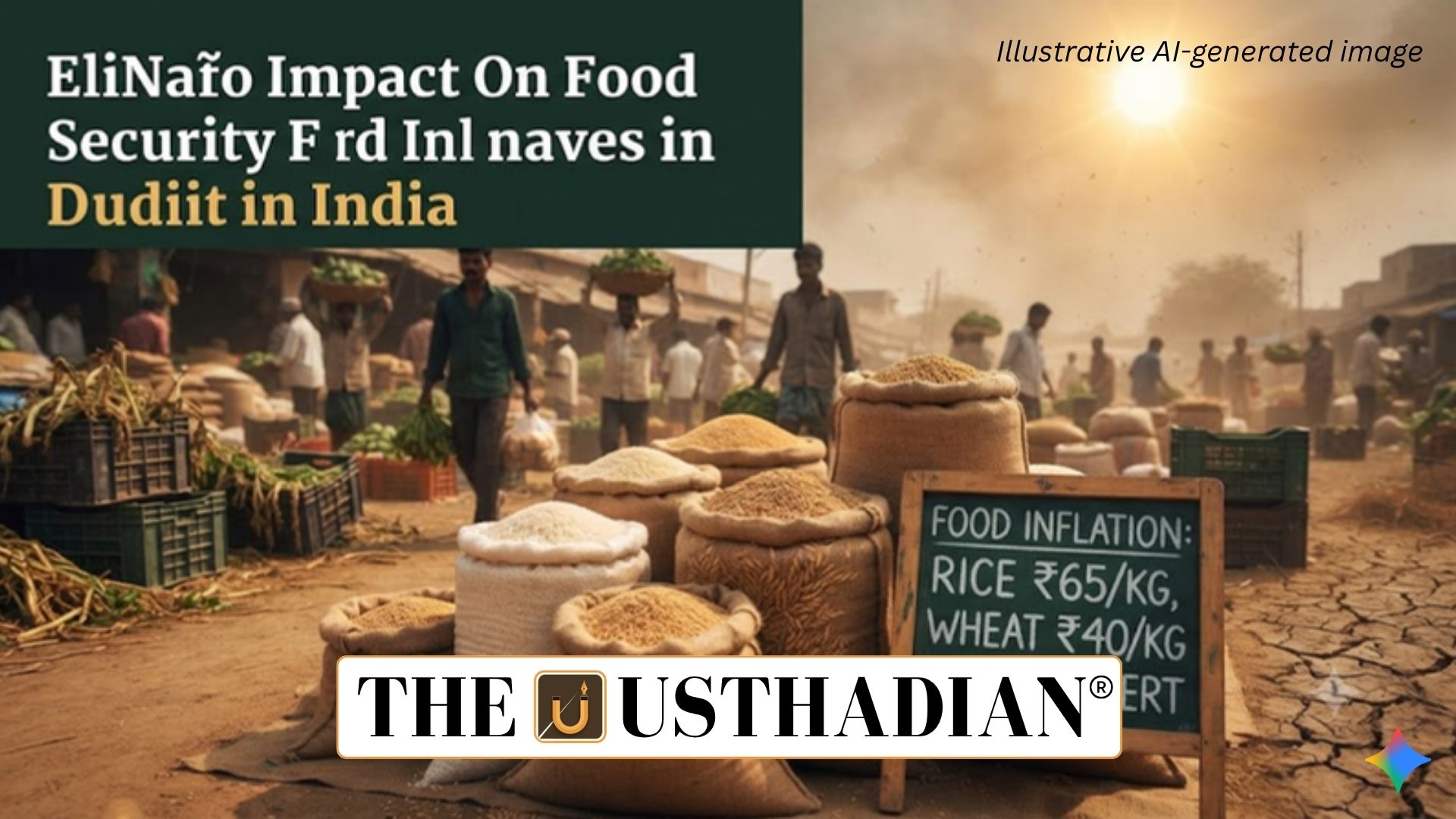
El Niño and Food Inflation
El Niño and Food Inflation Threaten India’s Food Supply: India’s food inflation outlook is facing renewed pressure from an uneven monsoon, strengthening El Niño conditions, crop production risks and geopolitical disruptions. Although food prices have remained relatively manageable so far, weakening domestic supplies and rising global commodity prices could increase inflationary pressures.
The interaction between weather conditions and global food markets is particularly important because India depends heavily on the monsoon for agricultural production.
How the Monsoon Performed
The 2026 southwest monsoon showed considerable variation across months. In June, not a single low-pressure system (LPS) developed against the normal average of around three. Rainfall was consequently 38% below the Long Period Average (LPA).
July brought four LPSs, broadly close to the climatological average. Their longer persistence resulted in 24 LPS days, compared with the normal 13.56 days, and rainfall was 1% above the LPA.
August recorded six LPSs against the normal 5.38. However, rainfall remained 16.3% below the LPA. Weakened easterly trade winds associated with El Niño reduced the movement of moisture-bearing air towards India.
Static GK fact: A low-pressure system develops when warm, moist air rises, cools and condenses, encouraging cloud formation and rainfall.
Overall Rainfall Deficit
By 13 September, cumulative all-India rainfall was 14.7% below the LPA. As many as 24 of 36 meteorological subdivisions recorded rainfall deficiencies exceeding 10%.
Southern States, along with Marathwada and Vidarbha in Maharashtra, experienced significant rainfall deficits. Better rainfall was concentrated mainly over Odisha, Chhattisgarh, eastern Madhya Pradesh, Gangetic West Bengal, Jharkhand and Uttar Pradesh.
Kharif Crop Risks
Total kharif acreage appeared relatively resilient at 1,096.5 lakh hectares as of 11 September, only 1.4% below the 1,112.5 lakh hectares recorded during the corresponding period in 2025.
However, acreage alone does not indicate final crop performance. Fertiliser sales declined during April–July 2026, including lower sales of DAP, muriate of potash and complex fertilisers. Urea sales also declined by 6.6%.
Market prices have increased compared with the previous year, reflecting expectations of tighter crop supplies. The US Department of Agriculture projects India’s rice production at 147 million tonnes, down from 154 million tonnes, while maize output is projected at 50 million tonnes against 55.1 million tonnes previously.
Uneven rainfall—with prolonged dry periods followed by intense rainfall—can reduce yields even when overall sowing remains relatively high.
Stronger El Niño Raises Rabi Concerns
El Niño conditions have strengthened, with sea surface temperatures in the equatorial Pacific near Ecuador and Peru around 1.8°C above normal.
The US National Oceanic and Atmospheric Administration (NOAA) projects a more than 90% probability of very strong El Niño conditions, defined by SST anomalies above 2°C, from September to January. Strong conditions could continue until March, followed by weaker conditions through May.
A stronger El Niño can suppress rainfall and raise temperatures over India, potentially producing a short and warmer winter.
Major rabi crops exposed to weather risks include wheat, rapeseed-mustard, chana, masoor, matar, potato, onion, garlic, jeera, saunf and dhaniya.
Global Food Prices Add Pressure
Global food markets had benefited from consecutive strong harvests during 2024-25 and 2025-26. Record production of wheat, rice, maize, sugar, soyabean, rapeseed and palm oil created a supply cushion.
That cushion is now weakening. The FAO Food Price Index reached 133.3 points in August, its highest level since November 2022, although still below the record 160.2 points recorded in March 2022.
The vegetable oil index reached its highest level since June 2022, while the cereals index touched a 27-month high.
Static GK Tip: The FAO Food Price Index tracks international prices of major food commodities against a 2014–16 base of 100.
Food Inflation Outlook
India faces simultaneous risks from deficient rainfall, stronger El Niño conditions, possible rabi crop losses and tightening international food markets. Geopolitical tensions can further affect trade routes, logistics, energy costs and agricultural inputs.
For policymakers, the situation highlights the importance of buffer-stock management, supply monitoring and calibrated trade measures to prevent temporary supply disruptions from developing into prolonged food inflation.
Static Usthadian Current Affairs Table
El Niño and Food Inflation Threaten India’s Food Supply:
| Fact | Detail |
| Main Climate Driver | El Niño |
| Monsoon Deficit | 14.7% below LPA as of 13 September |
| Deficient Meteorological Subdivisions | 24 out of 36 |
| Kharif Acreage | 1,096.5 lakh hectares |
| Projected Rice Output | 147 million tonnes |
| Projected Maize Output | 50 million tonnes |
| Current El Niño SST Anomaly | Around 1.8°C |
| NOAA Very Strong El Niño Probability | Over 90% |
| FAO Food Price Index | 133.3 points in August |
| FAO Index Base | 2014–16 = 100 |
| Key Rabi Risks | Wheat, mustard, pulses, potato, onion and spices |
| Policy Response | Buffer stocks, supply management and calibrated trade measures |