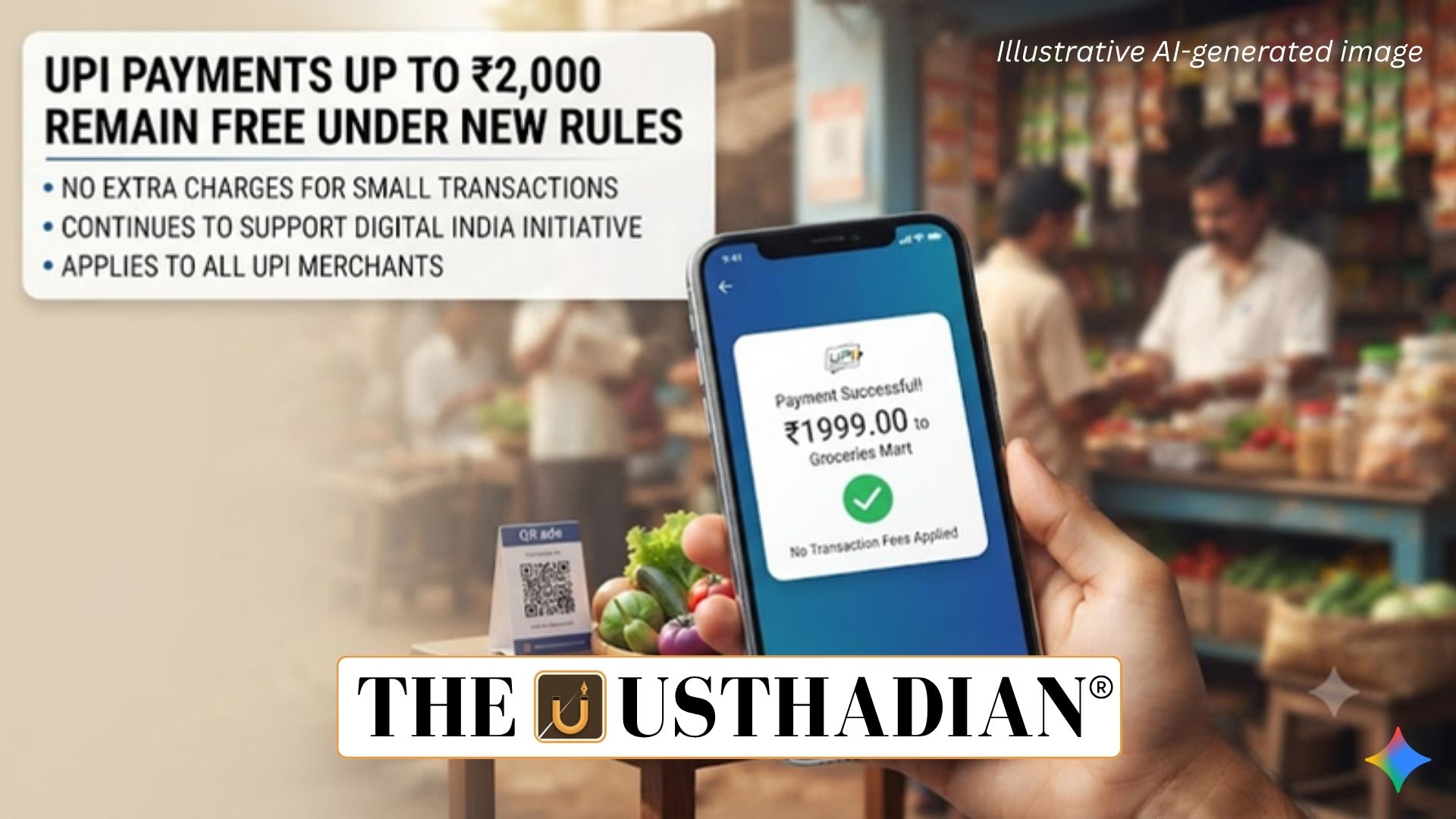
UPI Transactions Remain Free
UPI Payments Up to ₹2,000 Remain Free Under New Rules: The government has clarified that UPI transactions up to ₹2,000 will remain free of charges for users. Banks and payment system providers cannot impose fees on either the payer or the recipient for eligible transactions within this limit.
The clarification also extends the fee exemption to RuPay debit card transactions up to ₹2,000, supporting the continued use of low-value digital payments.
Finance Ministry Notification
The clarification came amid discussions surrounding amendments to the Payment and Settlement Systems Act, 2007. Concerns had emerged that changes to the legal framework could eventually result in additional charges being imposed on users of digital payment services.
A Finance Ministry gazette notification specifically recognises UPI transactions up to ₹2,000 as an “electronic mode of payment.” Consequently, payment systems and banks cannot charge either the payer or payee for such transactions.
Static GK fact: The Payment and Settlement Systems Act, 2007 provides the legal framework for regulating payment systems in India, with the Reserve Bank of India (RBI) playing a central regulatory role.
No Charges for Small UPI Payments
For consumers, the clarification means that eligible person-to-person (P2P) UPI transactions continue to be free. Users making small-value payments therefore do not have to bear an additional transaction fee.
The policy is particularly relevant for India’s large digital-payment ecosystem, where UPI is extensively used for everyday transactions such as transfers, purchases and payments to small merchants.
Merchant Discount Rate
The government has also clarified the position regarding the Merchant Discount Rate (MDR). There is currently no fixed MDR applicable to UPI transactions under the stated arrangement.
If an MDR mechanism is introduced for certain transactions in the future, it would apply only beyond a specified threshold and would not be imposed uniformly on all UPI payments.
The government has indicated that any such MDR for eligible UPI transactions would be lower than conventional MDR applicable to debit and credit card transactions.
Static GK Tip: MDR is the fee associated with processing a digital card or payment transaction, generally involving the merchant’s payment ecosystem and service providers.
Significance for Digital Payments
Keeping small-value UPI payments free can encourage continued adoption of digital transactions among consumers, small businesses and merchants. It also supports India’s broader objective of expanding convenient and accessible digital payment infrastructure.
UPI’s low-cost structure has been an important factor in its widespread adoption. Maintaining affordability for small transactions can particularly benefit users who rely on digital payments for routine, low-value purchases.
Payment and Settlement Systems Act
The Payment and Settlement Systems Act, 2007 is an important component of India’s payment-system regulatory framework. It empowers the RBI to regulate and supervise payment systems and establishes provisions relating to their operation.
The latest clarification is therefore significant because it addresses concerns about whether changes to the legal framework could affect the cost of commonly used digital payment methods.
Static Usthadian Current Affairs Table
UPI Payments Up to ₹2,000 Remain Free Under New Rules:
| Fact | Detail |
| Payment System | Unified Payments Interface (UPI) |
| Fee-Free UPI Limit | Up to ₹2,000 |
| Eligible Transactions | UPI transactions within the specified limit |
| RuPay Exemption | RuPay debit card transactions up to ₹2,000 |
| Legal Framework | Payment and Settlement Systems Act, 2007 |
| Government Authority | Ministry of Finance |
| Transaction Classification | Electronic mode of payment |
| Consumer Charges | No charges for eligible UPI transactions |
| P2P UPI Payments | Remain free |
| MDR | No fixed MDR under the stated arrangement |
| Future MDR | May apply to specified transactions above a threshold |
| Key Regulator | Reserve Bank of India |