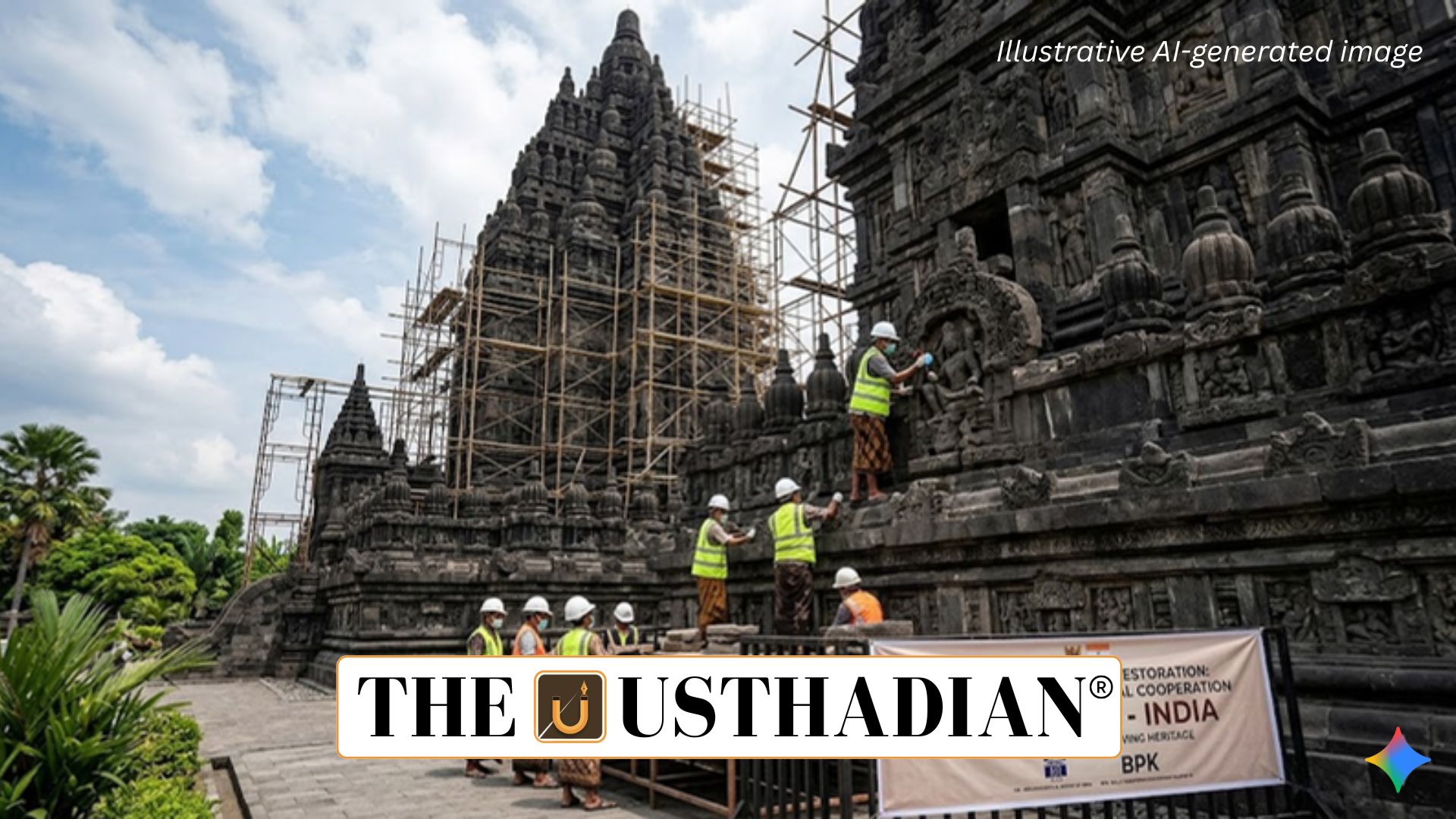
India and Indonesia cultural collaboration
Prambanan Temple Restoration Strengthens India Indonesia Cultural Cooperation: India and Indonesia strengthened bilateral ties through collaboration on the Prambanan Temple complex restoration. The discussion took place on March 16, 2026, involving Indonesia’s Culture Minister Fadli Zon and the Archaeological Survey of India (ASI).
This initiative reflects growing international cooperation in cultural heritage conservation. It also highlights India’s global role in preserving ancient monuments using scientific expertise.
Static GK fact: India’s Archaeological Survey of India was established in 1861 and manages over 3,600 monuments.
Importance of Prambanan temple complex
The Prambanan Temple is a UNESCO World Heritage Site located in Indonesia. Built in the 9th century, it is one of the largest Hindu temple complexes in Southeast Asia.
The complex includes temples dedicated to Shiva, Vishnu, and Brahma. Nearby sites like Sewu and Plaosan temples reflect a blend of Hindu and Buddhist traditions.
Static GK Tip: Prambanan is also known as “Loro Jonggrang” in local folklore.
Integrated restoration approach
The restoration project focuses not only on a single structure but on the entire cultural landscape. Indonesia emphasized preserving Sewu and Plaosan temples along with Prambanan.
This ecosystem-based approach ensures historical continuity and cultural integrity. It recognizes the interconnected nature of ancient temple complexes.
Anastylosis technique in restoration
A key feature of the project is the use of the Anastylosis technique, a scientific conservation method. It involves reconstructing monuments using original stones recovered from the site.
New materials are added only when required for structural stability. This method ensures authenticity and historical accuracy in restoration.
However, thousands of scattered stone fragments present a major challenge. Careful identification and placement are essential for accurate reconstruction.
Static GK fact: Anastylosis was widely used in restoring Borobudur Temple in Indonesia.
Role of ASI and technology integration
The ASI plays a crucial role by providing technical expertise and restoration experience. It has proposed a pilot project involving one or two temples initially.
This phased approach helps refine techniques before full-scale implementation. It reduces risks and improves efficiency.
The project also explores the use of Artificial Intelligence (AI). AI tools can assist in mapping, identifying, and reassembling stone fragments.
Significance for global heritage conservation
This collaboration highlights the importance of heritage diplomacy in strengthening international relations. It sets a model for combining traditional knowledge with modern technology.
The project also promotes sustainable preservation of ancient cultural ecosystems. It reinforces India’s leadership in global conservation efforts.
Static GK Tip: UNESCO World Heritage Sites are protected under international conventions for cultural and natural heritage.
Static Usthadian Current Affairs Table
Prambanan Temple Restoration Strengthens India Indonesia Cultural Cooperation:
| Topic | Detail |
| Project Name | Prambanan Temple Restoration collaboration |
| Countries Involved | India and Indonesia |
| Key Institution | Archaeological Survey of India |
| Technique Used | Anastylosis reconstruction method |
| Technology Integration | Use of Artificial Intelligence |
| Site Status | UNESCO World Heritage Site |
| Historical Period | Built in 9th century |
| Cultural Scope | Includes Sewu and Plaosan temples |
| Significance | Promotes heritage diplomacy and conservation |