Background of Pluto status change
Pluto Planet Status Debate Resurfaces: Pluto was discovered in 1930 by Clyde Tombaugh and was long considered the ninth planet. Its small size and unusual orbit later raised scientific questions.
In 2006, the International Astronomical Union (IAU) redefined the term “planet,” leading to Pluto being reclassified as a dwarf planet. This decision reshaped textbooks and scientific understanding globally.
Static GK fact: Pluto is located in the Kuiper Belt, a region beyond Neptune filled with icy bodies.
Scientific criteria for classification
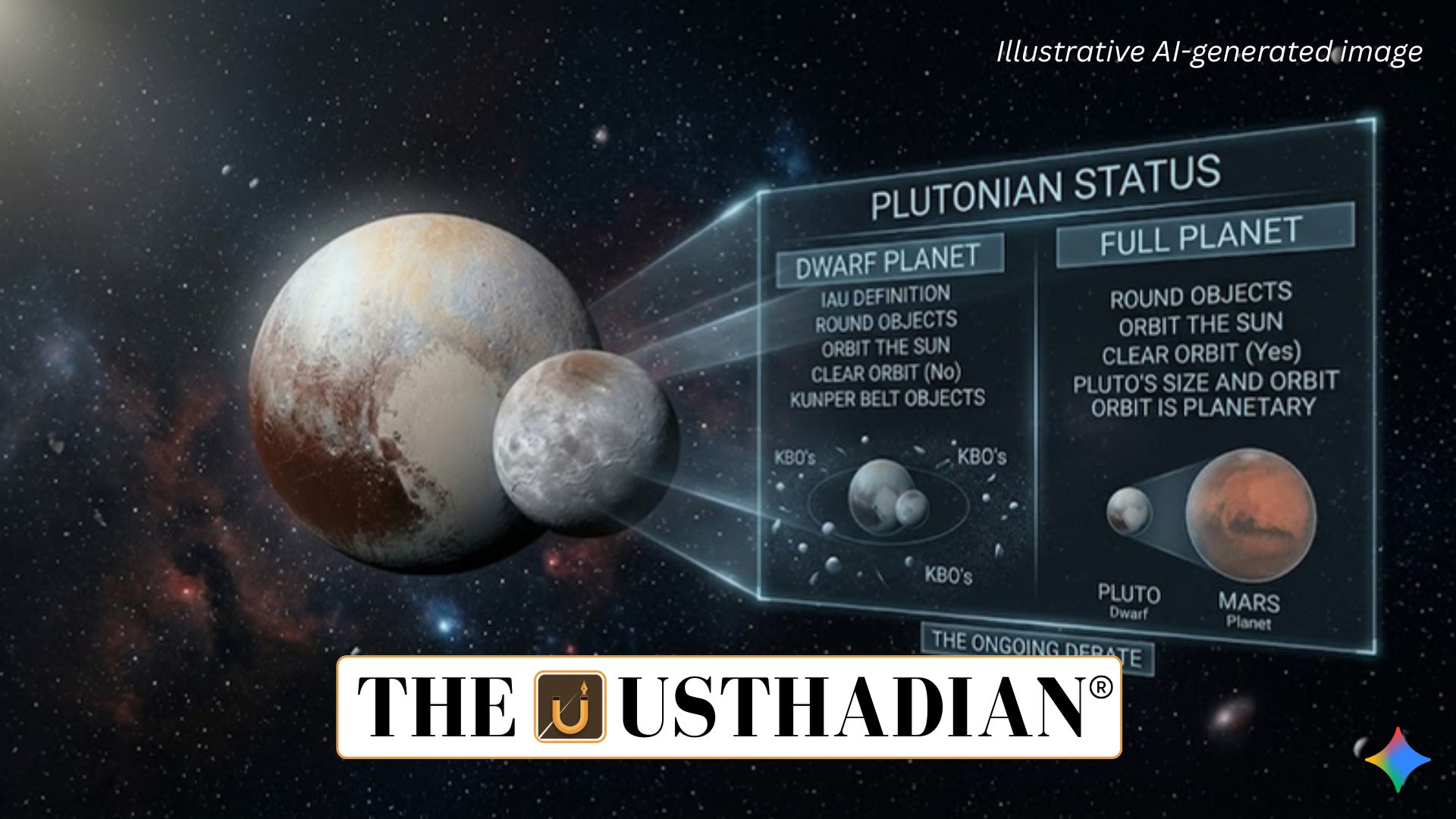
The IAU established three conditions for a celestial body to qualify as a planet. It must orbit the Sun, be nearly round due to gravity, and clear its orbital neighbourhood.
Pluto satisfies the first two conditions but fails the third. It shares its orbit with other objects in the Kuiper Belt, which prevents it from being classified as a full-fledged planet.
Static GK Tip: The eight recognized planets are Mercury, Venus, Earth, Mars, Jupiter, Saturn, Uranus, and Neptune.
Renewed debate and NASA role
The debate was recently revived after a 10-year-old student wrote to NASA requesting Pluto’s restoration as a planet. The letter highlighted Pluto’s features, including its moons and size.
NASA Administrator Jared Isaacman responded by stating that the issue is being “looked into.” This response triggered renewed global curiosity and discussions on Pluto’s classification.
Static GK fact: Pluto has five known moons, with Charon being the largest and most prominent.
Importance of Kuiper Belt
The Kuiper Belt is a vast region of icy objects beyond Neptune. It contains dwarf planets like Pluto and provides insights into the early solar system.
Pluto’s position in this region is a key reason behind its classification debate. Scientists believe studying such bodies helps understand planetary formation and evolution.
Static GK Tip: The Kuiper Belt is similar to the asteroid belt but is much larger and colder.
Scientific and educational relevance
The Pluto debate highlights how scientific definitions evolve with new discoveries. It also shows the role of public engagement in influencing scientific discourse.
Any change in Pluto’s status would require global consensus among astronomers. Until then, Pluto remains a symbol of how science is dynamic and continuously refined.
Static Usthadian Current Affairs Table
Pluto Planet Status Debate Resurfaces:
| Topic | Detail |
| Discovery | Pluto discovered in 1930 by Clyde Tombaugh |
| Reclassification Year | 2006 |
| Governing Body | International Astronomical Union |
| Current Status | Dwarf planet |
| Key Criterion Failed | Clearing orbital neighbourhood |
| Region | Kuiper Belt beyond Neptune |
| Major Moon | Charon |
| Scientific Importance | Helps study solar system formation |