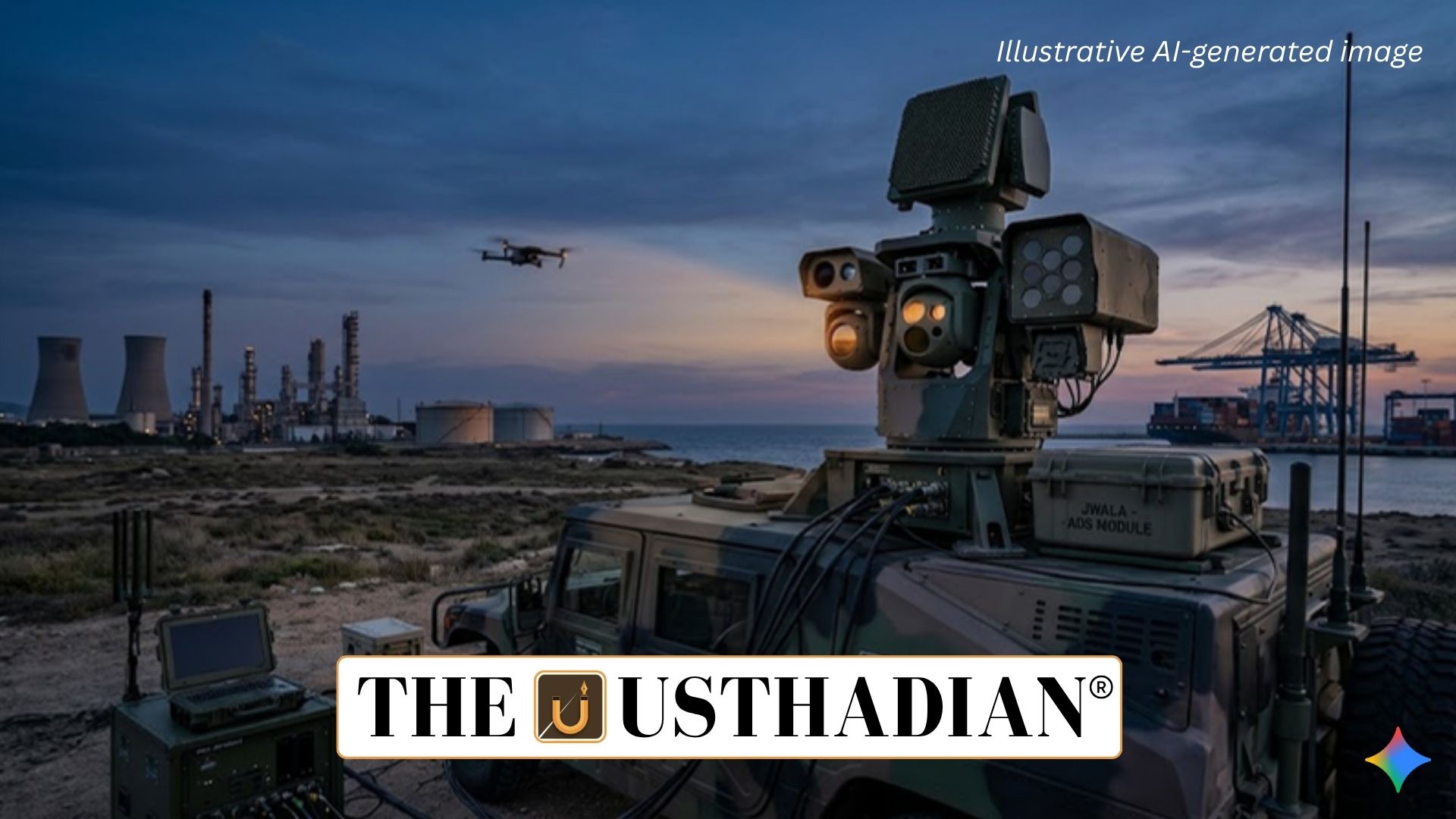
Why Affordable Counter-Drone Systems Matter
Jwala and India’s Push for Affordable Counter-Drone Defence: Modern warfare increasingly involves inexpensive unmanned aerial vehicles (UAVs) that can impose substantial costs on defenders. When a relatively cheap drone is intercepted using a much more expensive missile, the defender may successfully neutralise the threat but suffer an economic disadvantage.
This is known as cost asymmetry. It has increased the demand for affordable interceptors that can protect military installations, troops and critical infrastructure without exhausting defence budgets.
Static GK fact: UAVs are aircraft operated remotely or autonomously without an onboard human pilot. Counter-UAS systems are designed to detect, track and neutralise unmanned aircraft threats.
What Is Jwala-MK1
Jwala-MK1 is a short-range surface-to-air missile developed by IG Defence, an Indian defence technology company. According to the supplied report, the system is primarily intended to intercept hostile drones rather than conventional high-value aerial targets.
The missile was publicly showcased at the North Tech Symposium in Prayagraj in May 2026. Its reported engagement range is 2–5 km, with an altitude envelope of 50 metres to 5,000 metres.
Jwala uses a solid-fuel dual-pulse rocket motor, designed to provide propulsion during two phases of flight. The developer has reportedly test-fired two solid rocket motors, marking progress towards integrating the propulsion system.
Static GK Tip: Surface-to-air missiles (SAMs) are launched from the ground to engage aerial targets. Their capabilities depend on factors such as range, guidance, altitude coverage and target characteristics.
Development and Integration
Jwala still requires complete-system flight trials, guidance and control validation, representative-target testing and reliability assessment. Integration with command-and-control systems will also be important for operational deployment.
IG Defence plans to connect Jwala with its GRID battle-management architecture, which is intended to link sensors, threat assessment and defensive responses. This could help create an integrated counter-drone solution rather than relying on an interceptor alone.
However, its actual cost per successful interception cannot yet be established confidently. Procurement costs, interception performance and reliability under operational conditions require independent validation.
India’s Defence Manufacturing Ecosystem
India’s expanding defence industry provides a broader context for private-sector counter-drone development. According to the supplied report, defence production reached ₹1.78 lakh crore in FY2025–26, with private companies contributing approximately ₹42,000 crore, or 24%. Defence exports reportedly reached ₹38,424 crore during the same period.
Other companies active in relevant defence manufacturing and technology areas include Solar Industries India, Adani Defence & Aerospace, NIBE Group, Larsen & Toubro (L&T) and Paras Defence and Space Technologies. The supplied report also notes a partnership between Paras Defence and US-based Powerus concerning the Guardian-1 counter-drone interceptor.
Static GK fact: The Ministry of Defence supports indigenous defence development through initiatives that encourage domestic manufacturing, private-sector participation, start-ups and micro, small and medium enterprises (MSMEs).
Challenges and Strategic Significance
Jwala’s long-term success will depend on three factors: reliable interception, competitive lifecycle costs and large-scale production. A low-cost missile must also achieve adequate accuracy and reliability against its intended class of threats.
Affordable interceptors could reduce pressure on conventional air-defence inventories and improve the sustainability of defending important installations. Nevertheless, market projections and early technical milestones should not be treated as proof of operational effectiveness.
India’s counter-drone ambitions will ultimately depend on rigorous testing, indigenous supply chains and integration with wider air-defence networks.
Static Usthadian Current Affairs Table
Jwala and India’s Push for Affordable Counter-Drone Defence:
| Fact | Detail |
| System | Jwala-MK1 counter-drone interceptor |
| Developer | IG Defence |
| Public showcase | North Tech Symposium, Prayagraj, May 2026 |
| Reported engagement range | 2–5 km |
| Reported altitude envelope | 50 m–5,000 m |
| Propulsion | Solid-fuel dual-pulse rocket motor |
| Planned integration | GRID battle-management architecture |
| Main challenge | Reliable interception at a sustainable cost |
| Related technology | Counter-UAS and surface-to-air missile systems |
| Defence policy relevance | Indigenous production and private-sector participation |