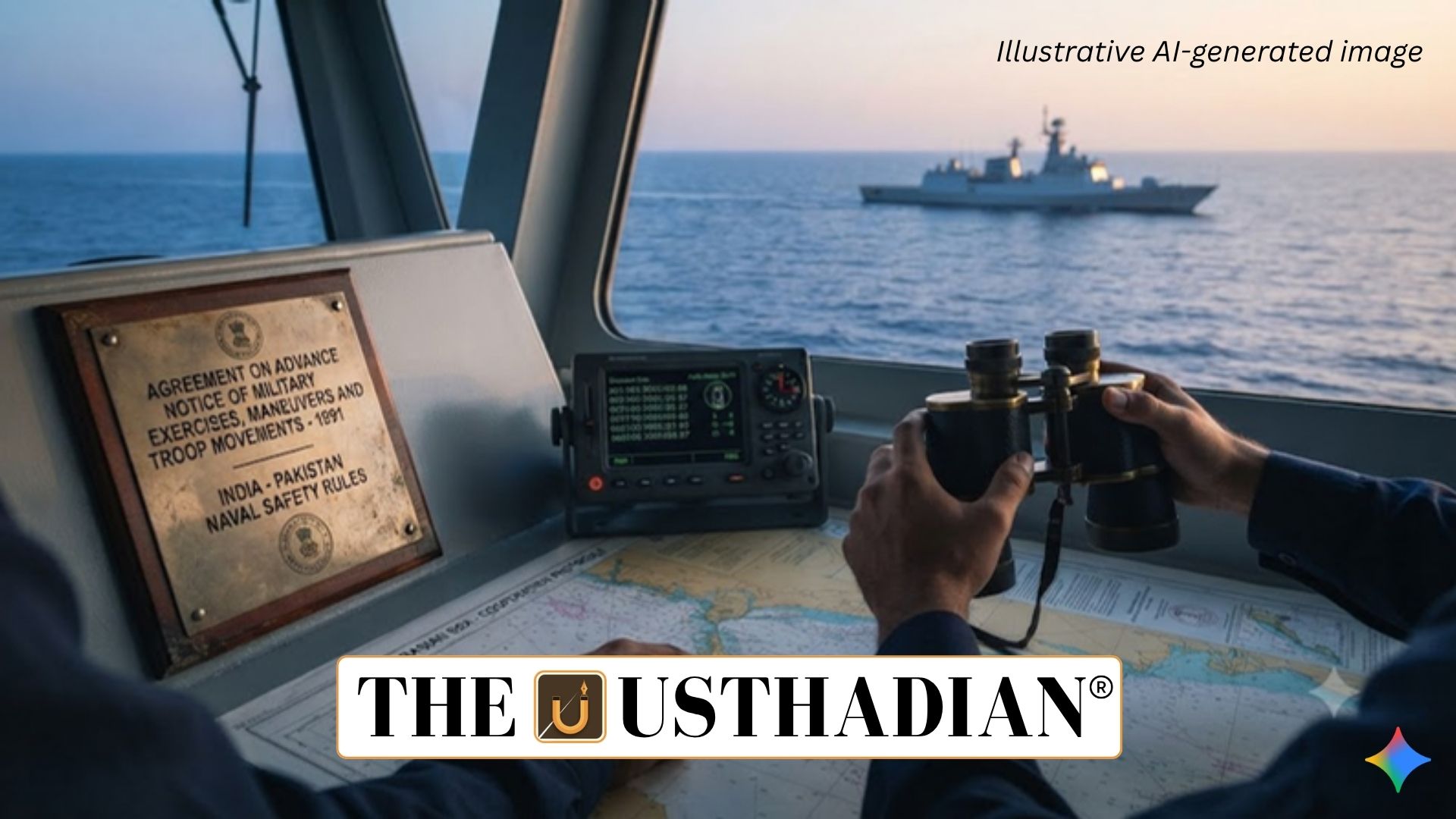
Naval Collision Renews Focus on 1991 Pact
India Pakistan Naval Safety Rules and the 1991 Agreement: A recent encounter between Pakistan Naval Ship (PNS) Hunain and an Indian Navy warship has brought renewed attention to the 1991 India-Pakistan Agreement governing military exercises and movements. The incident took place in international waters of the North Arabian Sea, around 120 nautical miles from the Gulf of Oman.
PNS Hunain, a Yarmook-class corvette, reportedly approached the Indian warship at high speed and manoeuvred dangerously, resulting in a minor collision. The Indian vessel continued its surveillance mission without damage, while the Pakistani ship sustained damage.
India described the conduct as unacceptable and unprofessional and stated that it violated Article 10 of the bilateral agreement.
What Article 10 Provides
The Agreement on Advance Notice on Military Exercises, Manoeuvres and Troop Movements was signed by India and Pakistan in April 1991. Its central objective was to reduce the possibility of military misunderstandings escalating into a wider crisis.
Article 10 specifies that naval ships and submarines of the two countries should not approach within three nautical miles of one another in international waters. The provision is designed primarily to reduce the possibility of accidental encounters and dangerous manoeuvres.
The agreement also establishes advance-notification requirements. Certain air and naval exercises require 15 days’ notice, while corps-level and army-level exercises require 60 and 90 days, respectively.
Static GK fact: One nautical mile equals 1.852 kilometres. A country’s territorial sea normally extends up to 12 nautical miles, while its Exclusive Economic Zone can extend up to 200 nautical miles under UNCLOS.
Other Military Safeguards
The agreement defines a major naval exercise as one involving six or more destroyer- or frigate-sized ships operating together and crossing into the other country’s EEZ.
It also contains provisions concerning military aircraft. Combat aircraft are generally required to maintain a separation of 10 km from the other country’s airspace, with specific exceptions where the prescribed distance is 5 km.
A companion agreement signed on the same day deals with the prevention of airspace violations and rules concerning overflights and landings by military aircraft.
Why the Agreement Was Needed
The pact emerged from a period of heightened military uncertainty. The 1987 Exercise Brass Tacks became a major catalyst after India conducted a large-scale military exercise in Punjab and Rajasthan involving around 150,000 troops, armoured formations and simultaneous air and naval activities.
The exercise heightened Pakistani concerns and demonstrated the risks created by large military deployments close to sensitive borders. Earlier confidence-building efforts, along with the two countries’ nuclear programmes and regional developments following the Soviet invasion of Afghanistan in 1979, also contributed to the push for formal safeguards.
Earlier Naval Incident
The current episode has a precedent. In June 2011, Pakistani warship PNS Babur came into contact with Indian Navy frigate INS Godavari in the Gulf of Aden. The encounter caused minor damage to the Indian vessel’s helicopter safety equipment and was subsequently addressed through diplomatic channels.
Grey-Zone Maritime Challenges
The use of deliberate or risky manoeuvres at sea is increasingly discussed in the broader context of grey-zone activity. Such actions operate below the threshold of conventional armed conflict while attempting to create strategic or operational pressure.
Similar maritime tactics have been reported in disputes involving the South China Sea, including close manoeuvring, ramming and water-cannon use. The growing concern is that ambiguous actions at sea can create escalation risks when established safety rules are ignored.
Static GK Tip: UNCLOS, adopted in 1982 and entering into force in 1994, provides the principal international legal framework governing the world’s oceans.
Preventing Maritime Escalation
The 1991 agreement remains an important confidence-building mechanism between two nuclear-armed neighbours. The latest naval incident highlights the importance of maintaining established separation rules, communication channels and operational discipline.
Clear procedures at sea can reduce the possibility that an accident or unsafe manoeuvre develops into a larger military confrontation.
Static Usthadian Current Affairs Table
India Pakistan Naval Safety Rules and the 1991 Agreement:
| Fact | Detail |
| 1991 Agreement | India-Pakistan agreement on advance notice of military exercises and movements |
| Article 10 | Naval ships and submarines should maintain three nautical miles separation in international waters |
| Recent Incident | PNS Hunain collided with an Indian Navy warship in the North Arabian Sea |
| Incident Location | Around 120 nautical miles from the Gulf of Oman |
| Exercise Brass Tacks | Major Indian military exercise conducted in 1987 |
| 2011 Precedent | PNS Babur and INS Godavari encountered each other in the Gulf of Aden |
| Territorial Sea | Extends up to 12 nautical miles under UNCLOS |
| EEZ | Extends up to 200 nautical miles from the baseline |
| Nautical Mile | 1.852 kilometres |
| Companion Agreement | Addresses airspace violations and military aircraft overflights and landings |