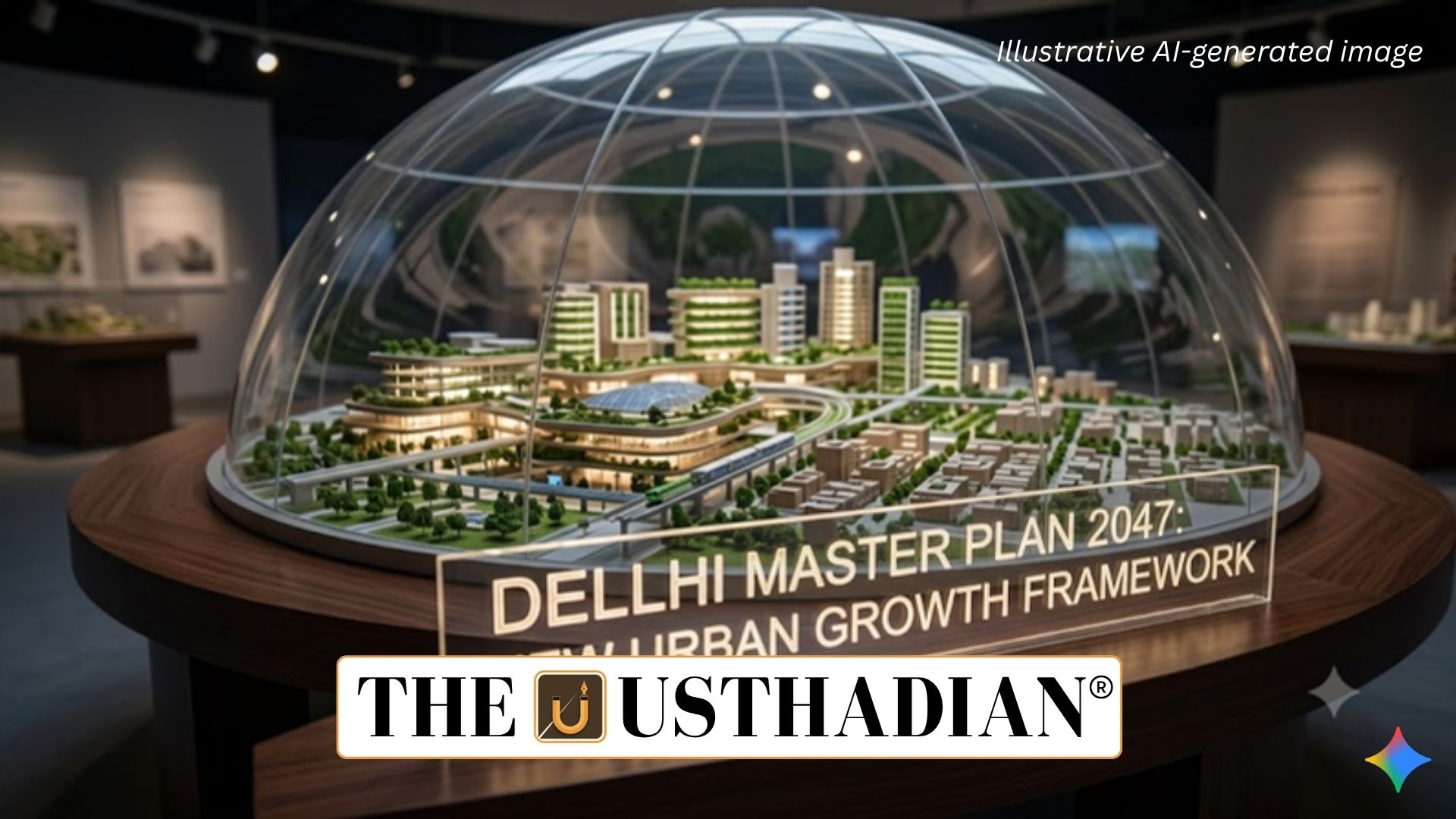
MPD 2047 Sets Delhi’s Long-Term Vision
Delhi Master Plan 2047 Sets a New Urban Growth Framework: The Master Plan of Delhi 2047 (MPD-2047) has been unveiled as a long-term framework to make the capital more inclusive, sustainable, resilient and economically competitive. The plan was announced on 20 August 2026 by Union Housing and Urban Affairs Minister Manohar Lal, in the presence of Delhi Lieutenant Governor Taranjit Singh Sandhu and Chief Minister Rekha Gupta.
The plan focuses on housing, transport, redevelopment, land management, economic growth, environmental protection and improved urban services.
Static GK fact: Delhi is the National Capital Territory (NCT) of India, and the Delhi Development Authority (DDA) is the principal agency responsible for planned urban development in the capital.
Housing Takes Centre Stage
Housing is one of the most important components of MPD-2047, with an overall objective of supporting the creation of nearly 40 lakh homes.
Around 18 lakh affordable homes are planned within Transit-Oriented Development zones along metro corridors. Another 7 lakh dwelling units are expected through redevelopment of group housing, DDA housing and government residential areas.
The plan also addresses housing requirements of more than 17 lakh residents of jhuggi-jhopri clusters. Rental housing for students, professionals, migrant workers and economically weaker groups is also proposed.
The “Jahan Jhuggi, Wahan Makaan” approach aims to provide permanent housing to eligible families living in informal settlements.
Land Pooling to Expand Housing
The Land Pooling Policy receives renewed emphasis under MPD-2047 and covers nearly 200 sq km of urbanisation area.
It is expected to generate around 12 lakh additional houses along with a road network of approximately 600 km. Under the infrastructure-first approach, DDA will prioritise construction of roads measuring 30 metres or more.
Selected land-pooling areas will also feature High Density Corridors, with Floor Area Ratio (FAR) up to 400 in certain pockets.
Transit-Oriented Development
Transit-Oriented Development (TOD) will guide urban expansion around public transport corridors. The objective is to create compact, mixed-use and better-connected neighbourhoods.
The plan proposes multimodal hubs connecting Metro, RRTS, buses, walking and cycling. It also includes improvements to UER-I, UER-II and UER-III, along with a proposed Unified Metropolitan Transport Authority.
A 52-km cycling track along the Yamuna floodplain is another major mobility initiative.
Static GK Tip: FAR refers to the ratio between the total floor area of a building and the size of the plot on which it is constructed.
Green Growth and Yamuna Restoration
Environmental sustainability forms a major pillar of MPD-2047. About 1,700 hectares of Yamuna floodplains are proposed for ecological restoration through 13 projects.
The plan promotes rooftop solar power, rainwater harvesting, water recycling, waste-to-resource initiatives and green mobility. Energy-efficient buildings and low-carbon development are intended to support the long-term goal of net-zero urban growth.
Heritage and New Economic Centres
MPD-2047 proposes conservation of around 1,500 heritage properties through Cultural Resource Management Plans. Adaptive reuse of selected heritage structures for museums, libraries, hotels and cultural activities will be permitted while retaining their historical character.
Narela is planned as an educational growth centre, with 138 hectares earmarked for universities. Dwarka is envisioned as an international gateway featuring IT companies, startups, data centres and industrial parks.
Unauthorised Colonies and Easier Approvals
The plan proposes regularisation of buildings in 1,511 unauthorised colonies on an “as is where is” basis. This could strengthen ownership security for approximately 45 lakh residents.
Regulatory simplification is another focus, with 133 use premises reduced to 45 and greater use of online approvals to improve Ease of Doing Business and Ease of Living.
Static Usthadian Current Affairs Table
Delhi Master Plan 2047 Sets a New Urban Growth Framework:
| Fact | Detail |
| Plan | Master Plan of Delhi 2047 |
| Announcement Date | 20 August 2026 |
| Housing Target | Nearly 40 lakh homes |
| Land Pooling Area | Nearly 200 sq km |
| Additional Housing through Land Pooling | 12 lakh houses |
| Proposed Road Network | 600 km |
| Yamuna Ecological Restoration | 1,700 hectares through 13 projects |
| Heritage Properties | Around 1,500 |
| Unauthorised Colonies | 1,511 |
| Residents Benefiting from Regularisation | Around 45 lakh |