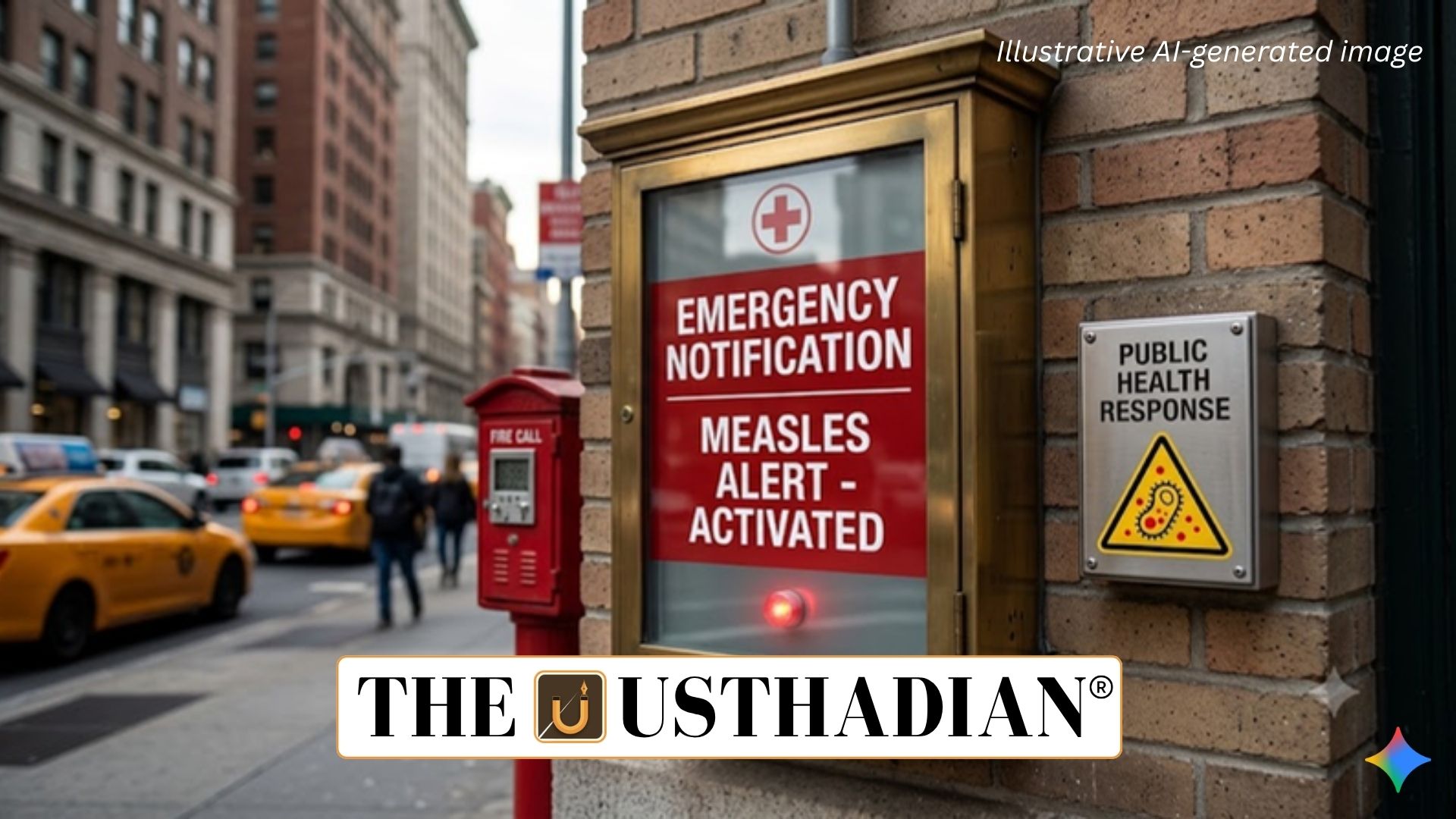
New York Declares a Disaster Emergency
New York Activates Emergency Measures Amid Rising Measles Cases: New York Governor Kathy Hochul declared a statewide disaster emergency effective 5 October 2026 in response to rising measles cases. According to the supplied report, the order is scheduled to remain in force until 4 November 2026.
The emergency declaration expands the healthcare workforce’s ability to support measles testing and vaccination. It particularly focuses on improving access to immunisation in communities with lower vaccination coverage.
Static GK fact: The New York State Department of Health is responsible for protecting and promoting public health across New York State.
Measles Cases Increase Across Rural Counties
According to figures cited in the executive order, New York had reported 108 measles cases by 3 October 2026. Of these, 101 cases were outside New York City, while seven were reported within the city.
Since 15 July 2026, the state had recorded 92 cases across 18 counties, with much of the increase occurring in rural and under-immunised communities. Local health departments had administered more than 1,000 MMR vaccine doses in rural areas during this period.
Expanded Powers for Healthcare Professionals
The emergency order broadens certain responsibilities relating to testing and vaccination. Registered nurses are permitted to order measles testing for symptomatic patients under the specified arrangements, while pharmacists can administer the measles, mumps and rubella (MMR) vaccine to children aged two years and older.
Vaccination records must be reported to the relevant authorities within 72 hours under the order. The reporting requirement described in the supplied report does not require additional consent from adult patients, although consent for vaccination itself remains necessary.
These measures seek to make testing and vaccination more accessible during the outbreak.
Measles Cases Rise Across the United States
The supplied report cites 3,471 measles cases in the United States during 2026, based on preliminary surveillance data. It also records 2,289 cases in 2025, compared with 285 in 2024 and 59 in 2023.
Different reporting dates and surveillance updates can produce different national totals. Therefore, case figures should be interpreted according to the date and source of publication.
Static GK fact: The Centers for Disease Control and Prevention (CDC) is the principal US federal public health agency responsible for disease surveillance, prevention and control.
Understanding Measles Elimination
The United States declared measles eliminated in 2000. Elimination means that continuous endemic transmission has been interrupted in a defined geographical area for at least 12 months under an effective surveillance system.
However, elimination does not mean that a disease can never reappear. Imported infections can trigger outbreaks, particularly where vaccination coverage is insufficient to prevent sustained transmission.
MMR Vaccination and Disease Prevention
The MMR vaccine protects against measles, mumps and rubella. Under the CDC’s routine childhood schedule, two doses are generally recommended: the first at 12–15 months and the second at 4–6 years of age.
Measles is a highly contagious viral disease that can cause serious complications, including pneumonia and encephalitis. Maintaining high vaccination coverage is essential to protecting children, vulnerable individuals and communities.
Static Usthadian Current Affairs Table
New York Activates Emergency Measures Amid Rising Measles Cases:
| Fact | Detail |
| State | New York, United States |
| Governor | Kathy Hochul |
| Emergency effective date | 5 October 2026 |
| Emergency end date | 4 November 2026 |
| New York cases by 3 October | 108 |
| Cases outside New York City | 101 |
| Cases in New York City | 7 |
| National cases cited for 2026 | 3,471, preliminary figure |
| US measles elimination | Declared in 2000 |
| MMR vaccine coverage | Measles, mumps and rubella |
| Routine first MMR dose | 12–15 months |
| Routine second MMR dose | 4–6 years |