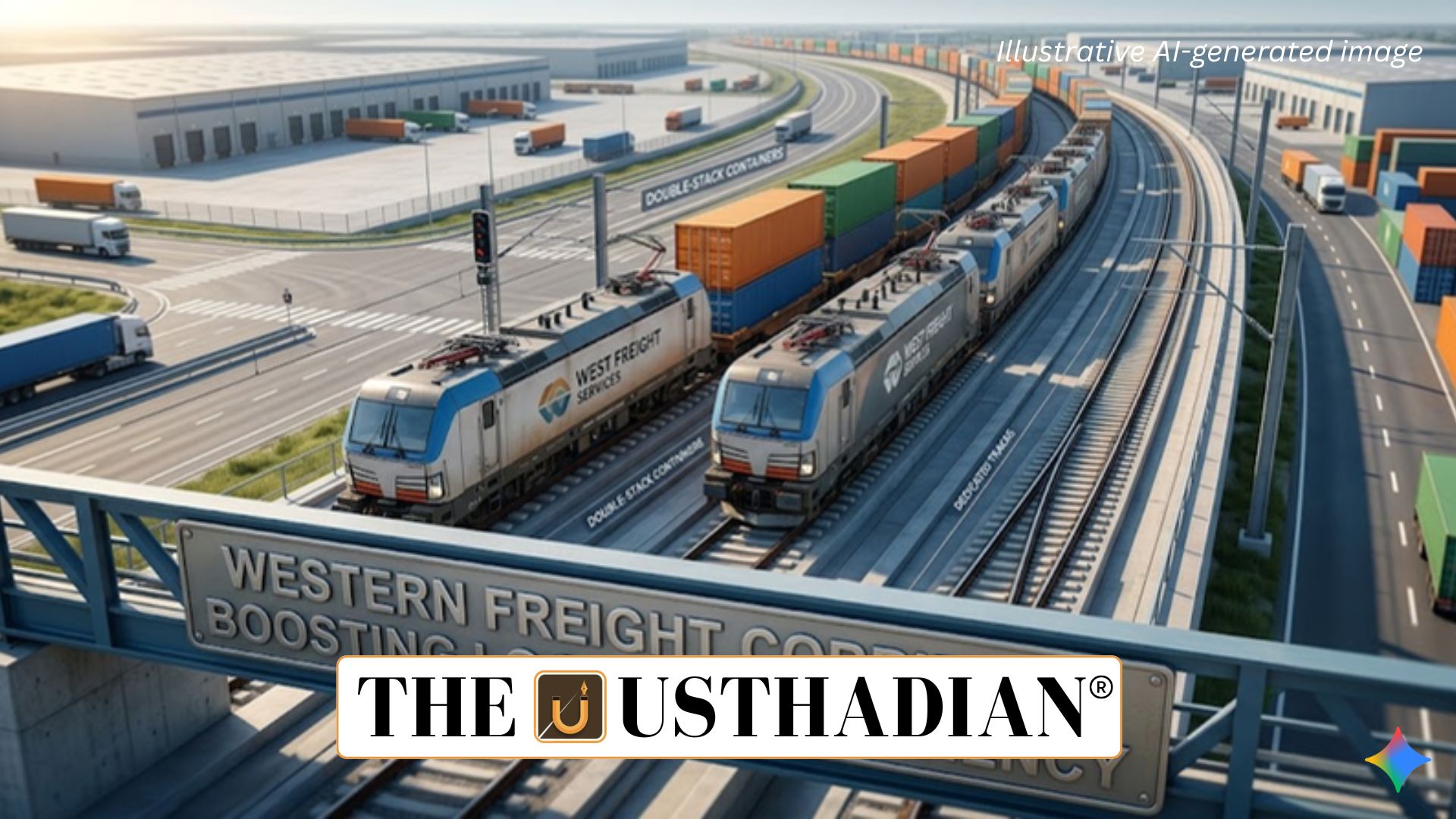
Major milestone in railway infrastructure
Western Dedicated Freight Corridor Completion Boosts Logistics Efficiency: The Western Dedicated Freight Corridor (WDFC) has been fully completed by the Ministry of Railways in April 2026. It spans 1,506 km from Dadri in Uttar Pradesh to Jawaharlal Nehru Port Terminal (JNPT) in Maharashtra.
This corridor is one of the most ambitious infrastructure projects aimed at modernizing India’s freight transport system.
Static GK fact: JNPT is India’s largest container port, located near Mumbai.
Background of the DFC project
The Dedicated Freight Corridor (DFC) project was conceived in 2005 to create exclusive railway lines for freight movement. It aims to separate freight and passenger traffic for better efficiency.
Two major corridors were approved in 2008:
- Eastern DFC (EDFC) from Ludhiana to Sonnagar (1,337 km)
- Western DFC (WDFC) from Dadri to JNPT
The project is implemented by the Dedicated Freight Corridor Corporation of India Limited (DFCCIL), established in 2006 as a special purpose vehicle.
Expansion plans under consideration
The government is planning additional corridors to expand freight capacity across regions. These include:
- East-Coast Corridor from Kharagpur to Vijayawada
- East-West Corridor connecting multiple industrial regions
- North-South Sub-corridor from Vijayawada to Itarsi via Nagpur
These proposals are currently under Detailed Project Report (DPR) stage.
Static GK Tip: DFCCIL operates under the administrative control of the Ministry of Railways.
Key benefits of Western DFC
The WDFC significantly reduces congestion on existing railway lines by separating freight and passenger trains. This enhances overall railway efficiency.
Freight trains on this corridor can operate at speeds of up to 100 km/h, improving delivery timelines. Industries benefit from faster and more reliable logistics.
The project also lowers logistics costs by minimizing delays and ensuring predictable transit times. This strengthens India’s competitiveness in global trade.
Environmental and economic impact
The entire DFC network is fully electrified, making it an environmentally sustainable transport option. It reduces dependence on road transport, thereby lowering carbon emissions.
The corridor supports industrial growth by connecting major ports and production hubs. It aligns with national initiatives like Make in India and Gati Shakti.
Static GK fact: Rail transport is more energy-efficient than road transport for bulk goods movement.
Strategic importance for future growth
The DFC is a key component of the National Rail Plan 2030, which aims to create a future-ready railway network. It enhances freight capacity and supports economic expansion.
Completion of the Western DFC marks a major step toward transforming India into a global manufacturing and logistics hub.
Static Usthadian Current Affairs Table
Western Dedicated Freight Corridor Completion Boosts Logistics Efficiency:
| Topic | Detail |
| Corridor Length | 1,506 km |
| Route | Dadri to JNPT |
| Implementing Agency | DFCCIL |
| Project Origin | Conceived in 2005 |
| Approval Year | 2008 |
| Freight Speed | Up to 100 km/h |
| Key Benefit | Reduced congestion and logistics cost |
| Environmental Impact | Fully electrified, lower emissions |
| Future Plan | Expansion through new corridors |
| National Alignment | National Rail Plan 2030 |