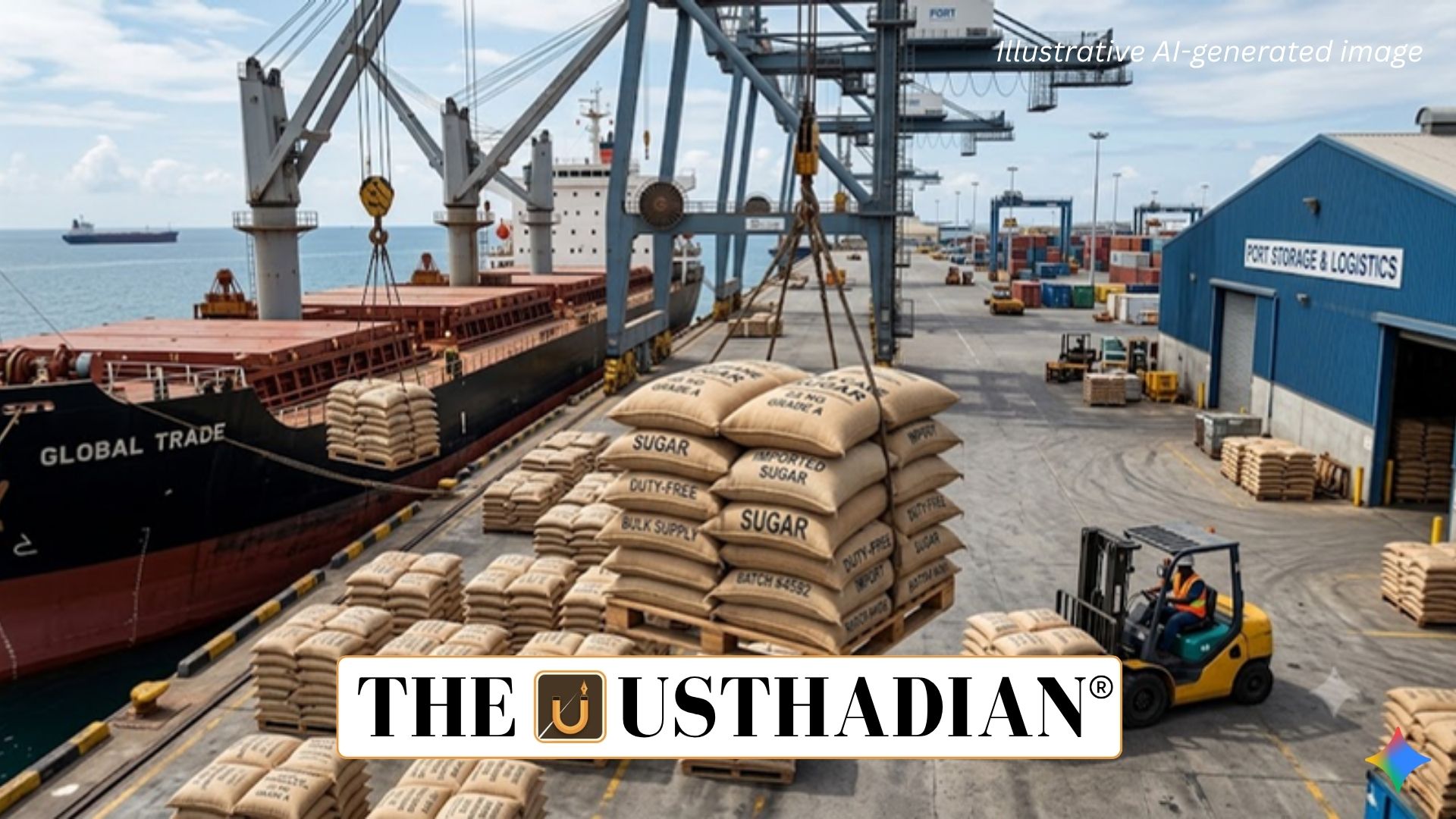
Government Opens Temporary Import Window
Duty-Free Sugar Imports Opened to Stabilise Domestic Prices: The Government of India has permitted duty-free imports of up to 10 lakh metric tonnes of raw sugar to strengthen domestic availability and moderate rising prices. The permission has been granted through the Tariff Rate Quota (TRQ) mechanism and will remain valid until 31 October 2026.
The decision comes ahead of the festival season, when sugar consumption generally increases because of higher demand for sweets, beverages and processed food products.
Static GK fact: DGFT (Directorate General of Foreign Trade) is an attached office of the Ministry of Commerce and Industry responsible for administering India’s foreign trade policy.
Sugar Prices Trigger Policy Action
Domestic sugar prices have increased considerably compared with the previous year. The average all-India wholesale sugar price has risen to around ₹5,400–₹5,500 per quintal, compared with approximately ₹3,900 per quintal during the corresponding period of the previous year.
Retail prices have also moved upward, reaching around ₹52.30 per kg, compared with ₹46.34 per kg a year earlier. The government expects additional imports to improve market supply and ease price pressure.
Understanding the Tariff Rate Quota
Under the new arrangement, 10 lakh tonnes of raw sugar can enter India without the applicable customs duty. The facility is specifically provided under the TRQ system, making it a temporary trade intervention rather than a permanent change in import policy.
The import window will close on 31 October 2026, allowing the government to respond to short-term supply requirements while monitoring domestic production and prices.
Static GK Tip: A Tariff Rate Quota (TRQ) allows a specified quantity of a commodity to be imported at a lower or zero tariff, while imports beyond the permitted quota may face a higher tariff.
Festival Season Raises Sugar Demand
The period from August to November generally witnesses stronger sugar consumption in India. Major festivals such as Ganesh Chaturthi, Dussehra and Diwali increase demand for traditional sweets and other sugar-intensive products.
The government’s import decision is therefore aimed at ensuring adequate availability during a period when seasonal demand could put additional pressure on domestic stocks.
Stockholding Rules for Bulk Consumers
Alongside the import measure, the government has introduced a temporary stockholding restriction for large sugar-consuming businesses.
A bulk sugar consumer is an organisation using more than 10 metric tonnes of sugar per month. Such consumers will not be permitted to maintain stocks exceeding 15 days of their consumption.
The stockholding restriction will apply from 1 September to 30 November 2026. The measure is intended to discourage excessive stock accumulation and improve the availability of sugar in the domestic market.
Impact on the Sugar Market
The combined measures of duty-free imports and stockholding restrictions are designed to address supply concerns from two directions. Imports can increase the physical availability of raw sugar, while stock limits can encourage more efficient distribution among large consumers.
The policy also demonstrates the government’s use of trade and supply-management measures to contain food-price pressures during periods of seasonal demand.
Static Usthadian Current Affairs Table
Duty-Free Sugar Imports Opened to Stabilise Domestic Prices:
| Fact | Detail |
| Commodity | Raw sugar |
| Import Quantity | 10 lakh metric tonnes |
| Import Duty | Duty-free under TRQ |
| Import Deadline | 31 October 2026 |
| Authority | Directorate General of Foreign Trade |
| Average Sugar Price | ₹5,400–₹5,500 per quintal |
| Average Retail Price | ₹52.30 per kg |
| Bulk Consumer Threshold | More than 10 MT per month |
| Maximum Stock | 15 days of consumption |
| Stockholding Period | 1 September to 30 November 2026 |