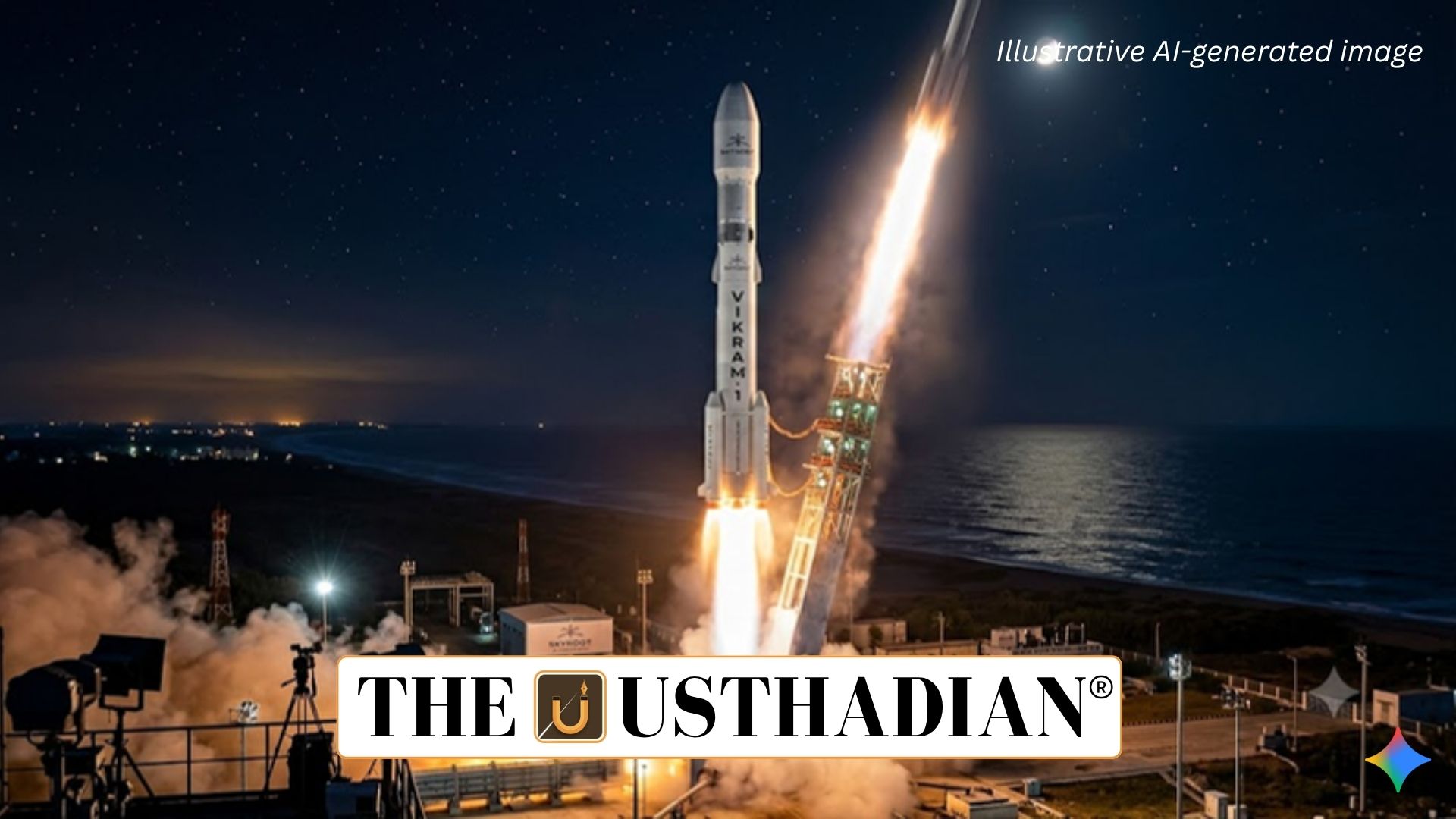
India’s First Privately Built Orbital Rocket
Vikram-1 Marks India’s Private Leap into Orbital Space: Skyroot Aerospace is set to launch Vikram-1, India’s first privately developed orbital launch vehicle, under its maiden mission named Mission Aagaman. The launch is scheduled during the 12 July–4 August 2026 launch window from the Satish Dhawan Space Centre (SDSC), Sriharikota.
The mission represents a major milestone for India’s private space sector by demonstrating the capability of an Indian startup to independently develop and launch an orbital-class rocket.
What is Vikram-1
Vikram-1 is a small satellite launch vehicle developed by the Hyderabad-based Skyroot Aerospace. Named after Dr. Vikram Sarabhai, the father of India’s space programme, the rocket is designed to provide reliable, affordable, and on-demand launch services for commercial satellite operators.
Unlike Vikram-S, which was a sub-orbital technology demonstrator launched in 2022, Vikram-1 is capable of placing satellites into Earth orbit.
Static GK fact: Dr. Vikram Sarabhai founded India’s space programme, and ISRO was established in 1969 under his leadership.
Mission Aagaman
The maiden flight has been named Mission Aagaman, symbolising the arrival of India’s private sector into orbital launch services.
Its primary objective is to validate real-flight performance and collect critical engineering data, including:
- Acoustic vibrations
- Thermal behaviour during ascent
- Stage separation performance
- Flight dynamics
- Vehicle stability
- Propulsion efficiency
The data gathered will help improve future commercial launches and enhance vehicle reliability.
Technical Specifications
Vikram-1 has been designed as a lightweight, four-stage launch vehicle optimised for the rapidly growing small satellite market.
Key specifications include:
- Height: Approximately 20–24 metres
- Structure: All-carbon composite airframe
- Stages: Four
- First Stage: Kalam-1200 solid motor
- Second Stage: Kalam-250 solid motor
- Third Stage: Kalam-100 solid motor
- Fourth Stage: Raman-I liquid propulsion engine
The rocket can carry:
- Up to 350 kg to Low Earth Orbit (LEO)
- Up to 260 kg to Sun-Synchronous Orbit (SSO)
The target orbit is approximately 450 km altitude with a 60-degree inclination.
Static GK Tip: Low Earth Orbit (LEO) generally extends up to about 2,000 km above Earth’s surface and is widely used for communication and Earth observation satellites.
Advanced Technologies
Skyroot Aerospace has incorporated several indigenous and advanced technologies into Vikram-1.
The rocket features an all-carbon composite structure, making it lighter and improving payload efficiency. It also extensively uses 3D-printed engine components, reducing manufacturing time and production costs.
In addition, Vikram-1 employs an indigenous Guidance, Navigation and Control (GNC) system, enabling autonomous flight corrections for accurate satellite deployment.
Significance for India
The successful launch of Vikram-1 would mark a historic achievement for India’s commercial space ecosystem. Following the liberalisation of the space sector, private companies are increasingly contributing to satellite launches and space technology development.
The mission demonstrates India’s capability to build globally competitive launch vehicles using indigenous innovation and supports the country’s ambition of becoming a leading player in the international small satellite launch market.
Static GK fact: The Indian National Space Promotion and Authorization Center (IN-SPACe) was established to promote and regulate the participation of private companies in India’s space sector.
Static Usthadian Current Affairs Table
Vikram-1 Marks India’s Private Leap into Orbital Space:
| Fact | Detail |
| Rocket | Vikram-1 |
| Developer | Skyroot Aerospace |
| Maiden Mission | Mission Aagaman |
| Launch Window | 12 July–4 August 2026 |
| Launch Site | Satish Dhawan Space Centre, Sriharikota |
| Rocket Type | Four-stage orbital launch vehicle |
| Payload Capacity | 350 kg (LEO), 260 kg (SSO) |
| Fourth Stage Engine | Raman-I liquid engine |
| Previous Rocket | Vikram-S (Sub-orbital, 2022) |
| Space Sector Regulator | IN-SPACe |