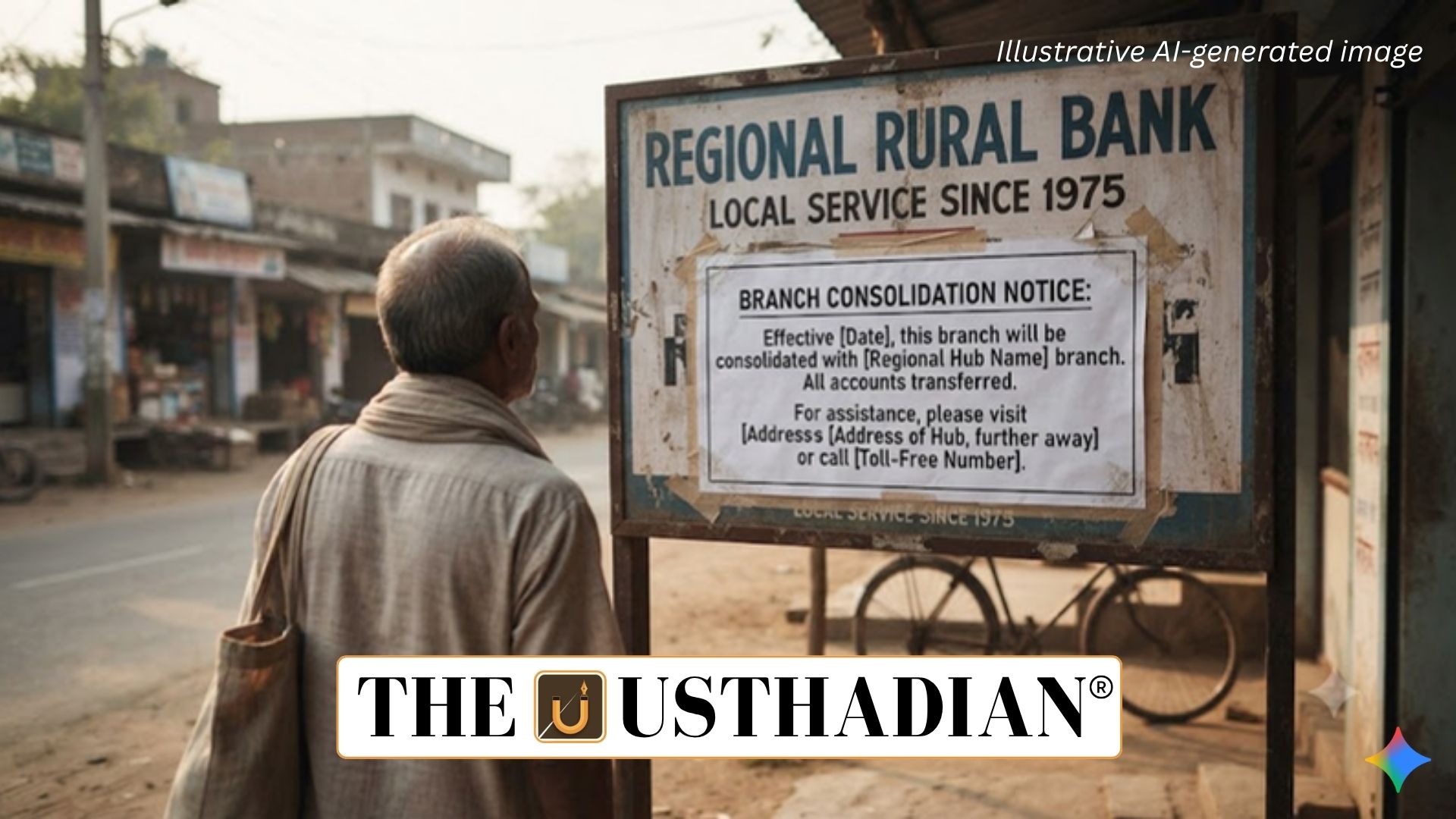
Regional Rural Banks Under Debate
RRB Consolidation Raises Concerns Over Local Rural Banking: The consolidation of Regional Rural Banks (RRBs) has triggered concerns over whether their original local and regional character is being diluted. Former RBI Governor C. Rangarajan described the consolidation process as “a step in the wrong direction” and warned that RRBs could eventually be absorbed into universal banks.
RRBs were created specifically to provide banking and credit services to rural communities, particularly small and marginal farmers, agricultural labourers, artisans and small entrepreneurs.
What Are Regional Rural Banks?
RRBs are scheduled commercial banks established to strengthen institutional credit delivery in rural areas. They were created under the Regional Rural Banks Act, 1976, following recommendations of the Narasimham Working Group, with the first RRBs established in 1975.
Static GK fact: The defining feature of RRBs is their regional orientation, which was intended to help banks understand local economic conditions, borrowers and agricultural credit requirements.
Ownership and Regulation
RRBs follow a three-way ownership structure:
- Central Government – 50%
- Sponsor Bank – 35%
- State Government – 15%
Every RRB has a sponsoring public sector commercial bank that provides managerial and financial support.
RRBs are regulated by the Reserve Bank of India (RBI) and supervised by NABARD.
Why Were RRBs Created?
The fundamental idea behind RRBs was that locally rooted banking institutions could distribute credit more effectively among rural and weaker sections.
Their creation formed part of India’s broader effort to improve access to institutional finance. This financial architecture subsequently expanded through bank nationalisation, priority-sector lending, Local Area Banks, Self-Help Groups (SHGs), microfinance institutions and Small Finance Banks (SFBs).
Static GK Tip: RRBs were therefore designed with a developmental objective, rather than being established solely to maximise commercial banking efficiency.
RRB Consolidation Since 2005
The government began consolidating RRBs in 2005, primarily to improve their operational viability and generate economies of scale.
The process occurred in several stages:
- 2005–2010: RRBs declined from 196 to 82.
- Further consolidation continued in subsequent phases.
- One State-One RRB: The latest phase reduced the number from 43 to 28, effective May 1, 2025.
Most states now have a single RRB. In at least one case, the sponsoring bank has completely absorbed its RRB.
Rangarajan’s Main Concern
- Rangarajan questioned whether consolidation is consistent with the original purpose of RRBs.
His argument is that RRBs were established because local presence and regional knowledge were considered essential for improving rural credit distribution. If several regionally focused institutions are merged into one state-level organisation and are eventually absorbed by universal banks, the distinctive RRB model could disappear.
The concern is therefore not merely about the number of RRBs but about whether their institutional purpose survives consolidation.
Small Finance Banks Face Another Challenge
Rangarajan also highlighted the limited presence of Small Finance Banks in India.
According to the concerns cited, only 11 SFBs were operating, which may be inadequate to address the country’s unmet credit requirements.
He also pointed to a structural difficulty: SFBs are required to satisfy many conditions applicable to universal banks. This can reduce the commercial incentive for new promoters to establish specialised small-finance institutions.
Self-Help Groups and Their Changing Role
Rangarajan also raised concerns about the evolution of Self-Help Groups.
SHGs were originally intended to bring people together for collective economic activity and mutual support. He argued that their role has increasingly shifted toward becoming instruments for implementing government programmes, potentially moving away from their original community-driven character.
Arguments Supporting RRB Consolidation
The government’s case for consolidation is primarily based on financial and operational viability.
Many smaller RRBs historically faced challenges involving capital adequacy, technology adoption and operational costs. Larger institutions can potentially:
- Achieve economies of scale
- Invest more efficiently in technology
- Maintain stronger capital positions
- Provide a wider range of financial products
- Reduce administrative and compliance costs
Thus, consolidation can strengthen the institutional capacity of RRBs and improve their ability to compete in a technology-driven banking environment.
Concerns About Consolidation
The principal counter-argument is that RRBs were not created simply to function as commercially optimal banks.
Potential concerns include loss of local knowledge, reduced attention to specific regional economies and greater distance between decision-making and rural borrowers.
There is also a longer-term concern that continued consolidation could eventually result in RRBs being absorbed into universal banks, weakening a specialised institutional channel for last-mile rural credit.
Why Rural Credit Still Matters
Access to affordable rural credit remains an important challenge. Small and marginal farmers, landless agricultural workers and rural micro-enterprises can face difficulties obtaining formal institutional finance and may consequently depend on informal sources.
Over several decades, India has developed a network comprising RRBs, cooperative banks, SHGs, microfinance institutions and SFBs to address this credit gap.
If consolidation reduces the local character of RRBs without strengthening alternative last-mile institutions, the intended expansion of formal rural finance could be undermined.
Way Forward
The challenge is to balance financial viability with developmental purpose.
Consolidated RRBs should retain mechanisms for local credit assessment, regional expertise and decentralised decision-making. At the same time, policymakers need to strengthen SFBs, cooperative institutions, SHGs and other channels capable of reaching underserved borrowers.
Static GK Tip: The central policy question is not simply “How many RRBs should India have?” but whether the rural financial system remains capable of delivering accessible, locally informed and affordable credit.
Static Usthadian Current Affairs Table
RRB Consolidation Raises Concerns Over Local Rural Banking:
| Fact | Detail |
| Full Form | Regional Rural Banks |
| RRB Act | Regional Rural Banks Act, 1976 |
| First RRBs | Established in 1975 |
| Key Recommendation | Narasimham Working Group |
| Central Government Ownership | 50% |
| Sponsor Bank Ownership | 35% |
| State Government Ownership | 15% |
| Sponsor Bank | Public sector commercial bank providing managerial and financial support |
| Regulator | Reserve Bank of India |
| Supervisor | NABARD |
| Consolidation Began | 2005 |
| RRBs During 2005–2010 | Reduced from 196 to 82 |
| One State-One RRB | Latest consolidation framework |
| RRBs After Latest Phase | Reduced from 43 to 28 |
| Effective Date | May 1, 2025 |
| Former RBI Governor Raising Concerns | C. Rangarajan |
| Major Concern | Loss of local and regional character |
| Small Finance Banks | 11 cited as operating |
| RRB Objective | Rural credit and banking access |
| Major Beneficiaries | Small and marginal farmers, agricultural labourers, artisans and small entrepreneurs |
| Consolidation Advantage | Economies of scale and improved operational viability |
| Major Risk | Weakening of local knowledge and last-mile credit delivery |
| Related Institutions | Cooperative banks, SHGs, microfinance institutions and SFBs |
| Core Policy Challenge | Balancing financial efficiency with developmental banking |