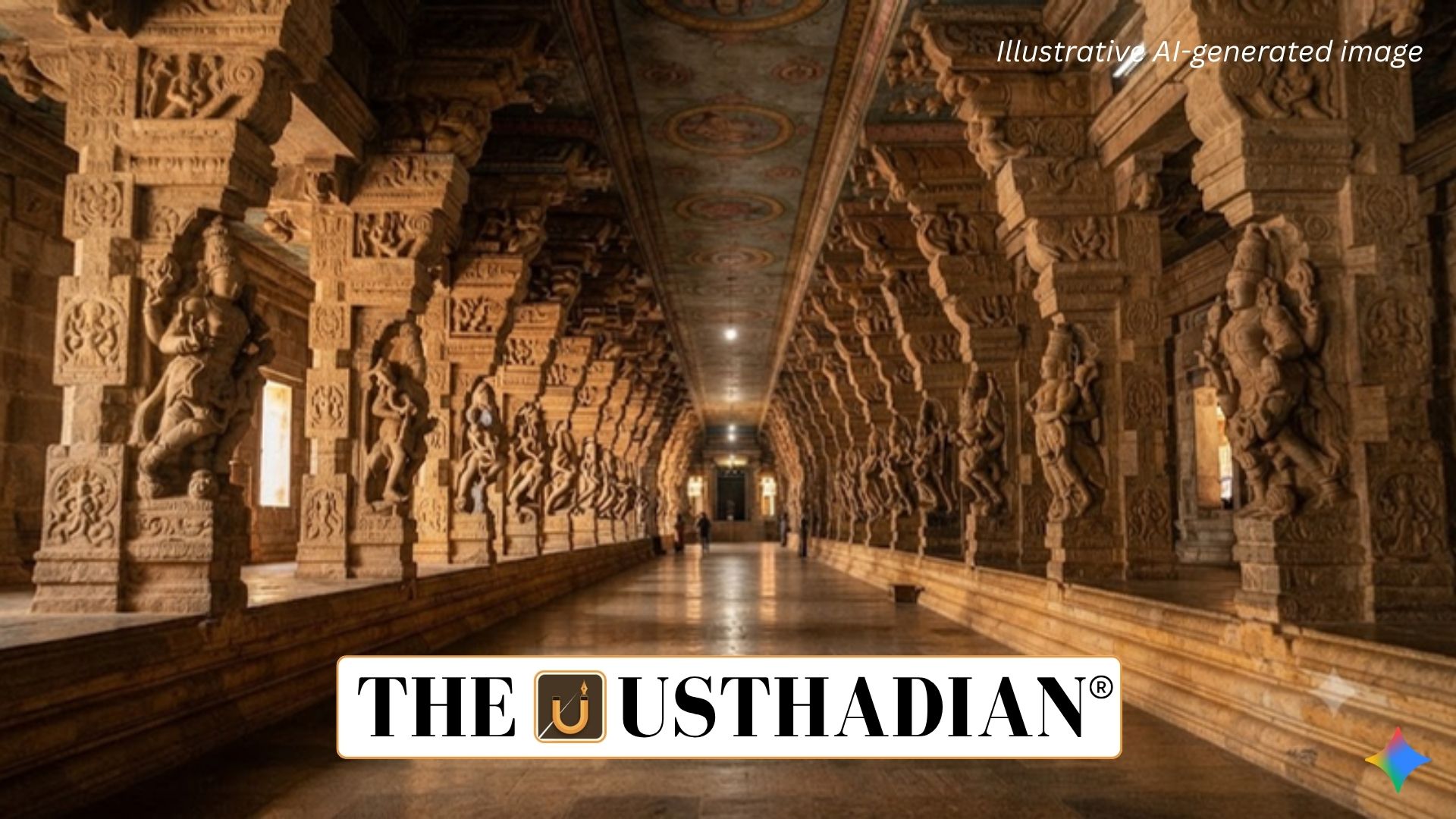
Ramanathaswamy Temple Corridor at BRICS Summit
Ramanathaswamy Temple Corridor Highlights Dravidian Heritage: During the 18th BRICS Summit in New Delhi, Prime Minister Narendra Modi and Chinese President Xi Jinping were seen shaking hands at Bharat Mandapam against a projection of the famous 1,212-pillared corridor of the Ramanathaswamy Temple in Rameswaram, Tamil Nadu.
The backdrop highlighted India’s architectural and cultural heritage during a major international diplomatic event. The choice was also notable because Tamil Nadu was the location of the two leaders’ previous meeting in India at Mamallapuram in October 2019.
Location and Religious Significance
The Ramanathaswamy Temple is located at Rameswaram on Pamban Island in Tamil Nadu’s Ramanathapuram district.
The temple is one of India’s most revered Shaivite pilgrimage centres and is counted among the 12 Jyotirlingas dedicated to Lord Shiva.
According to religious tradition, Lord Rama worshipped Lord Shiva at Rameswaram after returning from Lanka. The association of both Rama and Shiva gives the temple an important place in Hindu religious tradition.
Static GK fact: The 12 Jyotirlingas are important pilgrimage shrines associated with Lord Shiva and are located in different parts of India.
Historical Evolution of the Temple
The temple developed gradually over several centuries from an earlier modest structure into the monumental complex visible today.
Important stages in its evolution include:
- 12th century: Chola rulers constructed the first stone temple.
- Pandya and Vijayanagar periods: Successive rulers expanded the temple complex.
- 1513: Krishna Deva Raya of the Vijayanagar Empire visited the temple and made substantial offerings.
- Nayaka period: The Sethupathi rulers of Ramnad played a major role in expanding and completing the temple.
The Sethupathi rulers of Ramanathapuram were particularly important in shaping the temple’s present architectural form.
According to historical documentation, the temple underwent reconstruction and expansion following repeated destruction and attacks during earlier periods. The grand outer corridor was added much later than the original temple structure.
Architectural Features of Ramanathaswamy Temple
The Ramanathaswamy Temple is considered a remarkable example of Dravidian temple architecture.
1,212-Pillared Corridor
The temple is globally renowned for its exceptionally long pillared corridors. The famous outer corridor contains 1,212 massive stone pillars, each rising to approximately 6.9 metres.
The combined length of the corridors is commonly estimated at around 3,850 feet, or approximately 1.17 km, making it widely recognised as the longest temple corridor in the world.
The construction of the celebrated outer corridor is largely associated with Muthuramalinga Sethupathi, an 18th-century ruler of the Ramnad estate.
Static GK Tip: The Ramanathaswamy Temple’s exceptionally long pillared corridors are among the most distinctive features of Dravidian architectural design.
Gopurams and Temple Complex
The temple has imposing gopurams, or monumental gateway towers, on its eastern and western sides.
The eastern Rajagopuram rises approximately 126 feet and has nine levels.
The temple complex is enclosed by massive stone compound walls known as madil and covers approximately 15 acres.
Sacred Water Bodies
The temple complex also demonstrates sophisticated traditional water management.
There are 36 water bodies associated with the temple, including 22 sacred wells or theerthams within the temple premises.
These water structures have both religious and architectural significance and form an important part of the temple’s sacred landscape.
Design and Ornamentation of the Pillars
The corridor consists of rows of stone pillars positioned on raised platforms that support beams and the roof.
The pillars are not merely structural elements. Each is individually carved and decorated with floral designs, mythical figures and other ornamental motifs.
The columns, capitals, brackets and beams are arranged in an organised architectural grid, combining structural strength with the visual characteristics of Dravidian architecture.
Unique Visual Perspective
The long rows of pillars produce a striking perspective effect. As the corridor extends into the distance, the parallel lines appear to converge towards a single point.
Although the individual pillars follow a repeated architectural pattern, their arrangement creates a changing visual experience as visitors move through the corridor.
This architectural quality also made the corridor an effective visual backdrop during the Modi-Xi interaction at the BRICS Summit.
Significance of the BRICS Backdrop
The presentation of the Ramanathaswamy Temple corridor at a major international summit placed India’s civilisational heritage alongside contemporary diplomacy.
The temple represents the evolution of Dravidian architecture, religious traditions, regional royal patronage and monumental construction over several centuries.
The backdrop therefore served not merely as a decorative setting but also as a representation of India’s rich architectural and cultural heritage on the international stage.
Static Usthadian Current Affairs Table
Ramanathaswamy Temple Corridor Highlights Dravidian Heritage:
| Fact | Detail |
| Temple | Ramanathaswamy Temple |
| Location | Rameswaram, Tamil Nadu |
| District | Ramanathapuram |
| Island | Pamban Island |
| Religious Significance | One of the 12 Jyotirlingas |
| Architectural Style | Dravidian architecture |
| Famous Corridor | 1,212-pillared outer corridor |
| Corridor Length | About 1.17 km |
| Pillar Height | Approximately 6.9 metres |
| Important Patron | Muthuramalinga Sethupathi |
| Eastern Rajagopuram | About 126 feet, nine levels |
| Temple Area | Approximately 15 acres |
| Water Bodies | 36 |
| Sacred Wells | 22 theerthams |
| BRICS 2026 Context | Temple corridor used as backdrop for Modi-Xi handshake |
| Cultural Importance | Symbol of India’s Dravidian architectural and civilisational heritage |