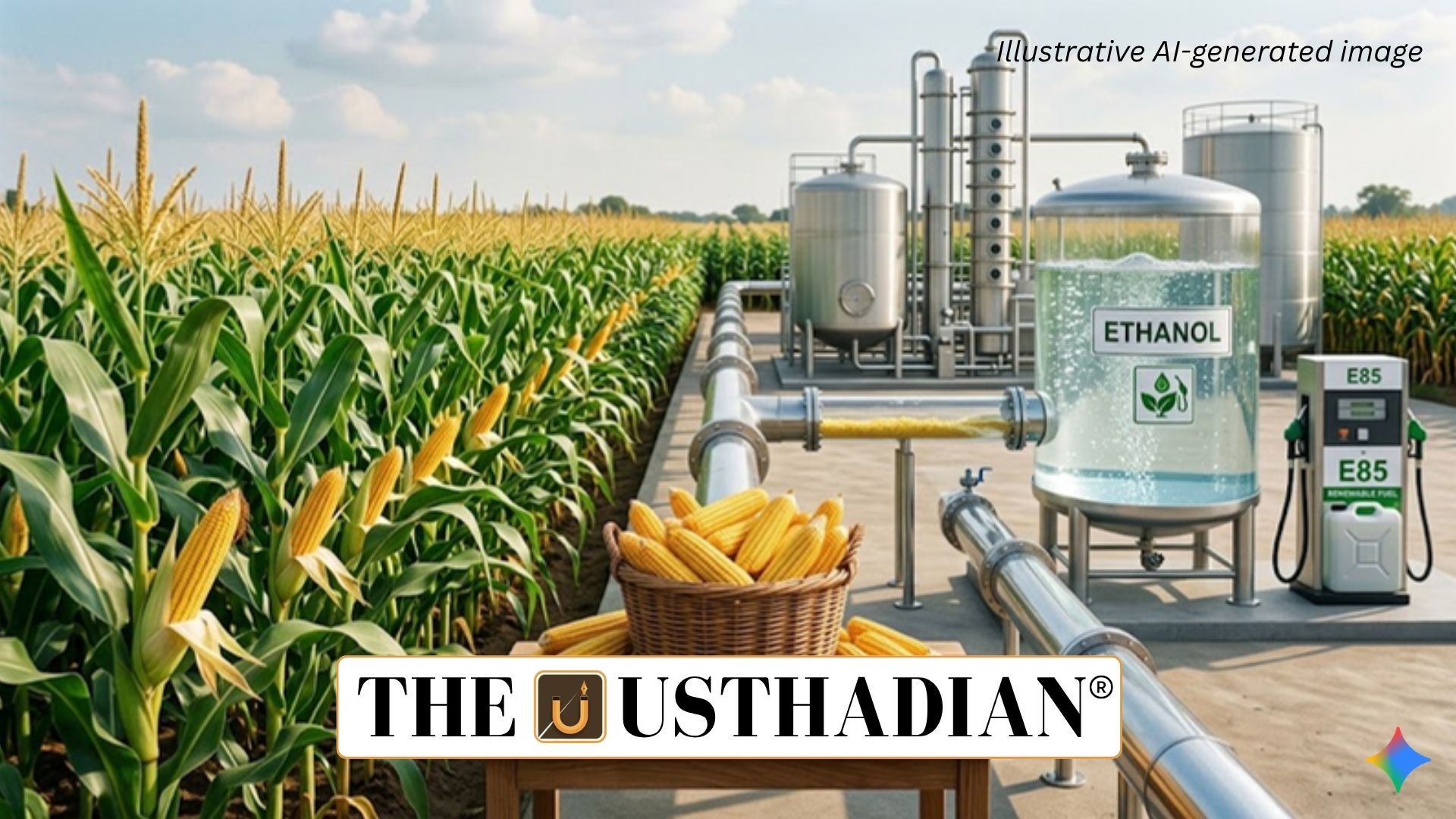
Maize Takes the Lead in Ethanol Production
Maize Drives India’s Next Phase of Ethanol Expansion: India’s Ethanol Supply Year (ESY) 2025-26 has marked a major milestone with maize emerging as the largest feedstock for ethanol production. For the first time, maize has overtaken traditional sugarcane-based sources, highlighting a significant shift in the country’s clean fuel strategy. This transition supports India’s objective of reducing fossil fuel dependence while strengthening energy security.
According to estimates compiled by the All India Distillers Association (AIDA), maize contributed nearly 182 crore litres of ethanol during the first half of ESY 2025-26, making it the single-largest source of ethanol production.
Static GK fact: India launched the Ethanol Blended Petrol (EBP) Programme in 2003 to promote blending of ethanol with petrol and reduce crude oil imports.
Ethanol Supply Records Strong Growth
India supplied approximately 515 crore litres of ethanol during the first six months of ESY 2025-26. This represents nearly 49% of the annual contracted supply of 1,059 crore litres, indicating steady progress in meeting national blending targets.
Monthly ethanol production also remained robust during the period. Supplies reached around 102 crore litres in December 2025, nearly 95 crore litres in March 2026, and approximately 92 crore litres in April 2026. These figures reflect improved production capacity and an efficient supply chain.
Grain-Based Ethanol Gains Momentum
Apart from maize, other grain-based feedstocks have also played an important role. Surplus rice and surplus food grains contributed around 125 crore litres, while damaged food grains added nearly 26 crore litres to ethanol production.
The increasing use of grain-based feedstocks diversifies India’s ethanol ecosystem and reduces excessive dependence on sugarcane. This balanced approach strengthens the long-term sustainability of the biofuel programme.
Static GK Tip: The Ministry of Petroleum and Natural Gas is the nodal ministry responsible for implementing the Ethanol Blended Petrol Programme in India.
Why Maize Is Becoming the Preferred Feedstock
Experts believe maize offers several long-term advantages over conventional feedstocks. It is available more consistently throughout the year, ensuring uninterrupted ethanol production and reducing seasonal fluctuations associated with sugarcane harvesting.
Maize also requires less water compared to sugarcane, making it suitable for regions facing water scarcity. As India moves towards higher ethanol blending targets beyond E20, maize is expected to provide a more scalable and sustainable solution.
Static GK fact: E20 refers to petrol blended with 20% ethanol, a major target under India’s clean energy roadmap.
Sugarcane Continues to Play a Vital Role
Although maize has become the leading feedstock, sugarcane-based ethanol continues to remain a major contributor. Distilleries using sugarcane supplied around 182 crore litres, accounting for nearly 62% of their contracted volumes.
Among sugarcane-based sources, Sugarcane Juice (SCJ) contributed around 130 crore litres, followed by B-Heavy Molasses (BHM) with 45 crore litres, and C-Heavy Molasses (CHM) with about 7 crore litres. These feedstocks continue to support India’s ethanol blending programme alongside expanding grain-based production.
Future Outlook
The growing contribution of maize reflects India’s evolving biofuel strategy focused on sustainability, energy security, and agricultural diversification. By combining grain-based and sugarcane-based ethanol production, India is creating a resilient supply system capable of supporting higher blending targets and reducing dependence on imported fossil fuels. Continued policy support and feedstock diversification will remain essential for achieving long-term clean energy goals.
Static Usthadian Current Affairs Table
Maize Drives India’s Next Phase of Ethanol Expansion:
| Fact | Detail |
| Largest ethanol feedstock in ESY 2025-26 | Maize |
| Ethanol supplied in first half of ESY 2025-26 | Around 515 crore litres |
| Annual contracted ethanol supply | Approximately 1,059 crore litres |
| Major grain-based contributor after maize | Surplus rice and surplus food grains |
| Estimated maize ethanol production | Around 182 crore litres |
| Ethanol Blended Petrol Programme launched | 2003 |
| Target under E20 programme | 20% ethanol blending in petrol |
| Nodal ministry | Ministry of Petroleum and Natural Gas |
| Industry body | All India Distillers Association (AIDA) |
| Main objective | Reduce crude oil imports and promote clean energy |