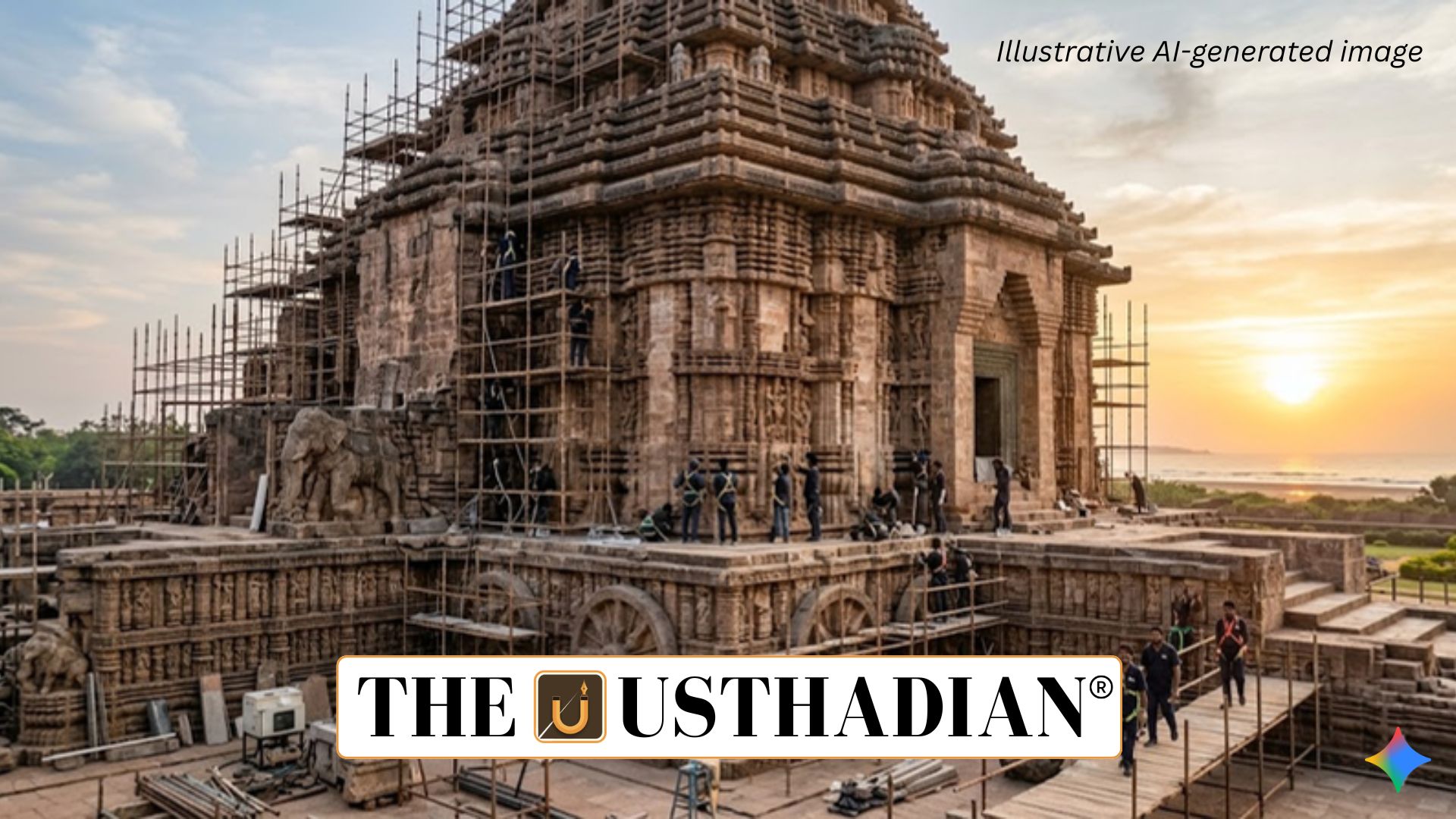
ASI Begins Major Conservation Work
Konark Sun Temple Restoration Drive Gains Momentum: The Archaeological Survey of India (ASI) has launched a major restoration project at the Konark Sun Temple in Odisha. This temple is a designated UNESCO World Heritage Site (1984) and is one of India’s finest examples of temple architecture.
The current project focuses on the Jagamohan (assembly hall), which had been filled with sand over a century ago to prevent collapse. The initiative marks a crucial step toward restoring the temple’s internal structure and ensuring long-term stability.
Static GK fact: The Archaeological Survey of India was established in 1861 by Alexander Cunningham, known as the Father of Indian Archaeology.
Why Sand Was Filled Inside
Between 1901 and 1903, British engineers filled the Jagamohan with sand as an emergency measure. At that time, structural weakness threatened the collapse of the temple’s main hall.
While effective in the short term, this method sealed the interior permanently. It restricted detailed study and limited conservation work only to the external structure for decades.
Static GK Tip: The Konark Sun Temple is also called the Black Pagoda due to its dark appearance and historical navigation significance.
Scientific Restoration Process
The ASI has adopted a careful and technology-driven approach to remove the sand. A 6×5-foot controlled passage is being drilled into the western wall using diamond drilling technology, which minimizes vibration and prevents structural damage.
Once the passage is created, sand is being manually removed in a phased manner. Continuous monitoring systems are in place to ensure that the temple remains stable throughout the process.
This restoration phase is expected to take nearly one year, considering the sensitivity and complexity of the structure.
Pre-Restoration Scientific Analysis
Before starting the operation, ASI conducted detailed scientific studies. Two test holes were drilled earlier to assess internal conditions.
Samples of sand and stone were analyzed by Indian Institute of Technology Madras, confirming that the sand remained stable. Only after expert evaluation and approval did the ASI proceed with the full-scale restoration.
Static GK fact: IIT Madras, established in 1959, is one of India’s premier engineering institutions and is located in Chennai.
Historical Importance of Konark Temple
The Konark Sun Temple was built in the 13th century by King Narasimhadeva I of the Eastern Ganga dynasty. The temple is designed in the shape of a massive chariot of the Sun God (Surya), with intricately carved stone wheels and horses.
It took nearly 12 years to construct and involved around 1,200 artisans and sculptors. The temple is renowned for its detailed carvings depicting mythology, daily life, and celestial themes.
Static GK Tip: The temple is aligned in such a way that the first rays of the rising sun illuminate the main entrance.
Static Usthadian Current Affairs Table
Konark Sun Temple Restoration Drive Gains Momentum:
| Topic | Detail |
| Project Authority | Archaeological Survey of India |
| Location | Konark Sun Temple, Odisha |
| Recognition | UNESCO World Heritage Site (1984) |
| Focus Area | Jagamohan (assembly hall) |
| Historical Action | Sand filling by British (1901–1903) |
| Current Technique | Diamond drilling and manual sand removal |
| Scientific Support | IIT Madras analysis |
| Builder of Temple | Narasimhadeva I |
| Dynasty | Eastern Ganga dynasty |
| Key Feature | Chariot-shaped Sun temple architecture |