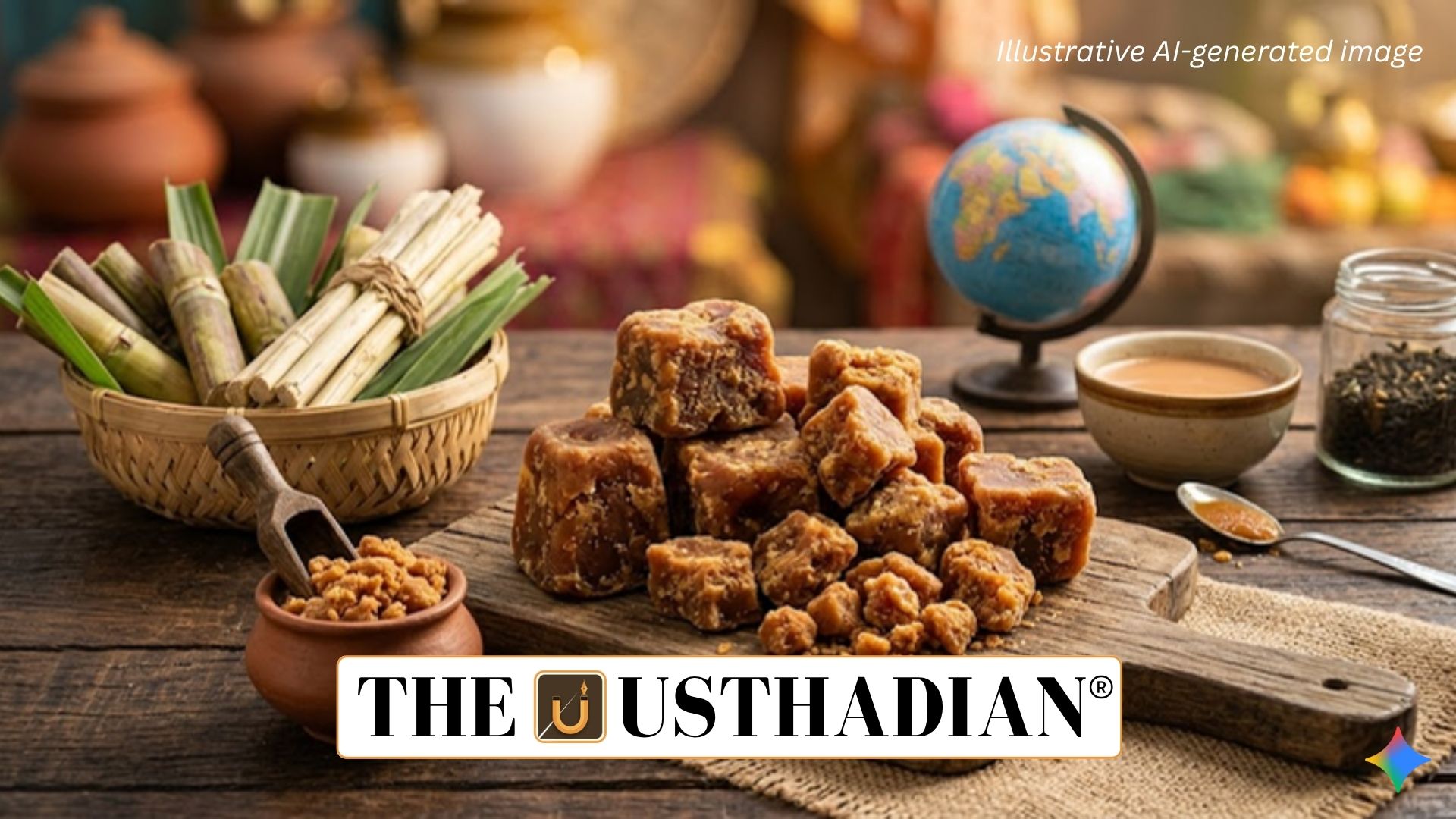
India Leads the Global Jaggery Industry
Indian Gur Emerges as a Global Natural Sweetener: India has emerged as the world’s largest producer of jaggery (gur), contributing more than 70% of global production. The country’s abundant sugarcane cultivation and long-standing tradition of jaggery making have positioned it as the leading supplier of this natural sweetener.
Around 20–30% of India’s sugarcane production is utilised for jaggery manufacturing instead of refined sugar. Unlike large sugar mills, jaggery production is largely decentralised, with thousands of small processing units operating close to farming communities.
Static GK fact: India is the second-largest producer of sugarcane in the world after Brazil, making sugarcane one of the country’s major commercial crops.
Importance of the Jaggery Sector
The jaggery industry plays a vital role in strengthening the rural economy by supporting nearly 2.5 million livelihoods. It provides employment opportunities to sugarcane farmers, small-scale processors, transport workers, rural labourers, and women-led food enterprises.
Since jaggery is generally processed near cultivation areas, transportation costs remain lower while more value is retained within rural communities. The sector also promotes agro-based entrepreneurship and local economic development.
Rising Global Demand for Indian Gur
Indian jaggery has witnessed remarkable growth in international markets due to increasing consumer preference for natural and minimally processed foods. Export earnings rose from US$197 million in 2015–16 to US$406.8 million in 2024–25, registering an increase of over 106%.
Major importing countries include Indonesia, the United States, the United Arab Emirates, Nigeria, and Nepal. The growing export demand reflects India’s expanding presence in the global health food market.
Static GK Tip: Agricultural exports from India are promoted by the Agricultural and Processed Food Products Export Development Authority (APEDA) under the Ministry of Commerce and Industry.
Why Gur Is Preferred Over Refined Sugar
Health-conscious consumers across the world are increasingly choosing jaggery as a natural substitute for refined sugar. Unlike white sugar, jaggery undergoes minimal processing and does not require extensive chemical refining during production.
Jaggery retains several naturally occurring minerals, making it nutritionally superior to refined sugar. Although it should still be consumed in moderation, it is widely recognised as a more wholesome traditional sweetener.
Nutritional Value of Jaggery
Jaggery contains important minerals such as iron, calcium, magnesium, potassium, phosphorus, zinc, copper, and manganese. Iron contributes to healthy haemoglobin levels, while potassium supports heart function and magnesium plays a role in muscle health.
In addition to minerals, jaggery also contains small quantities of antioxidants and naturally occurring micronutrients, earning it the reputation of being a healthier alternative to refined sugar.
Static GK fact: The Food Safety and Standards Authority of India (FSSAI) regulates food safety standards for products such as jaggery in India.
Government Support for the Jaggery Ecosystem
The Government of India has introduced several initiatives to strengthen the jaggery value chain and encourage food processing. Important schemes include the PM Kisan SAMPADA Yojana, PM Formalisation of Micro Food Processing Enterprises (PMFME) Scheme, One District One Product (ODOP) initiative, AGMARK certification, and Geographical Indication (GI) tagging.
Well-known GI-tagged jaggery varieties include Kolhapur Jaggery (Maharashtra), Muzaffarnagar Gur (Uttar Pradesh), and Marayoor Jaggery (Kerala). These certifications enhance product authenticity, improve branding, and increase export competitiveness.
Static Usthadian Current Affairs Table
Indian Gur Emerges as a Global Natural Sweetener:
| Fact | Detail |
| Global leader in jaggery production | India |
| Share of world production | Over 70% |
| Sugarcane used for jaggery | Approximately 20–30% |
| Rural livelihoods supported | Around 2.5 million |
| Export value (2015–16) | US$197 million |
| Export value (2024–25) | US$406.8 million |
| Major export promotion agency | APEDA |
| Key government schemes | PM Kisan SAMPADA, PMFME, ODOP |
| Famous GI-tagged varieties | Kolhapur, Muzaffarnagar, Marayoor Jaggery |
| Food safety regulator | Food Safety and Standards Authority of India (FSSAI) |