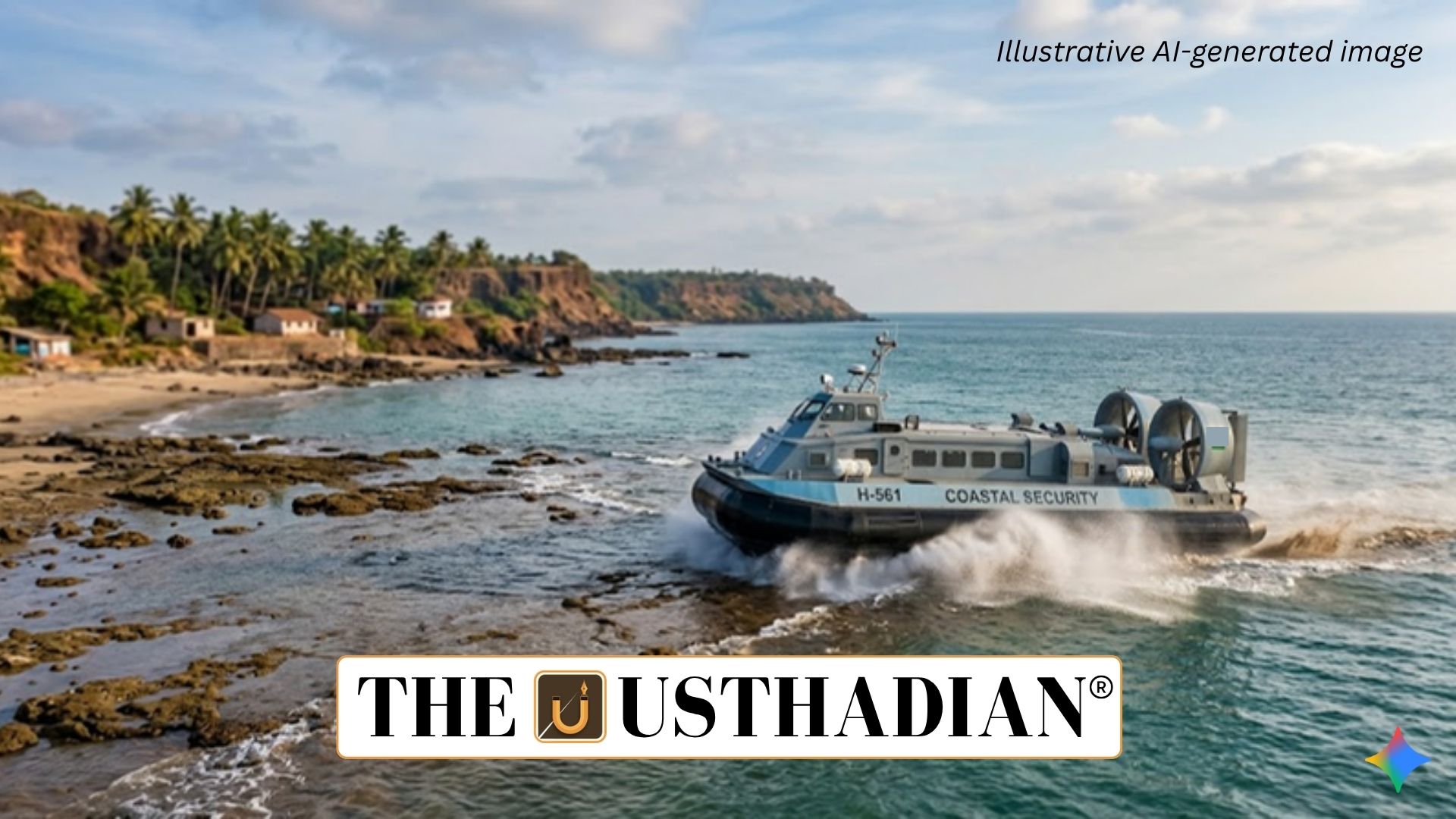
First Indigenous Hovercraft Joins the Coast Guard
India Strengthens Coastal Security with Indigenous Hovercraft H-561: The Indian Coast Guard (ICG) inducted H-561, the country’s first indigenously developed Air Cushion Vehicle (ACV), on 18 June 2026. The induction marks a major milestone in India’s efforts to strengthen maritime security through indigenous defence manufacturing.
Built under the Make in India initiative, H-561 enhances the Coast Guard’s capability to conduct coastal surveillance, rapid response, search and rescue missions, and maritime law enforcement in difficult coastal terrains.
Static GK fact: The Indian Coast Guard was established on 1 February 1977 and functions under the Ministry of Defence. Its headquarters is located in New Delhi.
What Is H-561
H-561 is the first of six indigenous hovercraft ordered by the Indian Coast Guard. It has been designed and manufactured by Chowgule & Company Private Limited at its shipbuilding facility in Goa.
The hovercraft represents India’s growing capability in designing and manufacturing advanced maritime platforms domestically while reducing dependence on imported defence equipment.
Understanding an Air Cushion Vehicle
An Air Cushion Vehicle (ACV), commonly known as a hovercraft, travels on a cushion of air created by powerful lift fans. Unlike conventional boats, it can move efficiently over both land and water without requiring deep water for navigation.
This unique capability allows hovercraft to operate across shallow waters, mudflats, sandy beaches, marshlands, estuaries, and coastal wetlands, making them highly suitable for coastal security operations.
Static GK Tip: A hovercraft is an amphibious vehicle capable of travelling over land, water, ice, and marshy terrain using a cushion of pressurized air.
Importance for Coastal Security
India has a coastline of over 7,500 kilometres, comprising creeks, mangroves, river mouths, and shallow coastal regions where conventional patrol vessels often face operational limitations.
The induction of H-561 enables the Coast Guard to access these difficult areas quickly, improving surveillance, anti-smuggling operations, disaster response, and protection against maritime threats.
Key Features of H-561
The indigenous hovercraft has been designed to meet the operational needs of the Indian Coast Guard with advanced mobility and rapid deployment capabilities.
Its major features include high-speed movement, multi-terrain operations, enhanced operational reach, and an indigenous design that supports India’s defence self-reliance objectives.
These capabilities make H-561 suitable for search and rescue operations, coastal patrolling, humanitarian assistance, and emergency response during natural disasters.
Boost to Make in India
The induction of H-561 reflects the success of the Make in India initiative in the defence sector. Indigenous development strengthens national security while encouraging domestic shipbuilding, technology development, and employment generation.
The hovercraft also contributes to the government’s vision of Aatmanirbhar Bharat by expanding India’s capability to manufacture sophisticated maritime platforms within the country.
Static GK fact: India’s maritime security is coordinated by the Indian Navy and the Indian Coast Guard, with the Coast Guard primarily responsible for coastal security, pollution control, anti-smuggling operations, and search and rescue within India’s maritime zones.
Static Usthadian Current Affairs Table
India Strengthens Coastal Security with Indigenous Hovercraft H-561:
| Fact | Detail |
| Hovercraft inducted | H-561 |
| Inducting agency | Indian Coast Guard |
| Induction date | 18 June 2026 |
| Vehicle type | Air Cushion Vehicle (ACV) |
| Built by | Chowgule & Company Private Limited |
| Manufacturing location | Goa |
| Number of hovercraft ordered | Six |
| Major role | Coastal surveillance, search and rescue, rapid response, maritime security |
| Associated initiative | Make in India |
| Parent ministry | Ministry of Defence |