India’s Fusion Research Milestone
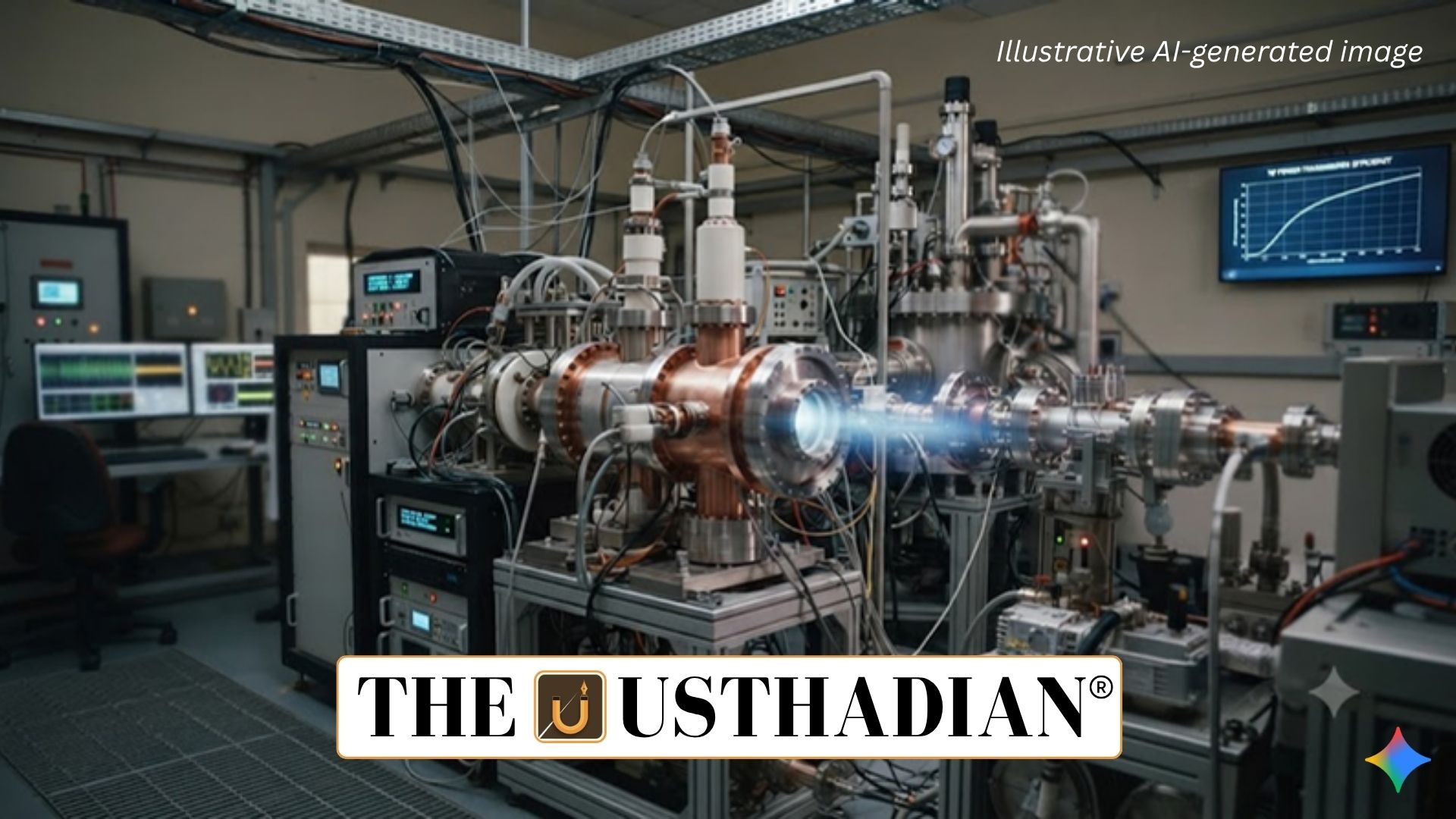
India Advances Fusion Research with New Gyrotron Technology: India has strengthened its nuclear fusion research capabilities with the installation of a new 82.6 GHz, 400 kW gyrotron on the SST-1 Tokamak at the Institute for Plasma Research (IPR), Gujarat. The system is expected to improve the ability to heat and sustain extremely hot plasma during fusion experiments.
The development represents an important step in India’s efforts to understand controlled nuclear fusion, the same fundamental process that powers the Sun and other stars.
Understanding India’s Artificial Sun
The term “Artificial Sun” refers to experimental fusion research rather than an actual artificial star. India’s SST-1, or Steady State Superconducting Tokamak, is designed to reproduce some of the extreme conditions required for nuclear fusion on Earth.
Nuclear fusion occurs when light atomic nuclei combine under extreme temperature and pressure, releasing substantial energy. In contrast, nuclear fission generates energy by splitting heavy atomic nuclei.
Static GK fact: A tokamak is a doughnut-shaped fusion device that uses powerful magnetic fields to confine extremely hot plasma away from its surrounding walls.
Role of the New Gyrotron
A gyrotron is a high-power microwave source capable of generating electromagnetic radiation at very high frequencies. The newly installed system operates at 82.6 GHz and can deliver 400 kW of power.
The new equipment represents an improvement over the earlier 42 GHz gyrotron used in the fusion research programme. Its stronger heating capability can support experiments involving higher-temperature plasma and longer-duration confinement.
Plasma Heating and Confinement
One of the biggest challenges in fusion research is maintaining plasma at extremely high temperatures while preventing it from touching the reactor walls. On Earth, researchers cannot rely on the enormous gravitational pressure found inside the Sun.
Tokamaks therefore employ magnetic confinement to control the plasma. Gyrotrons complement this system by supplying microwave energy that helps heat the plasma to the temperatures needed for fusion studies.
Indian fusion experiments have achieved plasma temperatures exceeding 200 million°C, which is far hotter than the Sun’s core.
Static GK Tip: The Sun sustains fusion through enormous gravitational pressure and temperatures in its core, whereas experimental tokamaks on Earth primarily rely on magnetic confinement.
Why the Development Matters
The upgraded gyrotron can contribute to research on plasma stability, confinement and steady-state operation. These are essential areas for developing future fusion reactors capable of maintaining controlled reactions for longer periods.
The technology also strengthens India’s domestic expertise in advanced plasma heating and fusion science. However, SST-1 remains an experimental research facility, not a commercial electricity-generating fusion plant.
Fusion Energy and Its Future
Fusion is being investigated as a potential future source of low-carbon energy because its fuel resources are comparatively abundant and the process does not produce carbon emissions during the fusion reaction itself.
However, achieving practical fusion power requires overcoming major scientific and engineering challenges, including sustained plasma confinement, efficient energy recovery and the development of materials capable of withstanding extreme conditions.
India’s new gyrotron therefore marks progress in fusion research, but commercial fusion electricity remains a long-term technological goal.
Static Usthadian Current Affairs Table
India Advances Fusion Research with New Gyrotron Technology:
| Fact | Detail |
| Major Development | New gyrotron installed for fusion research |
| Location | Institute for Plasma Research, Gujarat |
| Fusion Device | SST-1 Steady State Superconducting Tokamak |
| New Gyrotron Frequency | 82.6 GHz |
| Gyrotron Power | 400 kW |
| Earlier System | 42 GHz gyrotron |
| Plasma Temperature | More than 200 million°C achieved in experiments |
| Plasma Confinement | Magnetic confinement in a tokamak |
| Main Research Areas | Plasma heating, stability, confinement and steady-state operation |
| Current Status | Experimental research, not a commercial fusion power plant |