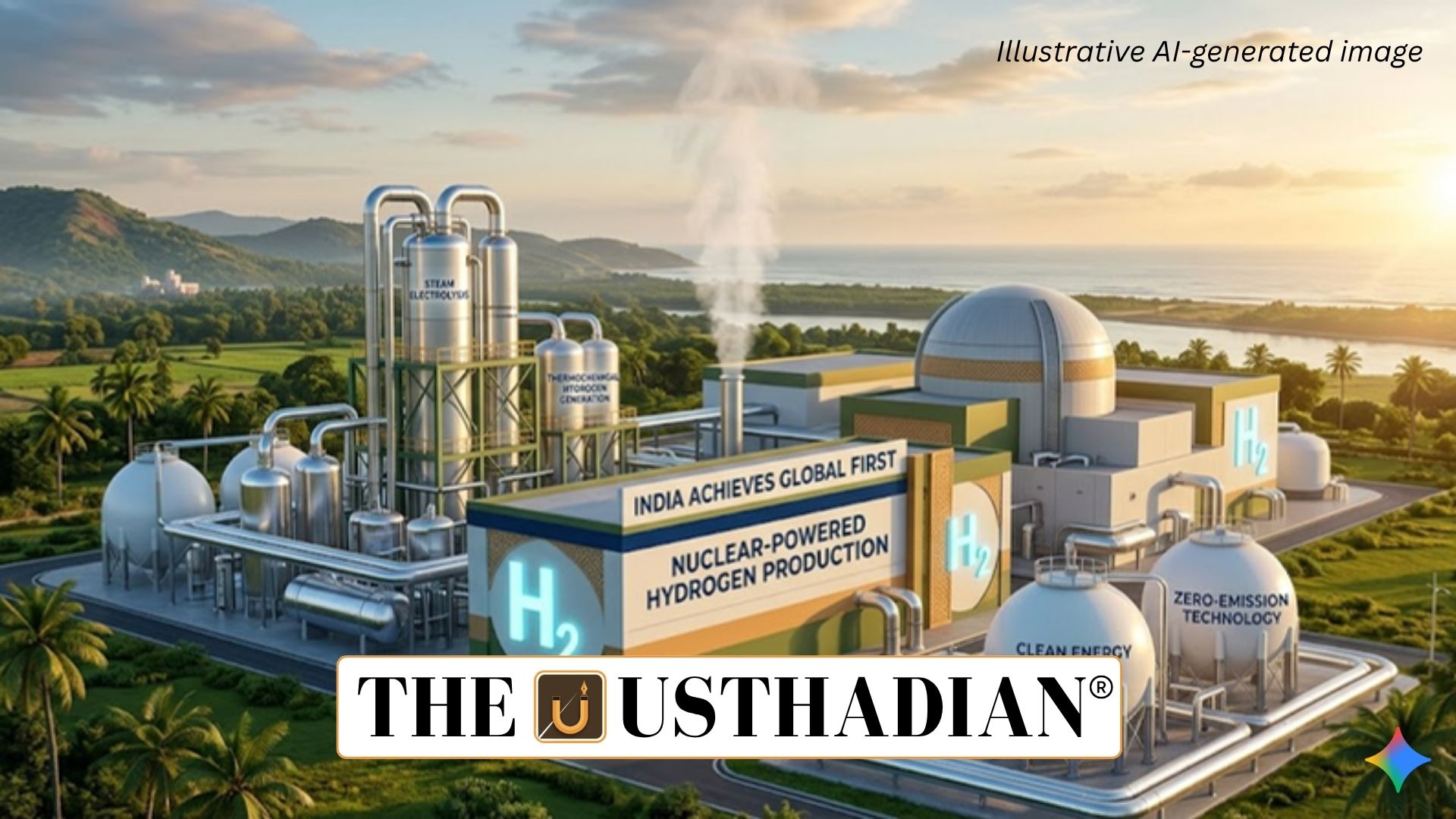
India Commissions a Global First
India Achieves Global First in Nuclear-Powered Hydrogen Production: India has commissioned the world’s first hydrogen production facility based on nuclear process heat, marking a major breakthrough in clean energy technology. The facility was inaugurated by Department of Atomic Energy (DAE) Secretary Ajit Kumar Mohanty at the Indira Gandhi Centre for Atomic Research (IGCAR) in Kalpakkam, Tamil Nadu.
The demonstration plant uses heat generated from a nuclear reactor instead of fossil fuels to produce hydrogen. The project highlights India’s growing capabilities in indigenous nuclear innovation and supports the country’s long-term clean energy goals.
Static GK fact: Kalpakkam is located in Tamil Nadu and houses major nuclear research facilities, including IGCAR and the Madras Atomic Power Station (MAPS).
What Makes the Facility Unique
The facility produces hydrogen using high-temperature nuclear process heat through the Copper-Chlorine (Cu-Cl) Thermochemical Cycle. This indigenous technology has been developed by the Bhabha Atomic Research Centre (BARC), Mumbai.
Unlike conventional hydrogen production, which depends largely on natural gas or electricity, this process uses nuclear heat to split water into hydrogen and oxygen with virtually no direct carbon emissions. It demonstrates the feasibility of integrating nuclear energy with hydrogen production.
Understanding the Cu-Cl Thermochemical Cycle
The Copper-Chlorine (Cu-Cl) Thermochemical Cycle is a sequence of chemical reactions involving copper and chlorine compounds to separate hydrogen from water. The process operates at temperatures of around 500°C, making it more energy-efficient than several other thermochemical hydrogen production methods.
The copper and chlorine compounds are continuously recycled during the process, minimizing waste while ensuring efficient hydrogen generation. This indigenous technology strengthens India’s position in advanced clean energy research.
Static GK Tip: BARC is headquartered in Mumbai and functions under the Department of Atomic Energy (DAE).
Role of the Fast Breeder Test Reactor
The hydrogen production facility utilizes thermal energy from the Fast Breeder Test Reactor (FBTR) located at IGCAR, Kalpakkam. Commissioned in 1985, the FBTR is India’s first operational fast breeder reactor and plays a vital role in the country’s three-stage nuclear power programme.
The reactor provides a continuous and reliable source of process heat, enabling round-the-clock hydrogen production while improving the overall utilization of nuclear energy infrastructure.
Importance for India’s Energy Future
Hydrogen is widely regarded as a clean fuel for sectors such as transport, steel, fertilizer, and heavy industries. However, most hydrogen currently produced worldwide is generated using fossil fuels, leading to significant carbon emissions.
By using nuclear process heat, India can produce clean hydrogen with higher efficiency, lower emissions, and reduced dependence on imported fossil fuels. The technology also strengthens energy security and supports India’s commitment to achieving net-zero emissions.
Static GK fact: India’s three-stage nuclear power programme was conceived by Dr. Homi Jehangir Bhabha to utilize the country’s abundant thorium resources for long-term energy security.
Static Usthadian Current Affairs Table
India Achieves Global First in Nuclear-Powered Hydrogen Production:
| Fact | Detail |
| Facility | World’s first nuclear process heat-based hydrogen production facility |
| Location | IGCAR, Kalpakkam, Tamil Nadu |
| Inaugurated by | Ajit Kumar Mohanty, Secretary, Department of Atomic Energy |
| Technology used | Copper-Chlorine (Cu-Cl) Thermochemical Cycle |
| Developed by | Bhabha Atomic Research Centre (BARC), Mumbai |
| Heat source | Fast Breeder Test Reactor (FBTR) |
| FBTR commissioned | 1985 |
| Operating temperature | Around 500°C |
| Key benefit | Carbon-free hydrogen production using nuclear process heat |
| Related programme | India’s three-stage nuclear power programme |