Why Cement Decarbonisation Matters
Greening India’s Cement Industry for a Low-Carbon Future: India aims to become a developed nation by 2047 and achieve net-zero emissions by 2070. Decarbonising construction is important to both objectives because buildings and infrastructure rely heavily on carbon-intensive materials, particularly cement and steel.
The construction sector and its wider supply chains account for an estimated 35–40% of global greenhouse gas emissions. Cement production alone contributes approximately 7–11% of global CO₂ emissions, making it a difficult industry to decarbonise.
India’s Cement Industry at a Glance
India is the world’s second-largest cement producer, with installed capacity estimated at around 668–700 million tonnes per annum (MTPA). Production reached approximately 490 million tonnes in FY 2025–26, registering reported year-on-year growth of 8.6%.
Housing accounts for roughly 65% of domestic cement demand, while commercial construction and public infrastructure projects, including those supported by PM Gati Shakti, contribute to consumption.
Cement is one of India’s eight core industries and carries a weight of 5.37% in the Index of Industrial Production (IIP). Southern India accounts for approximately 32% of installed capacity. Important limestone-producing states include Rajasthan, Andhra Pradesh, Tamil Nadu and Chhattisgarh.
Static GK fact: Portland cement developed in Britain during the 19th century and became a widely used construction binder because of its strength, versatility and suitability for large-scale construction.
Environmental Costs of Cement Production
Cement manufacturing involves heating limestone and clay in kilns at approximately 1,450°C to produce clinker. Conventional production relies heavily on coal, petroleum coke and other fuels.
Two major sources of emissions are involved:
- Process emissions: During calcination, calcium carbonate decomposes into calcium oxide and CO₂. These emissions occur independently of the fuel used.
- Energy-related emissions: Heating kilns and operating industrial machinery require substantial energy, often derived from fossil fuels.
Other environmental effects include limestone-mining-related habitat destruction, air pollution from nitrogen oxides and particulate matter, transportation emissions and pressure on local resources. A life-cycle approach must therefore consider mining, manufacturing, transportation, construction and building use.
India’s Decarbonisation Targets
India’s cement industry emits approximately 0.62 tonnes of CO₂ per tonne of cement, according to the supplied material. Proposed emissions-intensity milestones include:
| Indicator | Target or estimate |
| Current emissions intensity | 0.62 tonnes CO₂ per tonne |
| Target for 2030 | 0.56 tonnes |
| Target for 2047 | 0.51 tonnes |
| Projected production by 2070 | 1,546 million tonnes |
The central challenge is to reduce emissions per tonne while meeting rising construction demand. Lower emissions intensity alone may not guarantee lower total emissions if production expands substantially.
Key Strategies for Greener Cement
1. Cleaner fuels and renewable energy
Electrification, renewable power and alternative fuels can reduce fossil-fuel consumption. Refuse-derived fuel (RDF), made from combustible fractions of processed municipal waste, can partly replace conventional kiln fuels. A NITI Aayog roadmap cited in the supplied material recommends a 20% thermal substitution rate using RDF by 2030, potentially avoiding about 80 million tonnes of cumulative CO₂-equivalent emissions. Effective waste segregation and quality control are essential.
2. Reducing clinker content
Clinker production is highly emissions-intensive. India’s clinker-to-cement ratio is estimated at 67.5%, below the cited global average of 77%. Greater use of suitable supplementary cementitious materials, such as fly ash and slag, can reduce clinker requirements. Portland Pozzolana Cement (PPC) and Portland Slag Cement (PSC) support this approach.
3. Carbon capture, utilisation and storage
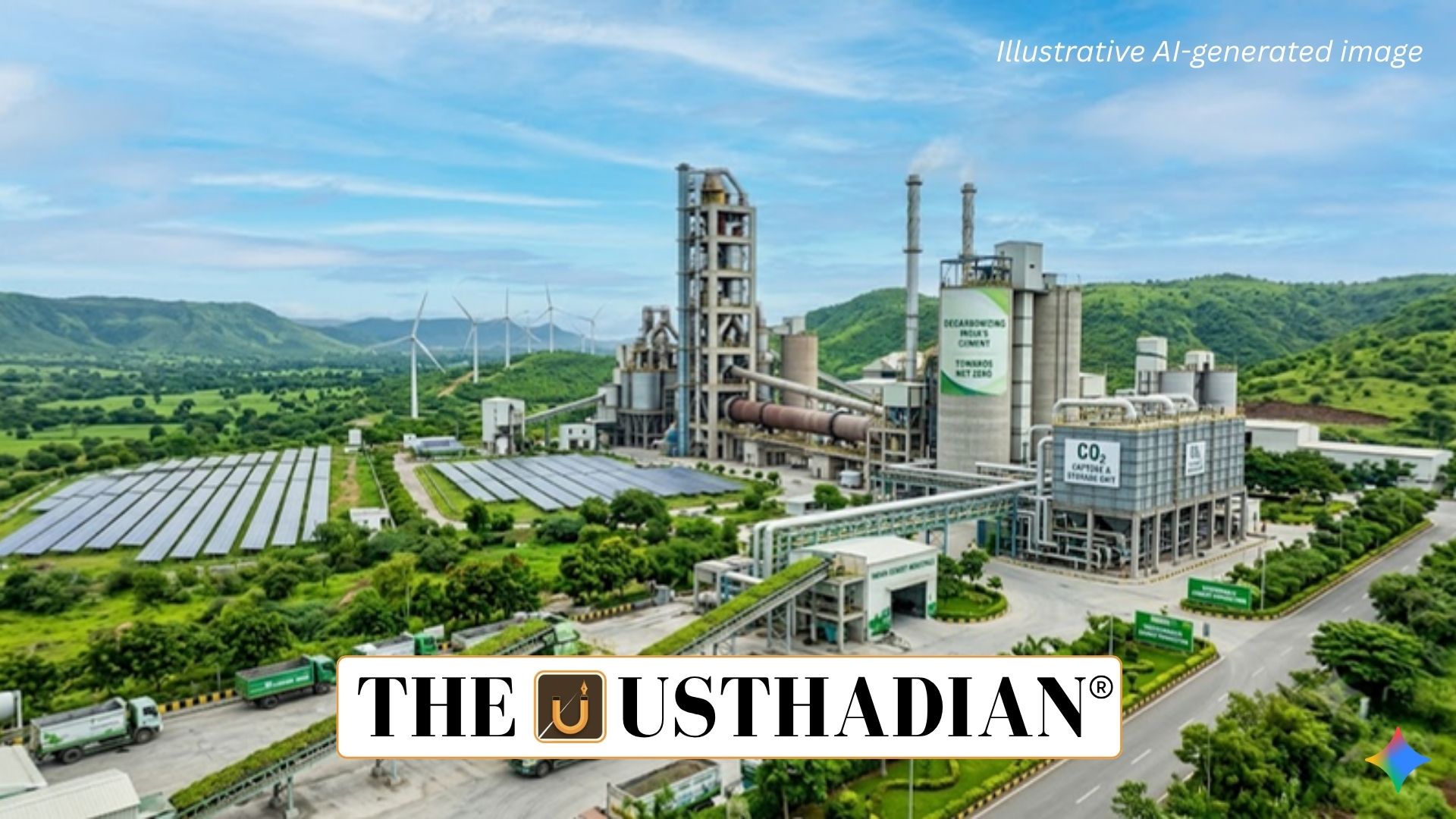
CCUS can capture residual CO₂ emissions that cannot be eliminated through fuel substitution because calcination itself releases carbon dioxide. Wider adoption requires technological progress, investment, transport networks, suitable storage sites and reliable monitoring.
4. Sustainable building design
Climate-responsive architecture, efficient material use and low-carbon construction specifications can reduce cement demand. Traditional methods, including rammed earth, compressed earth blocks, lime-surkhi mortar, Kath Kuni architecture and bamboo construction, may be suitable in specific locations when adapted to modern safety and performance standards.
Static GK Tip: Embodied carbon refers to greenhouse gas emissions associated with materials and construction processes, including extraction, manufacturing and transportation. It differs from operational emissions generated during a building’s use.
Way Forward
India should strengthen circular-economy practices, improve the use of suitable industrial by-products, promote low-carbon procurement and develop transparent embodied-carbon standards. Research, performance-based building regulations and financial incentives can accelerate green cement adoption while maintaining affordability, durability and structural safety.
The objective is not to eliminate cement indiscriminately, but to use it more efficiently and reduce its carbon intensity wherever technically feasible.
Static Usthadian Current Affairs Table
Greening India’s Cement Industry for a Low-Carbon Future:
| Fact | Detail |
| India’s cement production rank | Second-largest globally |
| Installed capacity | Approximately 668–700 MTPA |
| FY 2025–26 production | Approximately 490 million tonnes |
| Cement share of global CO₂ emissions | Approximately 7–11% |
| India’s net-zero target | 2070 |
| Cement emissions-intensity target for 2030 | 0.56 tonnes CO₂ per tonne |
| RDF | Refuse-derived fuel |
| CCUS | Carbon capture, utilisation and storage |
| PPC | Portland Pozzolana Cement |
| PSC | Portland Slag Cement |
| Key policy objective | Low-carbon, affordable and sustainable construction |