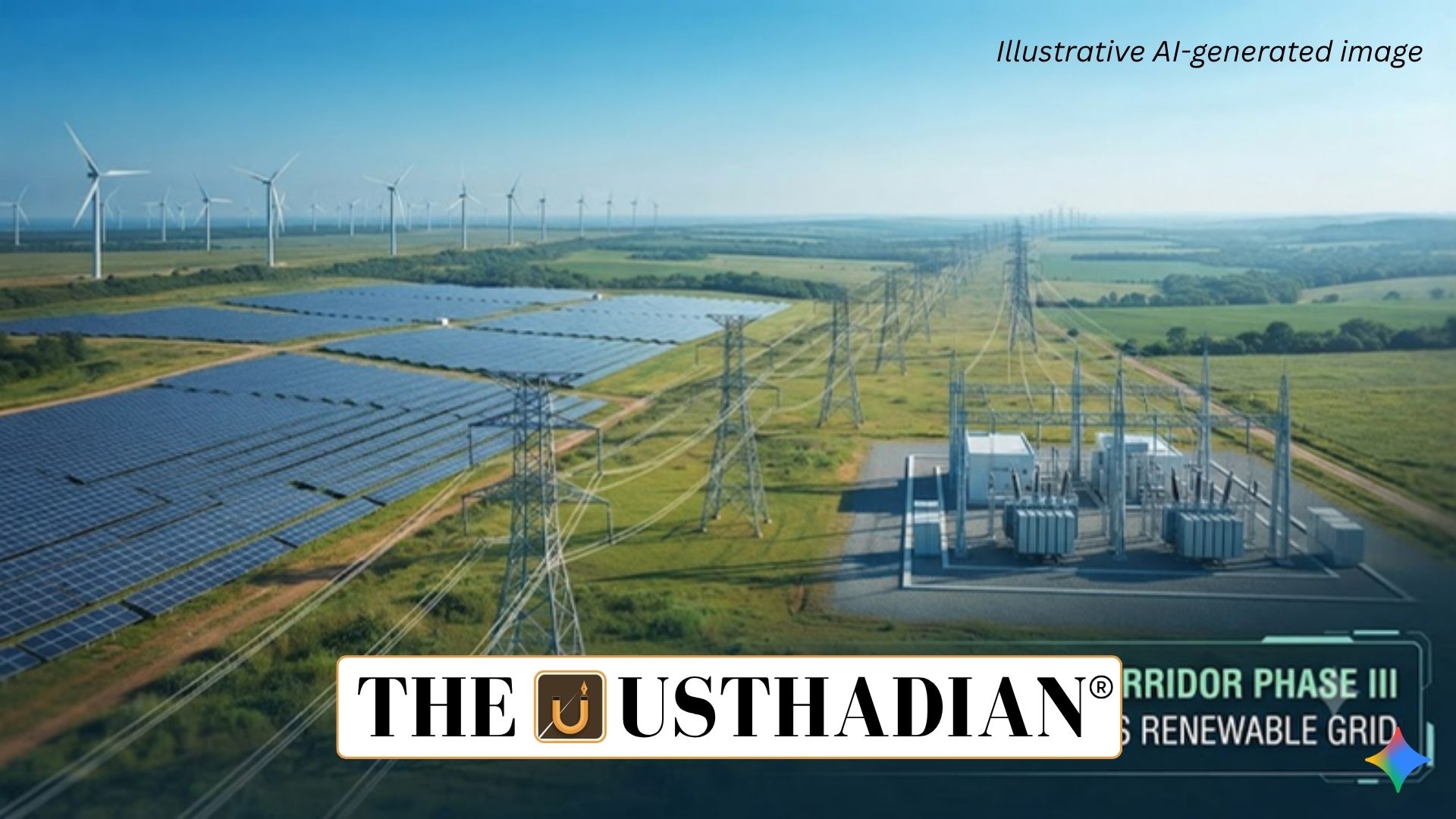
GEC Phase III Gets Major Investment
Green Energy Corridor Phase III Strengthens India’s Renewable Grid: The Union Government has approved the third phase of the Green Energy Corridor (GEC-III) with an estimated outlay of ₹1.86 lakh crore. The initiative is designed to support the evacuation of up to 135 GW of renewable energy and strengthen transmission infrastructure across states.
Power evacuation refers to transporting electricity generated at renewable-energy projects through transmission networks to areas where it can be consumed.
Static GK fact: The Green Energy Corridor is a dedicated transmission initiative designed to integrate large-scale solar and wind power into India’s electricity grid.
Battery Storage Added to the Corridor
A major feature of GEC-III is the inclusion of 50 GWh of Battery Energy Storage Systems (BESS). This is significant because renewable generation varies according to weather and time of day.
Storage systems can absorb surplus electricity when renewable generation is high and release it when demand increases or renewable generation falls. This helps improve grid flexibility and reduce renewable-energy curtailment.
₹1.86 Lakh Crore Allocation
More than ₹1.36 lakh crore is earmarked for Intra-State Transmission Systems (InSTS), while approximately ₹50,000 crore is provided for the 50 GWh battery-storage component.
The scheme also includes ₹54,082 crore in Central Financial Support (CFS) to offset intra-state transmission charges and help contain electricity costs for consumers.
GEC-III is targeted for completion by FY2033.
New Transmission Models
Greenfield transmission projects under InSTS will use Tariff-Based Competitive Bidding (TBCB). Under this model, transmission companies compete to develop and operate projects at competitively determined tariffs.
Brownfield projects involving upgrades to existing networks will follow the Cost-Plus Basis (CPB), under which approved project costs and returns are recovered through regulated tariffs.
State transmission utilities will act as implementing agencies, while transmission service providers can participate in TBCB projects under a build-own-operate-maintain model.
Tackling Renewable Curtailment
India’s renewable capacity has expanded rapidly, but transmission infrastructure has not always grown at the same pace. During periods of high solar generation, grid congestion can force operators to restrict or temporarily curtail renewable generation.
In FY2025–26, around 6,900 GWh of clean electricity reportedly faced restrictions because of transmission constraints.
Static GK Tip: Curtailment means reducing renewable electricity generation because the grid cannot safely absorb or transmit the available power.
Preparing for Future Demand
India could add around 400 GW of renewable capacity between 2030 and 2035–36, creating demand for nearly 160 GW of additional InSTS infrastructure.
GEC-III is expected to facilitate around 135 GW of this state-level transmission requirement. It also seeks to spread renewable capacity beyond the states where it is currently concentrated.
Proposals have been received from at least 13 states, compared with eight states under GEC-I and seven under GEC-II.
India’s Storage Challenge
India’s existing storage base remains modest compared with its future requirements. Installed capacity is approximately 2.9 GW of BESS and 7.2 GW of Pumped Hydro Storage (PHS).
The Central Electricity Authority’s projected requirement for 2035–36 is 174 GW / 888 GWh of total storage, comprising 80 GW / 321 GWh of BESS and 94 GW / 567 GWh of PHS.
Delays and Implementation
Earlier GEC phases have faced implementation delays. GEC-I is now expected to be completed by March 2027, while projects under GEC-II are expected to be completed by 2028.
A Cabinet Secretary-level steering committee will monitor the progress of GEC-II and GEC-III twice annually.
The third phase therefore combines transmission expansion with large-scale storage, addressing two critical requirements for integrating India’s rapidly growing renewable-energy capacity.
Static Usthadian Current Affairs Table
Green Energy Corridor Phase III Strengthens India’s Renewable Grid:
| Fact | Detail |
| GEC Phase III outlay | ₹1.86 lakh crore |
| Renewable evacuation capacity | 135 GW |
| Battery storage | 50 GWh BESS |
| Intra-State Transmission allocation | Over ₹1.36 lakh crore |
| Central Financial Support | ₹54,082 crore |
| Target completion | FY2033 |
| FY26 clean-energy restrictions | Around 6,900 GWh |
| Current BESS capacity | About 2.9 GW |
| Current PHS capacity | About 7.2 GW |
| 2035–36 storage requirement | 174 GW / 888 GWh |
| BESS target by 2035–36 | 80 GW / 321 GWh |
| PHS target by 2035–36 | 94 GW / 567 GWh |