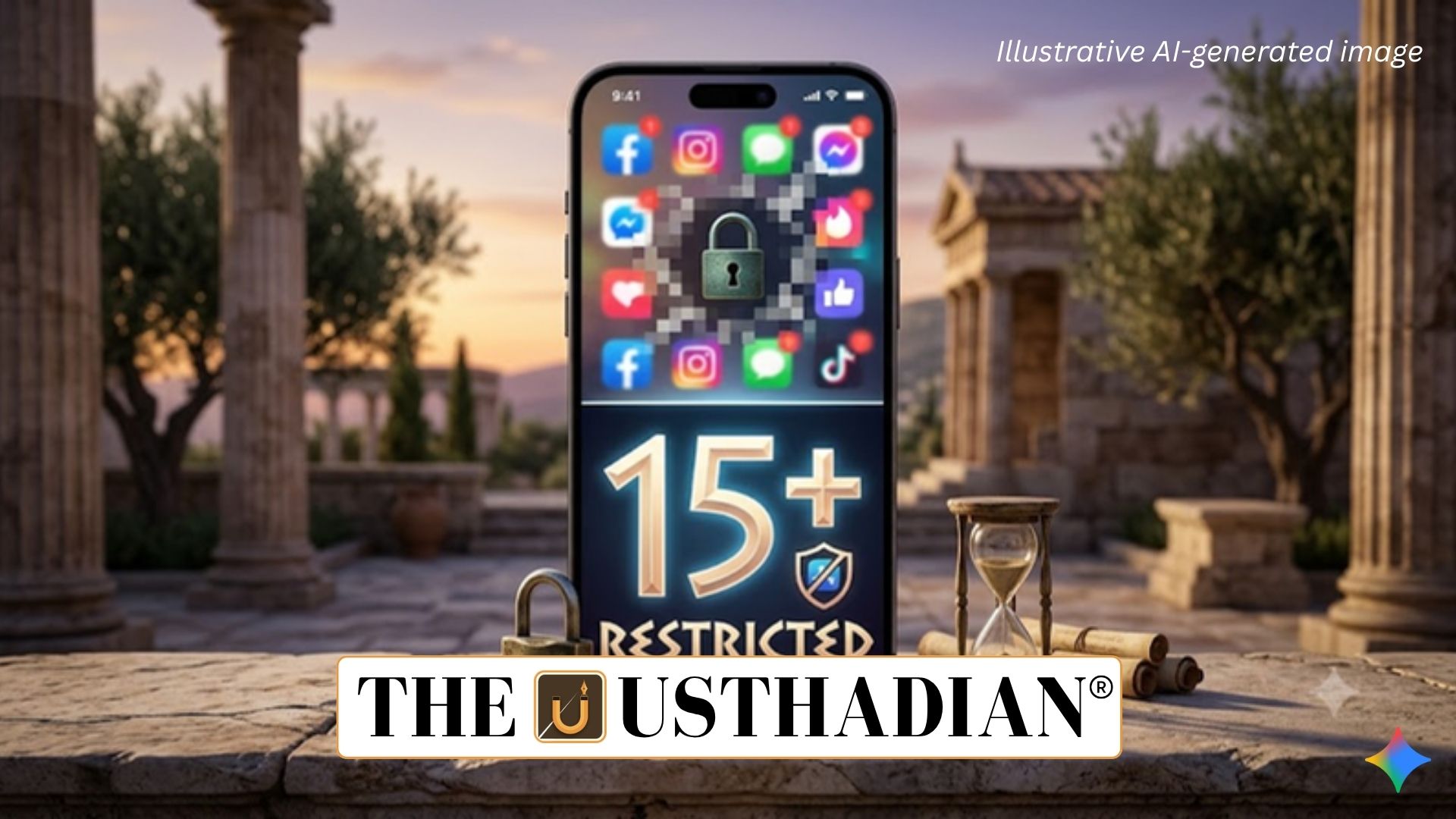
Greece’s Reported Social Media Restriction
Greece Moves to Restrict Social Media Access for Children Under 15: According to the supplied report, Greece legislation on 23 October 2026 to prohibit children under the age of 15 from using social media platforms. The restriction is scheduled to take effect on 1 January 2027.
The reported measure aims to address concerns about children’s digital well-being, including sleep disruption, reduced concentration, cyberbullying and exposure to inappropriate online content.
Platforms mentioned in the report include Facebook, Instagram, TikTok and LinkedIn. The restriction reportedly covers existing accounts and new users, with parental consent not providing an exemption.
Age Verification and KidsWallet
The proposed framework reportedly links age verification to the KidsWallet app. According to the supplied report, Prime Minister Kyriakos Mitsotakis stated that platforms would have approximately two and a half months to develop age-verification systems while protecting users’ privacy.
Age verification is intended to establish whether a user meets the minimum age requirement. However, its effectiveness depends on reliable verification methods, appropriate implementation and safeguards against misuse of personal information.
Static GK fact: Age assurance refers to methods used to estimate or verify a person’s age. These may include age verification using reliable evidence or age estimation using other techniques.
Understanding Zero-Knowledge Proofs
A zero-knowledge proof (ZKP) is a cryptographic method that allows one party to demonstrate that a statement is true without revealing the underlying information beyond what is necessary for verification.
In an age-verification system, such a technique could potentially establish that a person meets a specified age threshold without disclosing their full identity or date of birth to every platform.
However, privacy protection depends on the complete system design, including how credentials are issued, stored and verified.
Static GK Tip: Zero-knowledge proofs are associated with cryptography and privacy-preserving digital verification. They are not limited to age checks and can be used in other applications requiring verification without unnecessary information disclosure.
Objectives of the Restriction
The reported measure seeks to address several concerns associated with children’s social media use:
- Digital well-being: Reduce excessive or continuous scrolling.
- Sleep and concentration: Address concerns about the effects of prolonged screen use.
- Online safety: Reduce exposure to inappropriate content and harmful interactions.
- Cyberbullying prevention: Strengthen protection against online harassment.
- Offline social interaction: Encourage more face-to-face activities and relationships.
The effectiveness of such restrictions would depend on enforcement, platform compliance, age-verification accuracy and the availability of appropriate digital-safety education.
European Union Context
The supplied report states that Greece is working with six other European Union countries and the European Commission on a common age-verification solution. The initiative could contribute to wider discussions about children’s online protection and proposed EU-level measures, including the EU Kids Act.
The report also refers to a French legal development in August 2026. That comparison requires verification against official legal records before it can be treated as an established precedent.
A broader policy challenge for European countries is balancing children’s online safety with privacy, access to digital services and the practical enforcement of age restrictions.
Static Usthadian Current Affairs Table
Greece Moves to Restrict Social Media Access for Children Under 15:
| Fact | Detail |
| Country | Greece |
| Reported approval date | 23 October 2026 |
| Scheduled effective date | 1 January 2027 |
| Minimum age | 15 years |
| Platforms mentioned | Facebook, Instagram, TikTok and LinkedIn |
| Age-verification tool mentioned | KidsWallet app |
| Prime Minister | Kyriakos Mitsotakis |
| Cryptographic technology | Zero-knowledge proof |
| Main objectives | Online safety, digital well-being and cyberbullying prevention |
| Regional context | European Union digital-safety cooperation |
| Key policy challenge | Balancing child protection, privacy and enforceability |