Unique navigation ability discovered
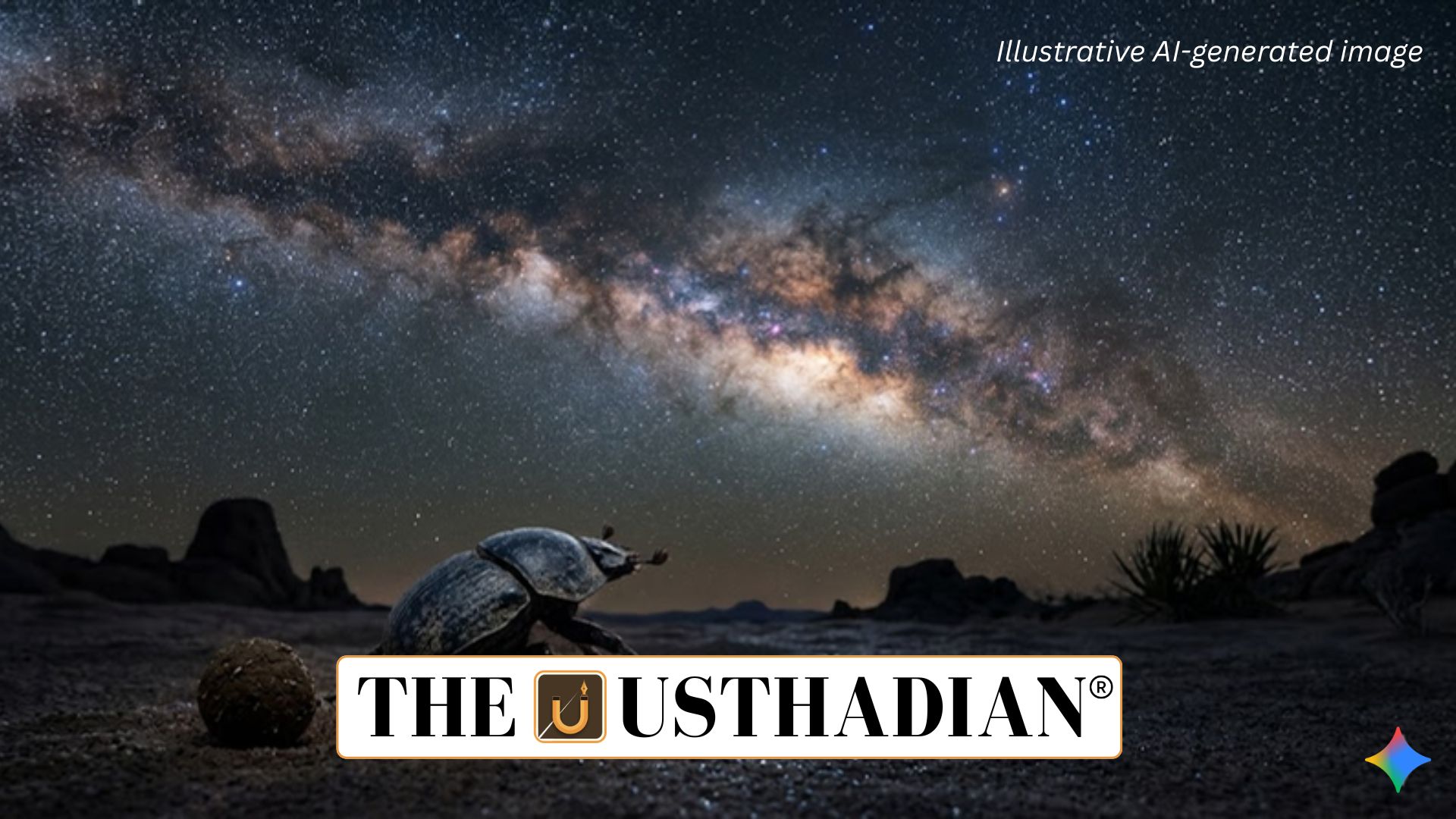
Dung Beetles Navigate Using Milky Way: Scientists have identified that dung beetles use the Milky Way galaxy to navigate during the night. This makes them the first known animals to rely on the galaxy for directional movement. The finding highlights an advanced level of celestial navigation in insects.
The species Scarabaeus satyrus played a key role in this discovery. These beetles can maintain a straight path even under low-light conditions, showing remarkable survival adaptation.
Static GK fact: The Milky Way galaxy contains billions of stars and is visible as a bright band in dark skies.
Importance of straight-line movement
Dung beetles depend on animal dung for both food and reproduction. After collecting dung, they shape it into a ball and roll it away quickly. This behavior helps them avoid competition from other beetles.
Maintaining a straight-line path is crucial for efficiency. Any deviation can result in losing the dung ball, wasting time and reducing reproductive success.
Static GK Tip: Many insects show instinctive behaviours that increase survival and reproductive efficiency.
Daytime navigation mechanism
During the day, dung beetles use the Sun as a reference point. They detect polarised light patterns, which are invisible to human eyes. Their compound eyes contain special receptors for this purpose.
By maintaining a constant angle relative to sunlight, beetles move in a consistent direction. This helps them quickly escape crowded areas.
Static GK fact: Polarised light is also used by other insects like bees for navigation.
Night navigation using the Milky Way
At night, sunlight is absent and moonlight is not always reliable. Scientists observed that beetles still moved in straight lines even on moonless nights. This led to further investigation.
Experiments showed that beetles orient themselves using the bright band of the Milky Way. Even when only the galaxy’s glow was visible, their navigation remained accurate.
Static GK Tip: The Milky Way is best visible in areas with low light pollution.
Experimental confirmation
Researchers conducted controlled experiments in both open fields and planetariums. When beetles could see the sky, they moved correctly in straight paths. When their view was blocked using caps, their movement became random.
This confirmed that their navigation depends on visual celestial cues rather than ground signals. The study demonstrates the complexity of insect sensory systems.
Static GK fact: Animal navigation studies often involve controlled environments like planetariums.
Scientific significance
This discovery expands understanding of animal behaviour and evolution. It shows that even small insects can develop highly efficient navigation systems using natural cues.
The findings may inspire advancements in robotics and navigation technologies by mimicking biological systems.
Static Usthadian Current Affairs Table
Dung Beetles Navigate Using Milky Way:
| Topic | Detail |
| Species Studied | Scarabaeus satyrus |
| Key Discovery | Use of Milky Way for navigation |
| Navigation Type | Celestial orientation |
| Day Navigation Tool | Sun and polarised light |
| Night Navigation Tool | Milky Way galaxy |
| Experiment Method | Open sky and planetarium testing |
| Key Finding | Visual cues essential for direction |
| Behaviour Purpose | Avoid competition and secure food |
| Scientific Field | Animal behaviour and ecology |
| Significance | Insight into evolutionary adaptation |