Rare cosmic activation observed
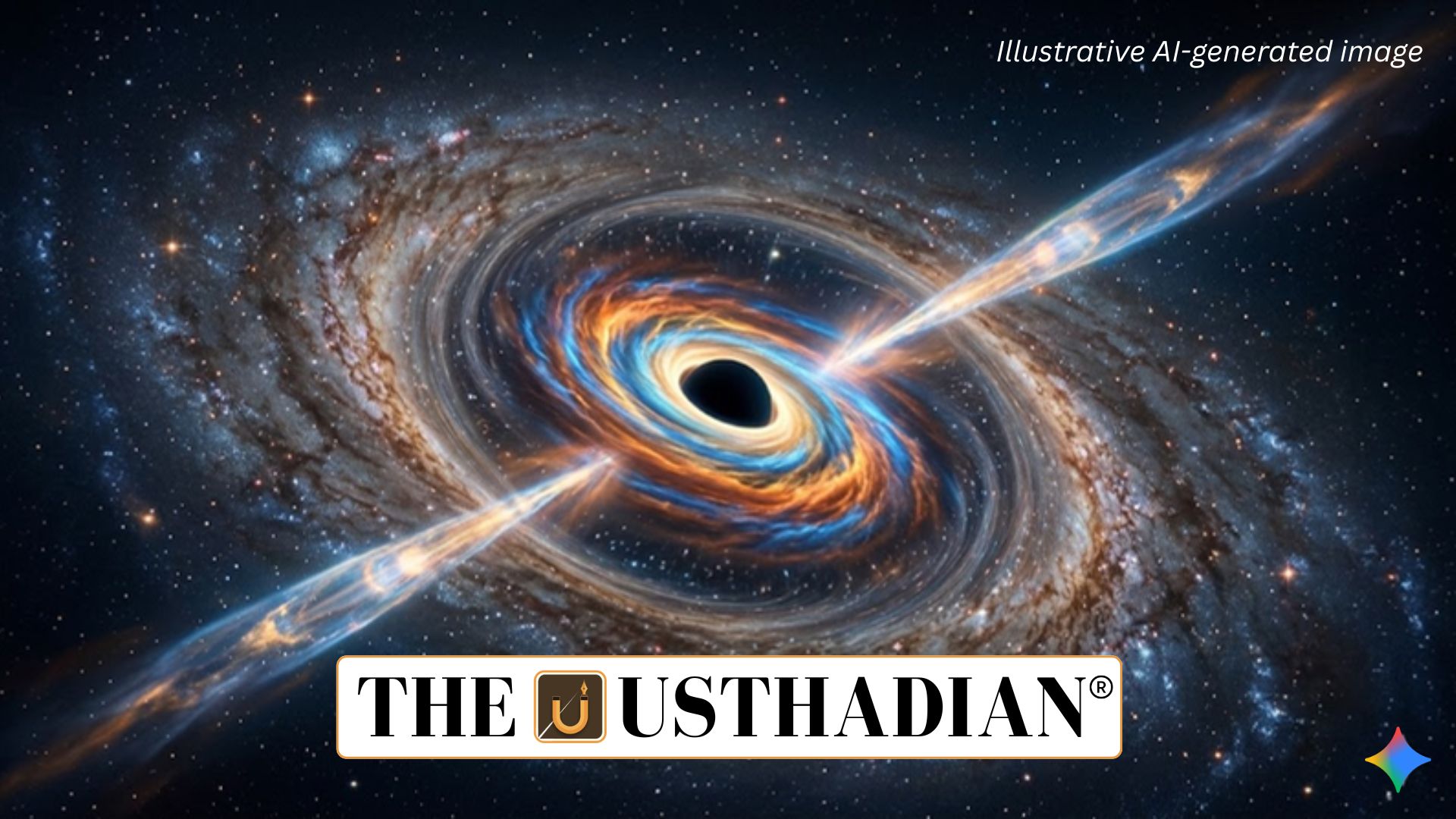
Dormant Black Hole Awakens After Millions of Years: Scientists recently observed a supermassive black hole reactivating after nearly 100 million years of dormancy. This rare phenomenon marks a sudden transition from an inactive state to a highly energetic phase. The event released intense radiation, drawing global attention in the field of astrophysics.
Such observations are crucial as they provide real-time evidence of how black holes behave over cosmic timescales. It also highlights the dynamic nature of the universe.
Static GK fact: The closest known black hole to Earth is Gaia BH1, located about 1,560 light-years away.
Meaning of a waking black hole
A black hole remains dormant when there is no nearby matter to absorb. When gas, dust, or stars enter its gravitational pull, it begins feeding again, forming an accretion disk around it.
This process leads to the emission of massive energy and radiation. The transition from dormancy to activity is referred to as the formation of an Active Galactic Nucleus (AGN).
Static GK Tip: The term “black hole” was popularised by physicist John Archibald Wheeler in 1967.
Cosmic eruption phenomenon
The event is often compared to a cosmic volcanic eruption due to the sudden release of accumulated energy. Instead of lava, the black hole emits high-energy jets and radiation into space.
These emissions can sometimes exceed the total energy output of entire galaxies. The jets travel at near-light speed and can extend across vast cosmic distances.
Static GK fact: Light travels at approximately 3 × 10⁸ metres per second in vacuum.
Role in galaxy evolution
Black holes play a significant role in shaping their host galaxies. The energy released during such eruptions can suppress or trigger star formation depending on conditions.
This interaction between black holes and galaxies is called feedback mechanism. It helps regulate the distribution of gas and matter within galaxies.
Static GK Tip: The Milky Way galaxy contains a central black hole named Sagittarius A*.
Scientific importance of discovery
This observation confirms that black holes follow a cyclical pattern of activity and dormancy. It challenges earlier assumptions that black holes remain stable over long periods.
The discovery provides valuable data to refine models of galaxy formation and evolution. It also deepens our understanding of extreme cosmic environments.
Static GK fact: The Milky Way is a barred spiral galaxy containing over 100 billion stars.
Future implications
Continuous monitoring of such events will help scientists understand unpredictable cosmic processes. It also emphasizes the importance of advanced telescopes and space missions.
India, through institutions like ISRO, is increasingly contributing to global space research. Future collaborations may further enhance discoveries in this field.
Static GK Tip: ISRO’s AstroSat is India’s first dedicated multi-wavelength space observatory.
Static Usthadian Current Affairs Table
Dormant Black Hole Awakens After Millions of Years:
| Topic | Detail |
| Event | Black hole awakening after 100 million years |
| Type | Supermassive black hole |
| Key Process | Accretion of gas and dust |
| Phenomenon | Active Galactic Nucleus formation |
| Emission | High-energy radiation and jets |
| Impact | Influences star formation in galaxies |
| Scientific Field | Astrophysics |
| Example | Sagittarius A* in Milky Way |
| Discovery Significance | Helps understand galaxy evolution |
| Observation Nature | Rare cosmic event |