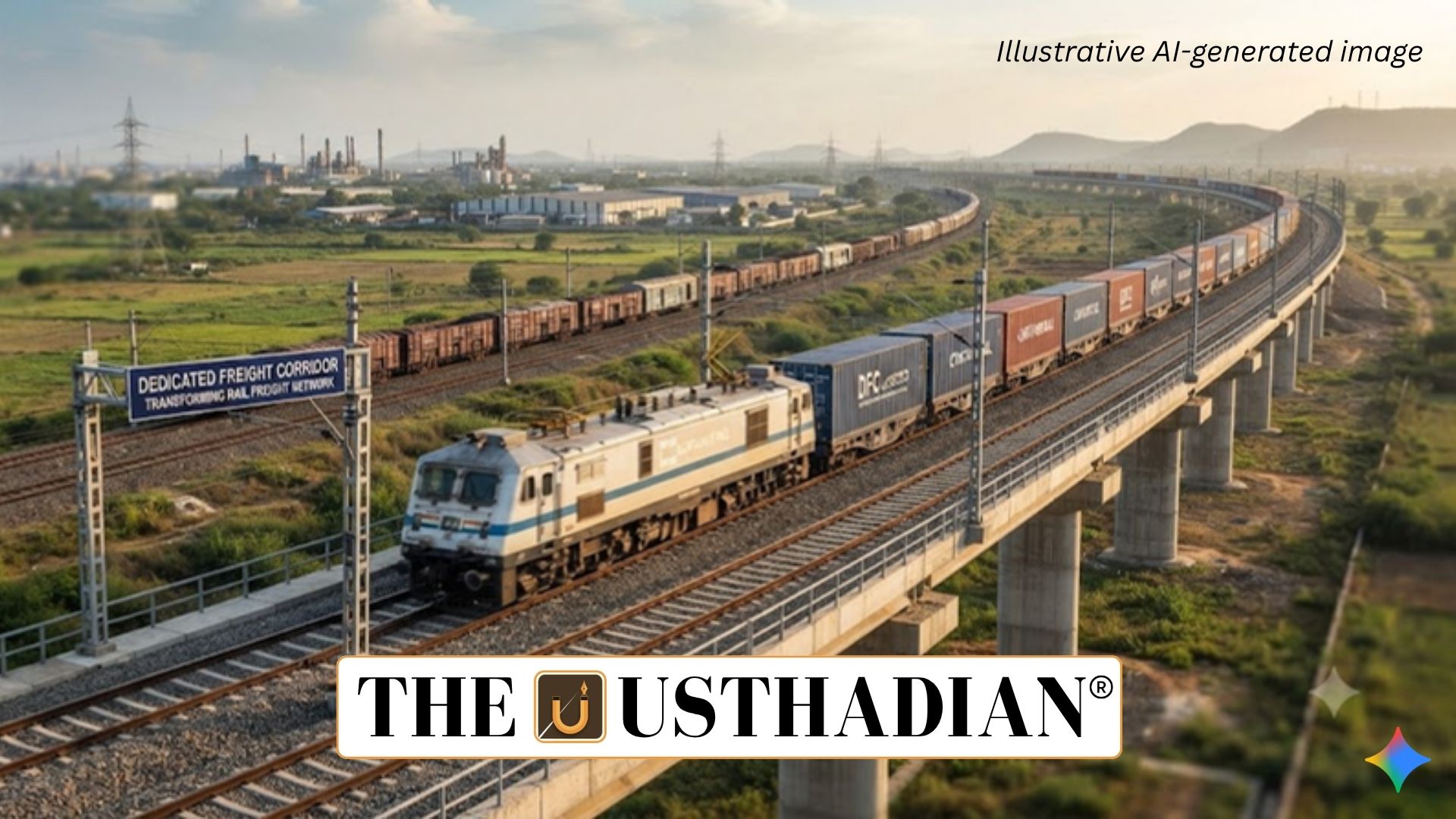
India Expands Dedicated Freight Network
Dedicated Freight Corridors Transform India’s Rail Freight Network: India’s Dedicated Freight Corridor (DFC) network has expanded to 2,843 km, following the commissioning of the final sections of the Western Dedicated Freight Corridor (WDFC).
The completion of the WDFC has strengthened India’s dedicated freight infrastructure and enabled the network to handle around 426 freight trains every day. The corridors are designed to improve freight speeds, reduce transit times and lower logistics costs.
What Are Dedicated Freight Corridors?
Dedicated Freight Corridors are railway routes constructed specifically for goods transportation, separating freight operations from passenger services.
India’s major trunk routes, particularly Howrah–Delhi and Mumbai–Delhi, had experienced severe congestion. Their capacity utilisation had reached approximately 115% to 150%, affecting the movement of freight trains because passenger services generally receive operational priority.
Static GK fact: DFCs separate freight traffic from passenger traffic, allowing goods trains to operate with fewer delays and at higher average speeds.
Origin and Development
The Dedicated Freight Corridor Corporation of India Limited (DFCCIL) was incorporated in 2006 as a special-purpose vehicle for implementing the project.
The initial period involved approvals, route alignment and land acquisition. Large-scale construction, track laying, electrification and commissioning accelerated considerably between 2014 and 2026.
How Were the DFCs Financed?
The project received major debt financing from multilateral institutions.
- World Bank: ₹14,900 crore
- Japan International Cooperation Agency (JICA): ₹38,722 crore
- Remaining requirement: Gross Budgetary Support
This financing supported the development of the country’s large-scale dedicated freight infrastructure.
Western Dedicated Freight Corridor
The WDFC extends for 1,506 km, connecting Jawaharlal Nehru Port Trust (JNPT) in Navi Mumbai with Dadri in Uttar Pradesh, near Delhi.
It primarily carries containers originating from major western ports, including JNPT, Mumbai Port, Pipavav, Mundra and Kandla.
These containers move towards inland destinations such as Tughlakabad, Dadri, Dhandari Kalan and Khatuwas.
The corridor can also transport commodities including:
- Fertilisers
- Foodgrains
- Salt
- Coal
- Iron and steel
- Cement
Eastern Dedicated Freight Corridor
The EDFC covers 1,337 km, connecting Ludhiana in Punjab with Sonnagar in Bihar.
It primarily serves the movement of coal and mineral traffic from eastern India.
The corridor consists of:
- 936-km electrified double-line section between Sonnagar and Dadri
- 401-km electrified single-line section between Ludhiana (Sahnewal) and Khurja
The EDFC was fully commissioned in October 2023.
Its alignment was designed to bypass several densely populated urban centres, reducing interference with existing passenger-oriented railway routes.
Western Corridor Reaches JNPT
The final three sections of the WDFC cover approximately 326 km and were developed at a cost exceeding ₹20,700 crore.
The sections include:
- New Sanand (N)–New Makarpura
- New Umbergaon–New Saphale
- New Saphale–New JNPT
With the Vaitarna (Saphale)–JNPT stretch becoming operational, the WDFC now has direct connectivity with JNPT.
Static GK Tip: Direct port connectivity is particularly important for containerised freight, as it can improve cargo movement between ports and inland logistics centres.
DFCs Deliver Major Speed Gains
One of the clearest benefits of DFC infrastructure is the improvement in freight-train speeds.
Average train speeds on DFCs have exceeded 50 kmph, roughly twice the average speed recorded on the conventional freight network.
Recent recorded figures included:
| Corridor | April | May |
| EDFC | 44.9 kmph | 44.7 kmph |
| WDFC | 53.6 kmph | 52.3 kmph |
Dedicated tracks allow freight trains to avoid many of the delays caused by passenger-train operations.
Why Freight Is Important for Indian Railways
Freight is a major source of revenue for Indian Railways, contributing more than 65% of its total earnings.
This revenue also supports the wider railway system, including the subsidisation of passenger services.
India currently moves approximately 27% of freight traffic by rail. Under the National Rail Plan, the target is to increase rail’s freight share to 45% by 2030, corresponding to around 3,000 million tonnes.
Indian Railways achieved its highest-ever freight loading of approximately 1,670 million tonnes in 2025–26.
Road-Rail Modal Shift
Road and rail networks compete for a substantial share of India’s freight movement.
The National Highways running alongside DFC routes represent only about 0.5% of India’s total road network, yet they carry nearly 40% of total road freight.
Shifting a portion of this traffic from roads to rail can potentially reduce road congestion, fuel consumption, transport costs and emissions.
Third Dedicated Freight Corridor
The government has also announced plans for a third Dedicated Freight Corridor connecting Dankuni in West Bengal with Surat in Gujarat.
A detailed project report is being prepared for the proposed corridor. It would provide an important east-west freight connection, complementing the existing dedicated routes.
Significance of Dedicated Freight Corridors
Lower Logistics Costs
Faster and more predictable freight movement can reduce transportation costs and improve the efficiency of supply chains. This is important because India’s logistics expenditure has historically remained relatively high compared with several comparable economies.
Better Port Connectivity
Connections between major ports and inland logistics hubs can accelerate container movement and improve turnaround times for exporters and importers.
Lower Emissions
Rail generally has a lower carbon intensity per tonne-kilometre than road freight. A greater shift of goods from roads to rail can therefore contribute to India’s efforts to reduce transport-related emissions.
More Capacity for Passenger Trains
Moving freight onto dedicated tracks releases capacity on heavily congested passenger routes. This can allow existing railway lines to accommodate additional passenger services and improve overall network efficiency.
Overall Significance
The expansion of India’s DFC network represents a major change in the country’s freight transportation architecture. By separating goods movement from passenger operations, the system aims to create faster, more reliable and cost-efficient freight transportation.
The completion of the Western Corridor, combined with the fully commissioned Eastern Corridor and plans for another east-west corridor, strengthens India’s long-term strategy for multimodal logistics, industrial growth, port connectivity and sustainable transport.
Static Usthadian Current Affairs Table
Dedicated Freight Corridors Transform India’s Rail Freight Network:
| Fact | Detail |
| Full Form | Dedicated Freight Corridor |
| Total DFC Network | 2,843 km |
| Daily Freight Trains | About 426 |
| Implementing SPV | Dedicated Freight Corridor Corporation of India Limited (DFCCIL) |
| DFCCIL Incorporated | 2006 |
| Western DFC Length | 1,506 km |
| Western DFC Route | JNPT, Maharashtra to Dadri, Uttar Pradesh |
| Eastern DFC Length | 1,337 km |
| Eastern DFC Route | Ludhiana, Punjab to Sonnagar, Bihar |
| EDFC Commissioned | October 2023 |
| WDFC Final Sections | Three sections covering about 326 km |
| Cost of Final WDFC Sections | Over ₹20,700 crore |
| Major Western Port | JNPT |
| WDFC Freight | Mainly containerised cargo and other commodities |
| EDFC Main Freight | Coal and minerals |
| World Bank Financing | ₹14,900 crore |
| JICA Financing | ₹38,722 crore |
| Recent EDFC Speed | Around 44.7–44.9 kmph |
| Recent WDFC Speed | Around 52.3–53.6 kmph |
| Railways Freight Revenue | More than 65% of total earnings |
| Current Rail Freight Share | Around 27% |
| National Rail Plan Target | 45% by 2030 |
| Target Freight Volume | Around 3,000 million tonnes |
| Highest Freight Loading | 1,670 million tonnes in 2025–26 |
| Proposed Third DFC | Dankuni, West Bengal to Surat, Gujarat |
| Major Benefits | Faster transit, lower logistics costs, port connectivity and reduced congestion |
| Environmental Benefit | Potential reduction in fuel use and transport emissions |
| Passenger-Service Benefit | Frees capacity on conventional railway routes |