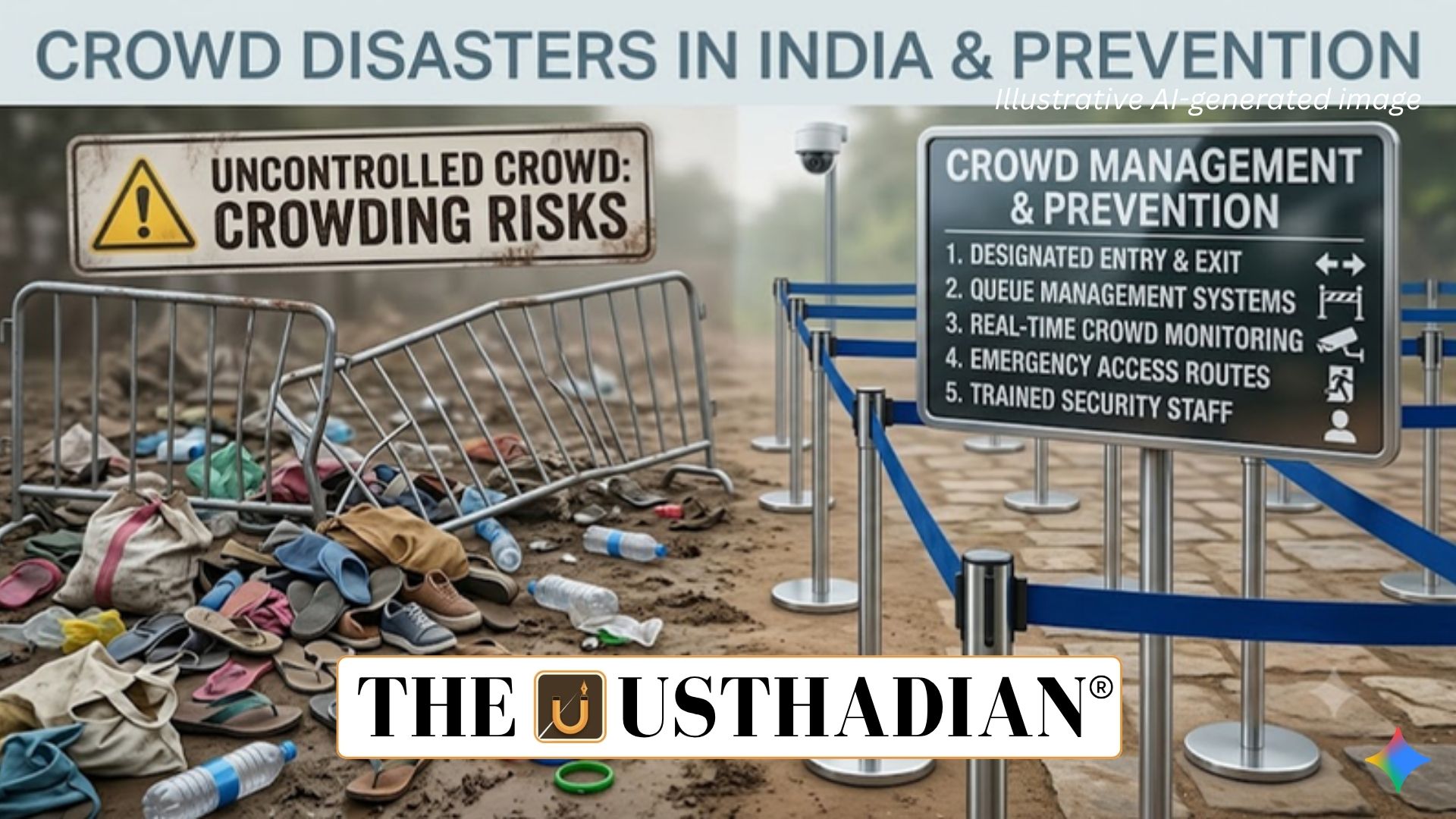
Kolkata Crowd Tragedy Highlights Safety Concerns
Crowd Disasters in India and Prevention Measures: According to the supplied report, a crowd crush at the Chorbagan Sarbojanin Durga Puja pandal in north Kolkata killed 19 people and injured around 25. Heavy rainfall, a large gathering and a possible public-address announcement were reported as potential contributing factors.
The incident has renewed attention on crowd safety at religious festivals and public gatherings. A 2014 report by the National Disaster Management Authority (NDMA) highlighted the recurring risk of crowd disasters at religious places.
Understanding Crowd Crush
The term stampede is commonly used for crowd emergencies, but crowd crush more accurately describes situations in which excessive density prevents people from controlling their movement.
Deaths can occur due to compressive asphyxia, when intense pressure from surrounding people restricts chest movement and breathing. Such incidents may arise from a combination of overcrowding, narrow passages, inadequate barriers, poor lighting and unexpected triggers.
Common triggers include fires, electrical failures, sudden announcements, security scares and abrupt changes in crowd movement.
Static GK fact: The NDMA was established under the Disaster Management Act, 2005, to coordinate disaster management and support preparedness and risk reduction in India.
Factors Behind the Chorbagan Incident
The supplied report identifies several possible contributing factors, including heavy rain, crowd movement towards the pandal and people continuing to move forward after others fell. A public-address announcement may also have intensified the rush.
The report further states that members of the puja committee and private security personnel were detained and a Special Investigation Team (SIT) was formed. These details concern preliminary developments and should not be treated as a final determination of responsibility.
Authorities reportedly asked other crowded pandals to temporarily stop admissions. This illustrates why organisers must monitor crowd density and movement, rather than relying only on estimates of total attendance.
Lessons from Previous Crowd Disasters
Two major historical incidents demonstrate the consequences of inadequate planning.
- Nashik Kumbh, 2003: The supplied report records 29 deaths, associated with barricade pressure, reverse crowd movement and the sharing of pilgrim routes by processions and vehicles.
- Kalubai Yatra, Mandhardevi, Maharashtra, 2005: The report records 293 deaths. An inquiry identified problems including a narrow, steep and slippery approach route, obstructive vendors, inadequate emergency facilities, poor crowd estimates and weak coordination.
These incidents show that crowd disasters generally result from several failures occurring together, rather than from one isolated cause.
NDMA Framework for Crowd Management
Effective crowd management requires matching expected demand with the safe capacity of the venue and its access routes.
- Estimate crowd demand: Assess previous attendance, arrival patterns, event significance and visitor characteristics.
- Identify capacity limits: Examine entrances, exits, staircases, bridges and narrow passages, not merely the overall venue.
- Regulate entry: Use registration, staggered admissions and temporary entry restrictions when demand exceeds safe capacity.
- Design safe movement routes: Provide separate entry and exit points, one-way routes and designated holding areas.
- Improve communication: Use clear announcements, visible signage and coordinated instructions to prevent conflicting crowd movements.
- Ensure emergency readiness: Provide adequate lighting, drinking water, medical assistance, trained volunteers and accessible evacuation routes.
- Monitor density continuously: Stop admissions before congestion becomes dangerous and coordinate decisions among police, organisers, emergency services and local authorities.
Static GK Tip: Crowd management follows a demand–capacity principle: attendance and movement must remain within the safe limits of the venue and its bottlenecks.
Importance of Prevention and Coordination
Crowd behaviour is influenced by surrounding movement and limited information. An announcement intended to warn people can unintentionally trigger simultaneous movement if it is unclear or does not provide safe directions.
Modern crowd management therefore emphasises risk assessment, clear communication, community participation and coordinated emergency planning rather than relying solely on force-based control.
Static Usthadian Current Affairs Table
Crowd Disasters in India and Prevention Measures:
| Fact | Detail |
| Reported Kolkata incident | Chorbagan Sarbojanin Durga Puja pandal |
| Reported casualties | 19 deaths and around 25 injured |
| NDMA | National Disaster Management Authority |
| Legal framework | Disaster Management Act, 2005 |
| Crowd crush | Dangerous pressure and restricted movement in dense crowds |
| Compressive asphyxia | Breathing impairment caused by pressure on the chest |
| Nashik Kumbh incident | 29 deaths reported in 2003 |
| Mandhardevi tragedy | 293 deaths reported in 2005 |
| Core prevention principle | Match crowd demand with safe capacity |
| Essential measures | Entry regulation, clear routes, monitoring and emergency coordination |