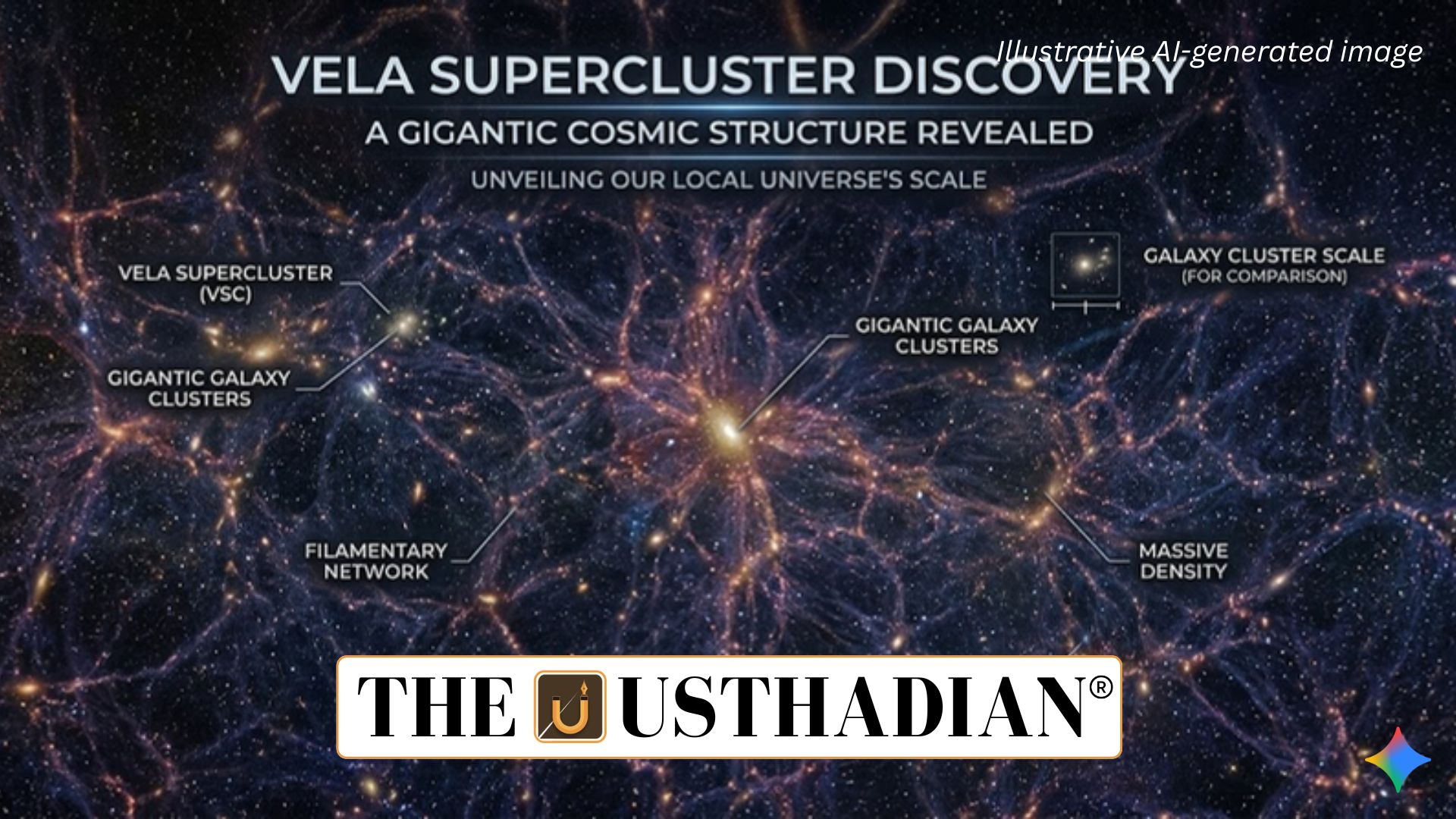
What is Vela Supercluster
Vela Supercluster Discovery: The Vela Supercluster is a massive cosmic structure consisting of at least 20 galaxy clusters, each containing hundreds to thousands of galaxies. These clusters are gravitationally bound, forming a single enormous entity in the universe.
It spans nearly 300 million light-years, making it one of the largest known structures. Scientists recently mapped its full extent for the first time, marking a major breakthrough in astrophysical research.
Static GK fact: A light-year is the distance light travels in one year, approximately 9.46 trillion kilometers.
Location and observation challenge
The supercluster lies about 800 million light-years from Earth. It is located in a region known as the Zone of Avoidance (ZoA), which makes observation extremely difficult.
The ZoA is an area covering nearly 20% of the night sky, obscured by dust and stars of the Milky Way galaxy. This blockage hides distant galaxies from optical telescopes, delaying discoveries like Vela.
Static GK Tip: The Milky Way is a barred spiral galaxy containing over 100 billion stars, including our Sun.
Mass and scale
The Vela Supercluster contains matter equivalent to nearly 30 million billion Suns, highlighting its immense gravitational influence. Its massive scale affects the motion of nearby galaxies and cosmic flows.
Scientists consider it larger and more massive than the Laniakea Supercluster, which includes Earth’s galaxy cluster. This makes Vela one of the most significant large-scale structures in the observable universe.
Scientific importance
Mapping the Vela Supercluster helps scientists understand the large-scale structure of the universe. It provides insights into how galaxies cluster and how gravity shapes cosmic formations.
The discovery also helps explain anomalies in galactic motion and improves models of dark matter distribution. Such studies are essential for understanding the universe’s expansion and evolution.
Static GK fact: Superclusters are among the largest known cosmic structures, forming part of the cosmic web.
Technological advancement in discovery
Advanced techniques like radio astronomy and infrared observation were crucial in detecting Vela despite the ZoA obstruction. These methods can penetrate dust clouds that block visible light.
International collaborations and improved telescopes played a key role in mapping this hidden structure. It showcases the importance of modern space observation technologies.
Way forward
Further studies of the Vela Supercluster will refine knowledge about cosmic evolution and gravitational dynamics. Scientists aim to map more hidden regions beyond the ZoA.
Continued investment in space research and telescope technology will help uncover other unknown structures in the universe, deepening our understanding of cosmic origins.
Static Usthadian Current Affairs Table
Vela Supercluster Discovery:
| Topic | Detail |
| Structure Type | Supercluster of galaxies |
| Number of Clusters | At least 20 galaxy clusters |
| Distance from Earth | Around 800 million light-years |
| Size | About 300 million light-years across |
| Region | Zone of Avoidance |
| Mass | Equivalent to 30 million billion Suns |
| Comparison | More massive than Laniakea |
| Observation Method | Radio and infrared astronomy |