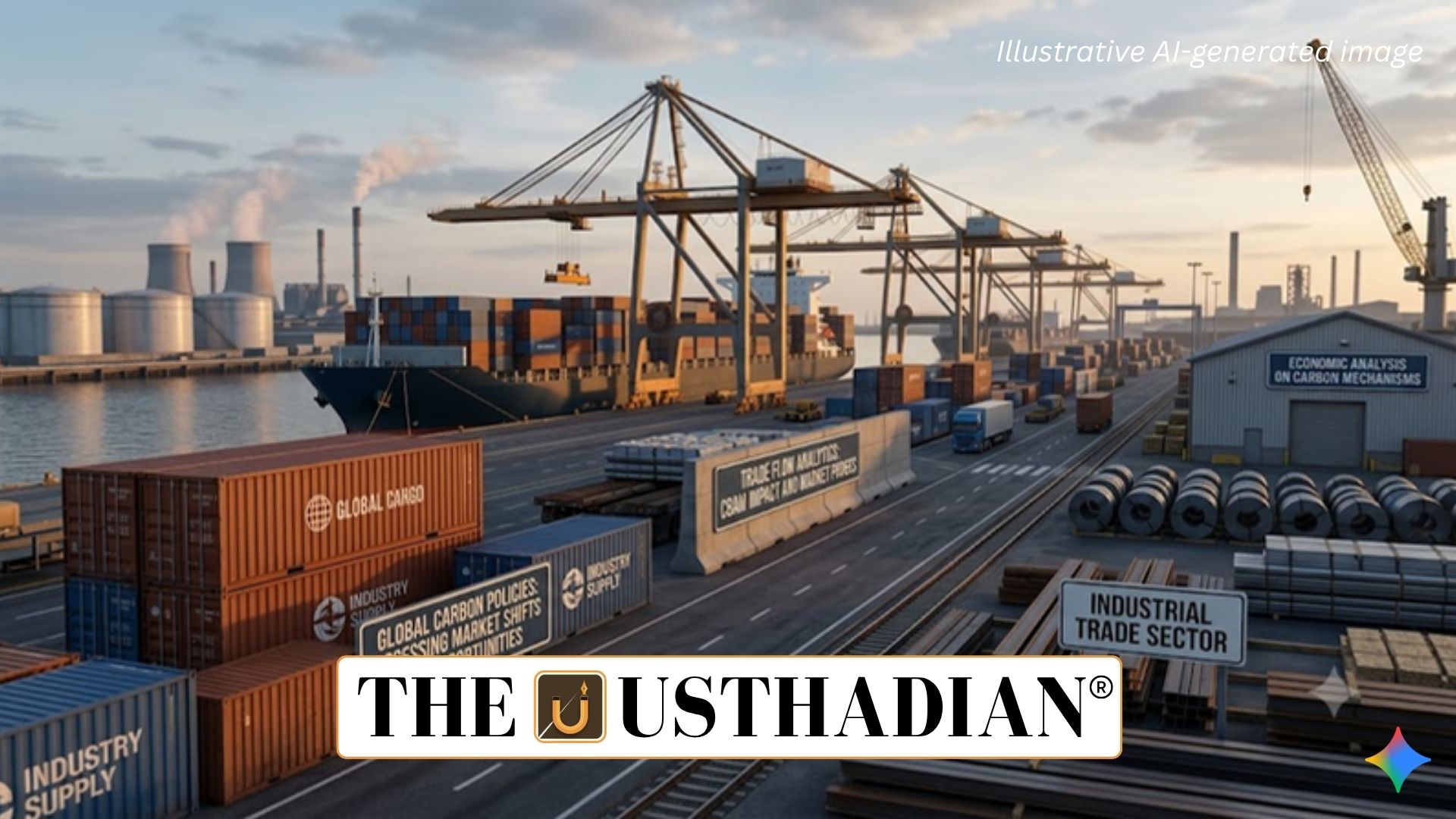
US Challenges the EU’s CBAM Framework
US Probe into EU Carbon Border Tax Could Benefit India: The United States Trade Representative (USTR) has launched an investigation into the European Union’s expanded Carbon Border Adjustment Mechanism (CBAM), raising concerns about its impact on American businesses. The USTR has invited public comments from small businesses until 9 November, according to the supplied report.
The investigation could increase trade tensions between the US and the EU. It may also create an opportunity for India if negotiations lead to greater flexibility in the EU’s carbon-border rules.
Understanding CBAM
CBAM is an EU mechanism designed to address carbon emissions embedded in imported goods. It seeks to align the carbon costs of certain imports with those faced by domestic producers under the EU’s climate policies.
The mechanism covers six sectors:
- Aluminium
- Cement
- Electricity
- Fertilisers
- Hydrogen
- Iron and steel
The US has objected to the EU’s use of default emissions values, which are based on country- and sector-level data. A punitive mark-up may apply when companies use default values rather than submitting verified company-specific emissions data. Verification by an EU-accredited third party can add compliance costs, particularly for smaller businesses.
Static GK fact: The European Union’s CBAM is linked to its broader climate framework, including the EU Emissions Trading System (EU ETS), which places a price on greenhouse gas emissions from covered activities.
How India Could Benefit from the Forward MFN Clause
During negotiations for the India–EU trade deal, India raised concerns about CBAM’s potential impact on its metal exports. According to the supplied material, Indian negotiators secured a forward Most-Favoured-Nation (MFN) clause relating to CBAM flexibility.
Under this arrangement, qualifying concessions granted by the EU to another trading partner could also extend to India, subject to the clause’s terms.
The supplied report also refers to an EU–US joint statement from August in which the European Commission committed to work towards providing additional flexibility in CBAM implementation for US businesses. If the ongoing investigation leads to further concessions covered by India’s clause, Indian exporters could benefit without separate negotiations.
However, the actual benefit would depend on the outcome of the US investigation and the precise scope of the agreed provisions.
Potential Impact on Indian Exports
The Global Trade Research Initiative (GTRI) has estimated that CBAM could impose a cost equivalent to 20–35% of the value of selected Indian exports, particularly iron, steel and aluminium, according to the supplied report.
The impact could be significant because Indian steelmakers often rely on the blast furnace–basic oxygen furnace (BF–BOF) route, which generally produces higher emissions than alternative production methods.
| Steelmaking route | Relative emissions |
| Blast furnace–basic oxygen furnace (BF–BOF) | Generally highest |
| Gas-based direct reduced iron (DRI) | Generally lower |
| Scrap-based electric arc furnace (EAF) | Generally lowest |
Actual emissions vary with technology, energy sources, raw materials and operating conditions.
Scrap Availability and India’s Green Steel Transition
India’s Green Steel Initiative aims to encourage lower-emission steel production, including greater use of scrap-based electric arc furnaces. However, scrap availability remains a major constraint.
A May 2025 report by the Indian Council for Research on International Economic Relations (ICRIER) cited in the supplied material states that scrap accounts for around 20% of India’s steelmaking feedstock, while domestic availability is approximately 25 million metric tonnes annually.
Limited scrap supply could slow the shift towards lower-emission production. Improving collection, recycling, processing and access to suitable scrap will therefore be important alongside investment in cleaner technologies.
Static GK Tip: The electric arc furnace melts scrap or other suitable metallic feedstock using electricity. Its emissions advantage depends partly on the electricity source and the materials used.
Way Forward
India should use any CBAM flexibility available under the trade agreement while strengthening its long-term industrial response. Priorities include expanding scrap collection, improving emissions measurement and verification, investing in cleaner steelmaking and supporting exporters with compliance costs.
The potential benefit from the US probe is a short-term opportunity. Sustained competitiveness will depend on reducing industrial emissions and developing a reliable domestic supply of recyclable steel.
Static Usthadian Current Affairs Table
US Probe into EU Carbon Border Tax Could Benefit India:
| Fact | Detail |
| CBAM | Carbon Border Adjustment Mechanism |
| Implementing bloc | European Union |
| US investigating authority | US Trade Representative |
| Sectors covered | Aluminium, cement, electricity, fertilisers, hydrogen, iron and steel |
| Potential Indian export cost | 20–35% for selected exports, as estimated by GTRI |
| Relevant trade provision | Forward MFN clause |
| ICRIER report cited | May 2025 |
| India’s reported domestic steel scrap availability | Around 25 million metric tonnes annually |
| Lower-emission steelmaking route | Scrap-based electric arc furnace, depending on energy and feedstock |
| Long-term priority | Cleaner steel production and improved scrap availability |