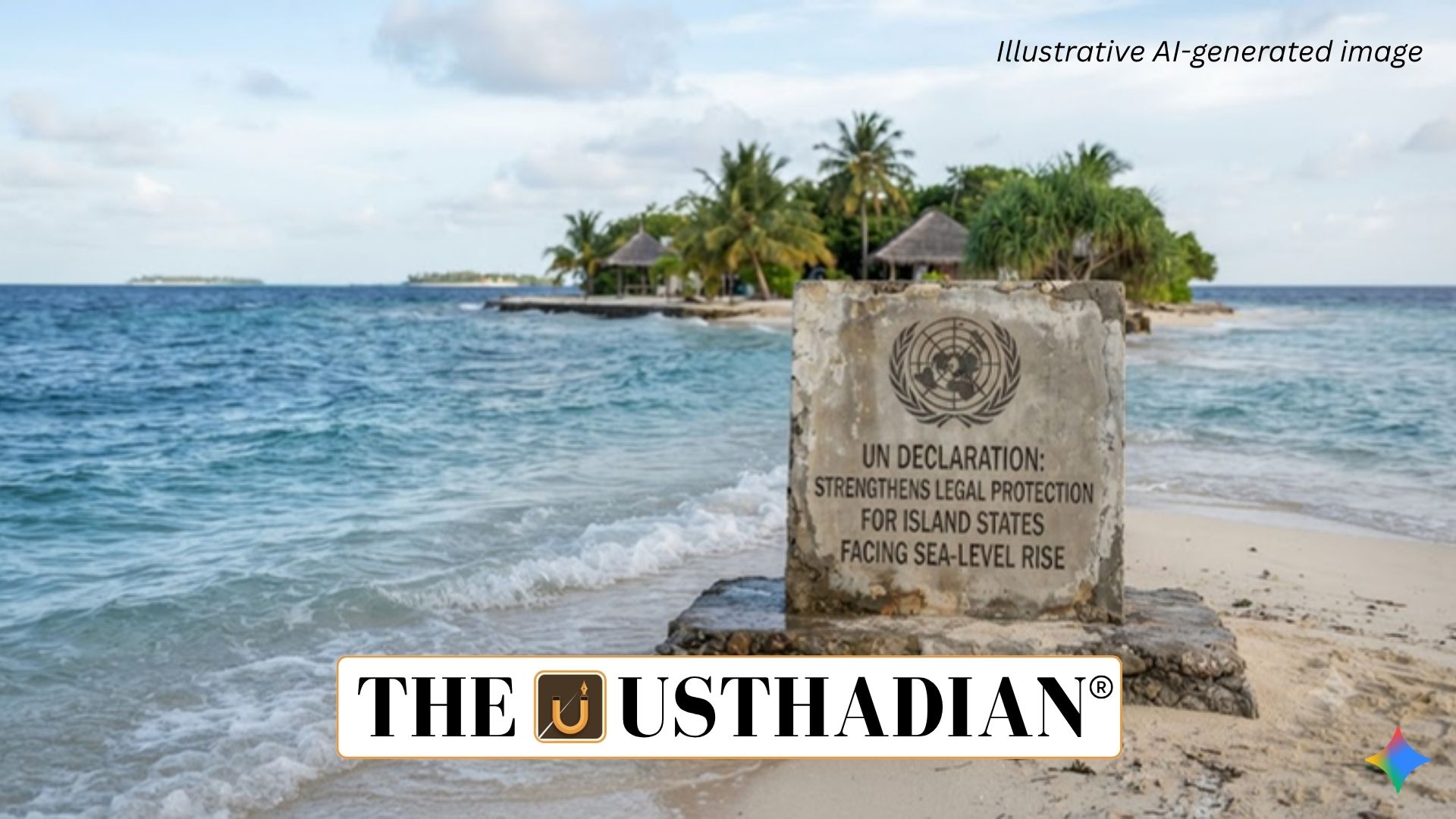
UN Adopts Landmark Sea-Level Rise Declaration
UN Declaration Strengthens Legal Protection for Island States Facing Sea-Level Rise: The United Nations General Assembly adopted its first Political Declaration on sea-level rise during a high-level meeting in New York on 24 September 2026. The declaration addresses the legal, environmental, economic and humanitarian consequences of rising seas, with particular attention to Small Island Developing States (SIDS) and other low-lying countries.
The document links sea-level rise with questions of statehood, sovereignty, maritime rights, development, human security and climate finance. It provides a common political framework for strengthening international cooperation on these interconnected challenges.
Continuity of Statehood
A major element of the declaration is its recognition of the need to preserve the continuity of statehood and sovereignty of countries threatened by sea-level rise.
For vulnerable island nations, rising waters can cause land loss and make portions of territory difficult or impossible to inhabit. The declaration supports the presumption that a state’s legal identity and UN membership should not automatically disappear because climate change alters its physical territory.
This issue is particularly significant for Pacific island countries and other SIDS facing coastal erosion, flooding and potential displacement.
Static GK fact: Small Island Developing States (SIDS) are a distinct group of developing countries that face particular economic, environmental and climate-related vulnerabilities because of their small size, geographic isolation and exposure to natural hazards.
Maritime Zones Under UNCLOS
The declaration also addresses the stability of maritime zones in the context of rising sea levels. It supports legal certainty concerning maritime entitlements established under the United Nations Convention on the Law of the Sea (UNCLOS).
Maritime zones determine the rights and jurisdiction of coastal states over different areas of the sea and their resources. Maintaining stability is especially important for island nations whose physical coastlines may change because of climate-related impacts.
The approach is connected with wider developments in international law, including the 2025 International Court of Justice advisory opinion on climate change obligations.
Static GK Tip: UNCLOS was adopted in 1982 and establishes a comprehensive legal framework governing the world’s oceans, including territorial seas, exclusive economic zones and continental shelves.
Risks Faced by Coastal Communities
Sea-level rise creates multiple interconnected risks for vulnerable countries and populations. These include:
- Coastal flooding and erosion
- Loss of land and infrastructure
- Saltwater intrusion into freshwater resources
- Damage to agriculture and livelihoods
- Population displacement
- Threats to cultural heritage
- Uncertainty surrounding maritime claims
The UN meeting emphasized that sea-level rise is not only an environmental issue but also a development, humanitarian, economic and security concern. According to the declaration’s discussion, hundreds of millions of people live in low-lying coastal areas exposed to increasing climate risks.
Adaptation and Climate Finance
The declaration calls for stronger international cooperation on adaptation and resilience. Key priorities include multi-hazard early-warning systems, climate-risk assessments, resilient infrastructure, coastal protection and scientific cooperation.
It also emphasizes improved access to climate finance, particularly for developing countries, SIDS and Least Developed Countries (LDCs). Nature-based approaches such as mangrove restoration, seagrass conservation and other coastal ecosystems can complement engineered coastal protection.
SIDS and International Climate Diplomacy
Small Island Developing States have played an important role in bringing the legal consequences of sea-level rise into international discussions. Earlier initiatives included Pacific regional declarations concerning maritime zones and continuity of statehood.
The Alliance of Small Island States (AOSIS) has also consistently highlighted the implications of sea-level rise for sovereignty, maritime rights, human mobility and climate justice.
The 2026 declaration therefore represents a significant political development connecting climate science, international law and the long-term interests of vulnerable island nations.
Static Usthadian Current Affairs Table
UN Declaration Strengthens Legal Protection for Island States Facing Sea-Level Rise:
| Fact | Detail |
| Declaration | UN Political Declaration on Sea-Level Rise |
| Date | 24 September 2026 |
| Venue | New York |
| Adopting Body | United Nations General Assembly |
| Key Legal Issue | Continuity of statehood and sovereignty |
| Maritime Framework | UNCLOS |
| Major Beneficiaries | SIDS and other low-lying vulnerable states |
| Major Risks | Flooding, erosion, salinization and displacement |
| Adaptation Measures | Early warnings, coastal defence and resilient infrastructure |
| Nature-Based Solutions | Mangroves, seagrass and other coastal ecosystems |
| Climate Finance | Greater access for developing countries |
| Important Group | Alliance of Small Island States (AOSIS) |
| Related Legal Development | 2025 ICJ advisory opinion on climate change obligations |