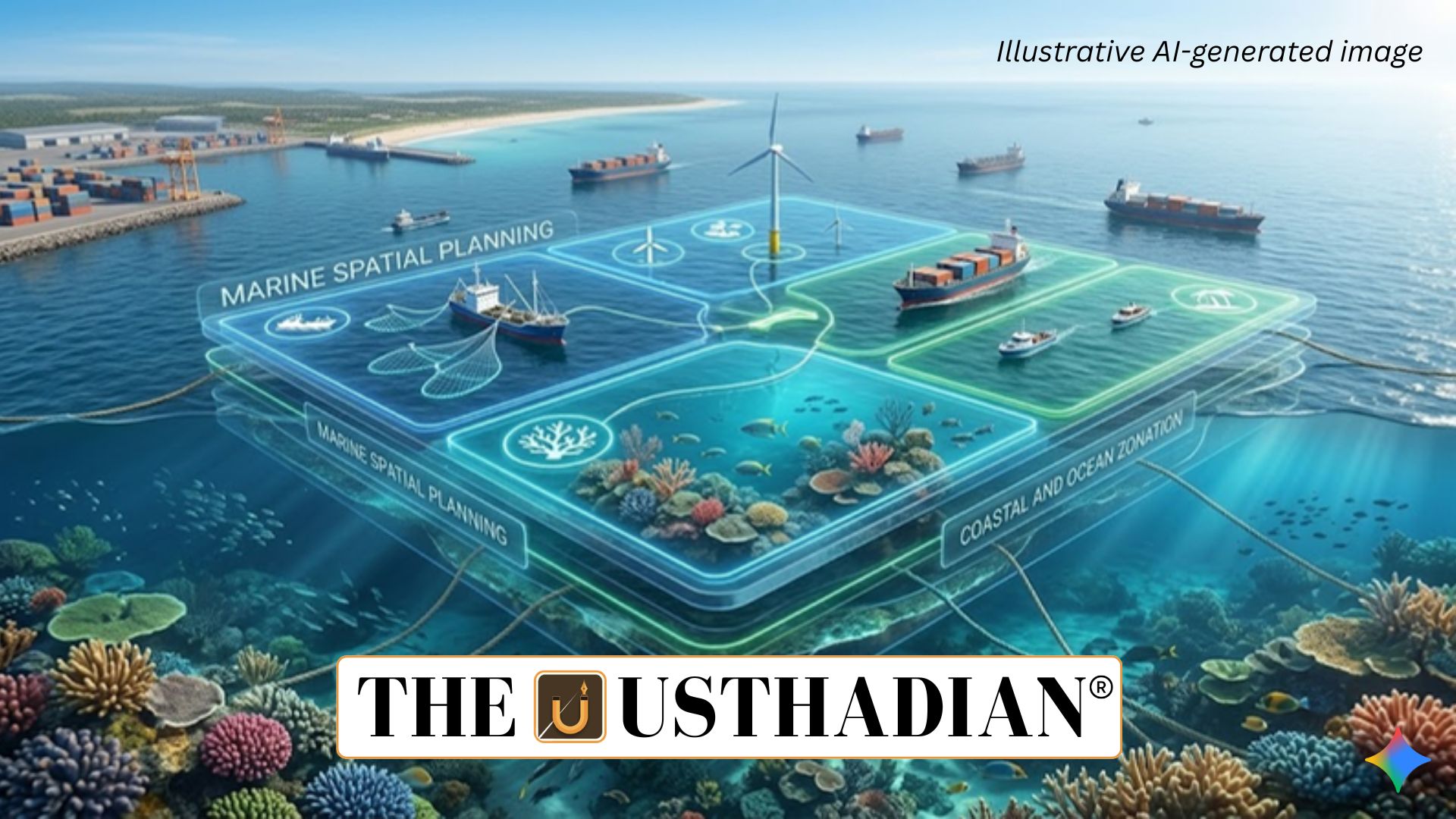
Odisha leads Marine Planning
Marine Spatial Planning in India: Odisha has become the first Indian state to officially launch Marine Spatial Planning (MSP). It signed a Memorandum of Understanding (MoU) with the National Centre for Coastal Research (NCCR) under the Ministry of Earth Sciences.
This move marks a shift towards scientific ocean governance. Earlier, MSP was implemented in Puducherry and Lakshadweep under the Indo-Norway Integrated Ocean Initiative (2019).
Static GK fact: Odisha has a coastline of about 480 km along the Bay of Bengal.
What is Marine Spatial Planning
Marine Spatial Planning (MSP) is a structured public process that analyses and allocates marine space. It balances ecological, economic, and social objectives in ocean areas.
It helps in organizing human activities such as fishing, shipping, tourism, and energy generation. The aim is to reduce conflicts and ensure sustainable use of marine resources.
Static GK Tip: The Bay of Bengal is the largest bay in the world and supports rich biodiversity.
Importance for Blue Economy
MSP plays a key role in promoting the Blue Economy, which focuses on sustainable ocean-based development. It ensures optimal utilization of marine resources without degrading ecosystems.
By allocating specific zones for activities like offshore wind energy and fisheries, MSP improves efficiency. It also attracts investment by providing clarity in marine resource use.
Policy and Planning Benefits
MSP supports evidence-based policymaking in coastal and marine sectors. It helps governments identify suitable zones for projects like deep sea mining and renewable energy.
At the same time, it prevents ecological damage by avoiding sensitive marine habitats. This reduces conflicts between development and environmental conservation.
Static GK fact: India’s Exclusive Economic Zone (EEZ) extends up to 200 nautical miles from its coastline.
Climate Resilience and Sustainability
MSP strengthens climate resilience by promoting integrated ocean management. It helps in adapting to rising sea levels, coastal erosion, and extreme weather events.
Sustainable marine planning ensures long-term ecological balance. It also protects livelihoods dependent on coastal ecosystems.
Global Support and Framework
The Intergovernmental Oceanographic Commission (IOC) of UNESCO provides guidelines for MSP implementation. It supports countries in developing scientific and governance frameworks.
India’s adoption of MSP reflects its commitment to global ocean sustainability goals. It aligns with international efforts for responsible marine resource management.
Static Usthadian Current Affairs Table
Marine Spatial Planning in India:
| Topic | Detail |
| Marine Spatial Planning | Scientific allocation of marine space for sustainable use |
| First State Initiative | Odisha launched MSP in India |
| Implementing Agency | National Centre for Coastal Research |
| Earlier Implementation | Puducherry and Lakshadweep under Indo-Norway Initiative |
| Key Objective | Balance ecological, economic, and social goals |
| Blue Economy Role | Promotes sustainable marine resource utilization |
| Policy Use | Supports offshore energy and deep sea mining planning |
| Climate Role | Enhances resilience against coastal and marine risks |
| Global Body | UNESCO’s Intergovernmental Oceanographic Commission |