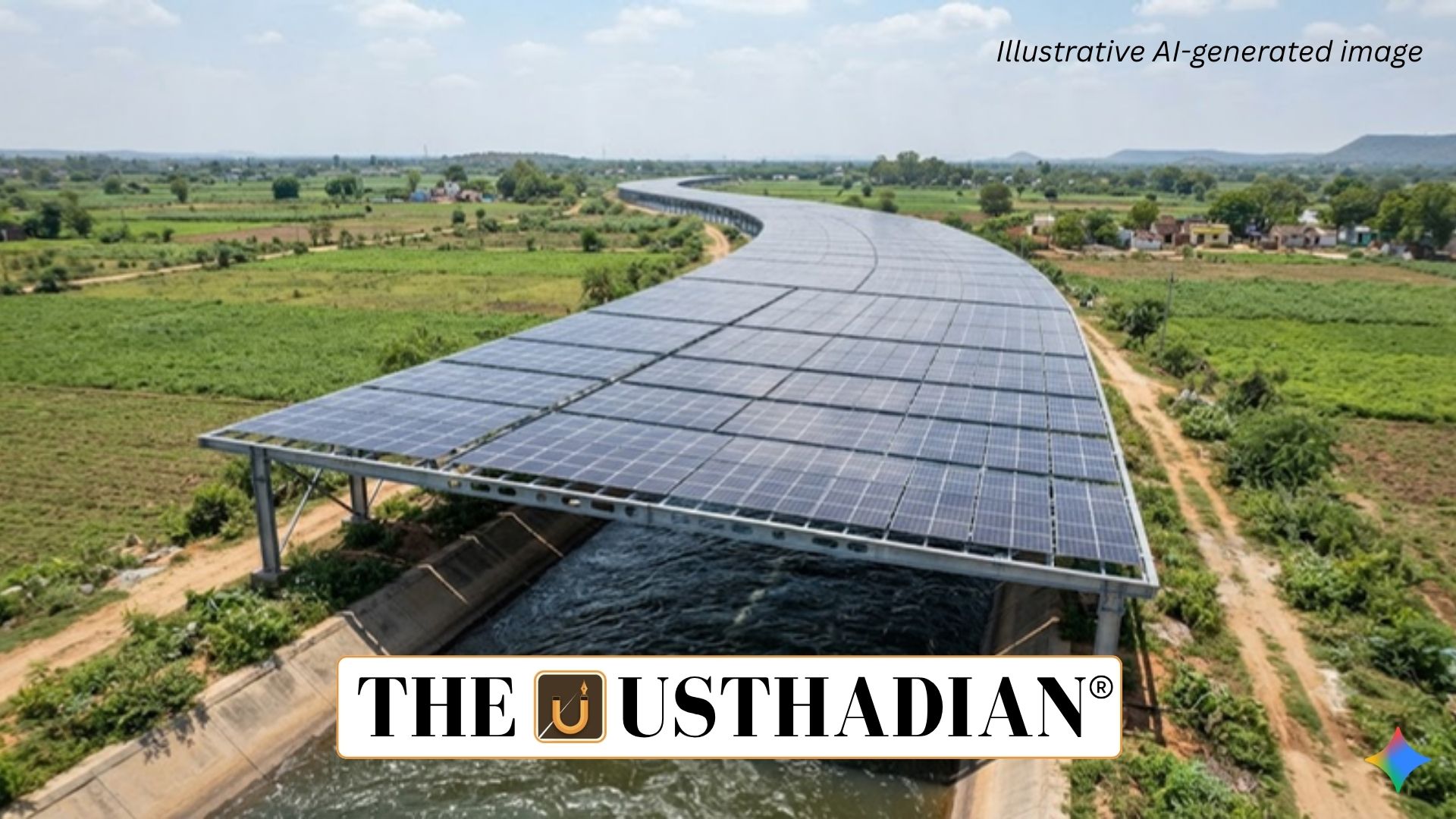
What Is Canal Top Photovoltaics
Canal Top Solar Projects Expand India’s Renewable Energy Options: Canal-Top Photovoltaics (CTPV) involves installing solar panels on specially designed structures positioned above irrigation canals. Unlike floating solar projects, where panels are mounted on platforms placed directly on water, CTPV systems remain elevated above the canal.
The structures can span the canal or be positioned along its banks depending on canal width, orientation and engineering requirements. Their design must maintain uninterrupted water movement while providing a suitable surface for solar generation.
Dual Benefits of CTPV
The major advantage of CTPV is its ability to produce renewable electricity without requiring large additional areas of land. In Punjab, a 20-MW canal-top project has been estimated to save nearly 100 acres of land.
Covering canal stretches with solar panels can also reduce direct exposure of water to sunlight and thereby lower evaporation losses. This is particularly relevant for water-stressed regions where irrigation water conservation is important.
Water beneath the panels can additionally provide a cooling effect that may support better solar-panel performance during periods of high temperature.
Static GK fact: Photovoltaic technology converts sunlight directly into electricity through semiconductor-based solar cells.
India’s Early CTPV Projects
India has experimented with canal-top solar projects for more than a decade. A 1-MW system over the Narmada Canal in Mehsana, Gujarat, commissioned in 2012, is an early example.
The project has been reported to generate around 1.6 million units of electricity annually while saving nearly 9 million litres of water each year.
Subsequently, two 10-MW systems were commissioned in Vadodara, Gujarat, during 2014–17, while around 20 MW was installed across Punjab during 2017–18.
In September 2025, the Punjab Energy Development Agency invited expressions of interest for 40 MW of canal-top photovoltaic projects across the state’s extensive canal network. Haryana has also explored CTPV installations on selected irrigation canals.
Policy Support
The Ministry of New and Renewable Energy (MNRE) introduced a pilot-cum-demonstration scheme for grid-connected CTPV and canal-bank projects in 2014.
The scheme envisaged 50 MW each for canal-top and canal-bank projects. Financial assistance was capped at ₹3 crore per MW for CTPV and ₹1.5 crore per MW for canal-bank projects, or 30% of project cost, whichever was lower.
Static GK Tip: MNRE is the Union ministry responsible for promoting renewable-energy development and deployment in India.
India’s Large Potential
A 2024 assessment involving the Center for Study of Science, Technology and Policy estimated India’s combined canal-top and canal-bank solar potential at around 131 GW.
The assessment considered factors such as solar irradiation, canal characteristics, proximity to substations and protected areas. The states identified with the highest potential included Uttar Pradesh, Bihar, Karnataka, Andhra Pradesh and Punjab.
Why CTPV Has Not Scaled
Despite its potential, CTPV remains a niche technology. The principal challenge is higher project cost, as elevated structures require additional steel, foundations and specialised engineering.
Maintenance is also more difficult because panels are positioned above operational canals. The winding and linear nature of canal networks can further complicate project design, grid connectivity and electricity transmission.
The Way Forward
The PM Surya Sarovar Yojana, with a reported target of 5,000 MW of floating solar capacity, reflects growing interest in solar generation on water bodies. Similar policy attention could support canal-top projects.
Scaling CTPV will require appropriate site selection, standardised technical specifications, streamlined approvals, affordable finance and coordination between renewable-energy and irrigation agencies.
CTPV is unlikely to replace conventional ground-mounted or rooftop solar. However, using existing canal infrastructure for electricity generation can expand renewable capacity while simultaneously conserving land and reducing water losses.
Static Usthadian Current Affairs Table
Canal Top Solar Projects Expand India’s Renewable Energy Options:
| Fact | Detail |
| Technology | Canal-Top Photovoltaics |
| Main purpose | Solar electricity generation over canals |
| Major advantage | Saves land and reduces evaporation |
| Early Indian project | Narmada Canal, Mehsana, Gujarat |
| Early project year | 2012 |
| Example capacity | 1 MW |
| Reported annual generation | 1.6 million units |
| Reported annual water saving | Nearly 9 million litres |
| MNRE pilot scheme | 2014 |
| Combined estimated potential | Around 131 GW |
| High-potential states | Uttar Pradesh, Bihar, Karnataka, Andhra Pradesh and Punjab |
| Major constraint | High infrastructure and maintenance cost |
| Related scheme | PM Surya Sarovar Yojana |