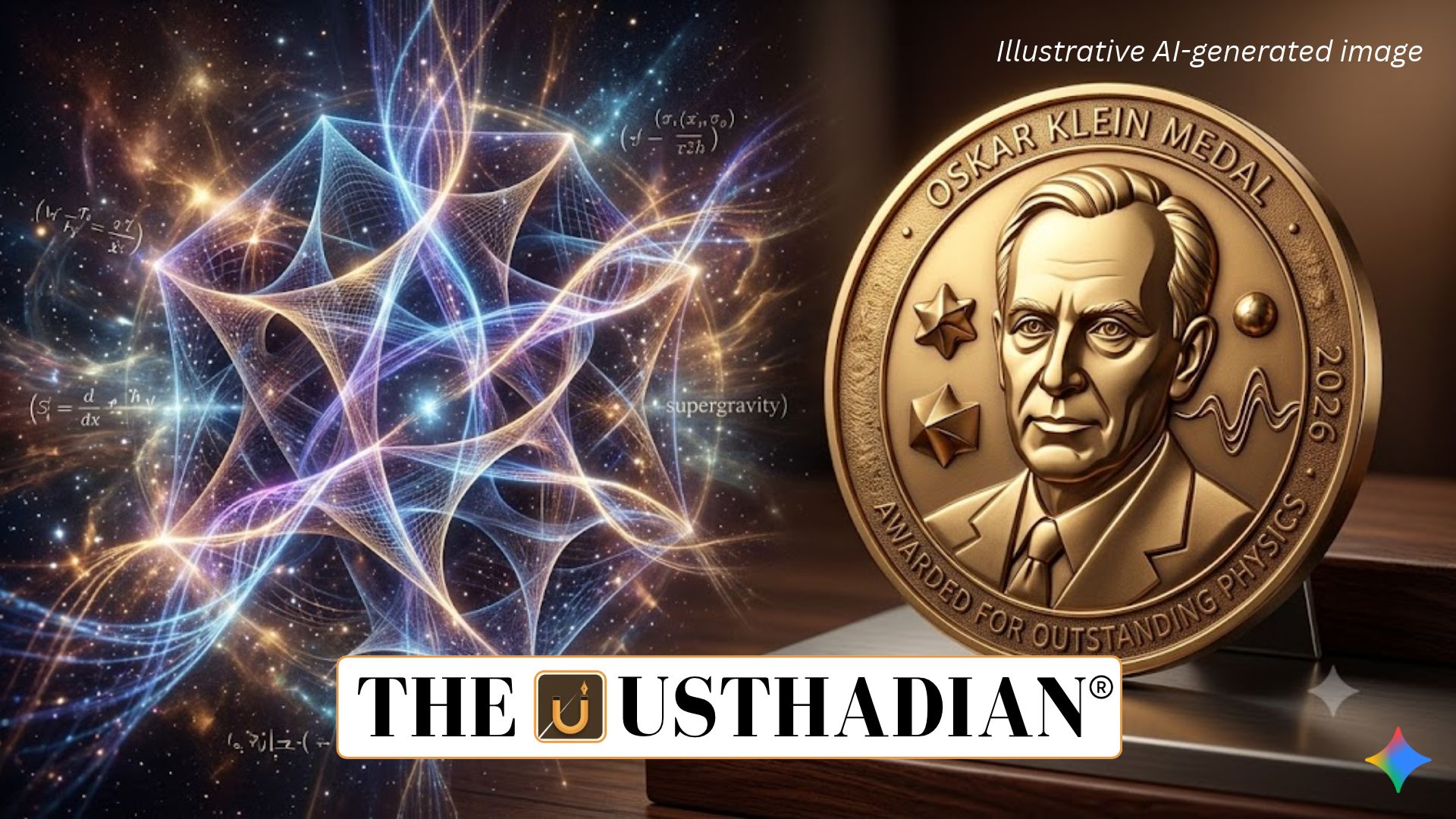
Ashoke Sen Receives Oskar Klein Medal
Ashoke Sen Wins Oskar Klein Medal 2026 for Contributions to String Theory: According to the supplied report, Indian theoretical physicist Ashoke Sen received the Oskar Klein Medal 2026 in recognition of his contributions to string theory and theoretical physics. He is described in the report as the first Indian physicist to receive this honour.
Sen serves as the ICTS-Infosys Madhava Chair Professor at the International Centre for Theoretical Sciences (ICTS) in Bengaluru. His research has contributed to understanding the mathematical and physical foundations of string theory, particularly through work on duality, black-hole entropy and string field theory.
About the Oskar Klein Medal
The Oskar Klein Medal is an international physics award named after Oskar Klein, a Swedish theoretical physicist known for his contributions to quantum physics and theoretical physics. The award recognises distinguished contributions to the field and is associated with the Oskar Klein Memorial Lecture.
According to the supplied report, the 2026 lecture was delivered by Ashoke Sen on 22 October 2026 at Stockholm University’s AlbaNova Centre. Its title was “Gravity from Strings and Strings from Gravity.”
The report lists prominent past awardees, including Hans Bethe, Steven Weinberg and Chen-Ning Yang, all of whom made major contributions to modern physics.
Ashoke Sen’s Major Contributions to Physics
String theory: String theory is a theoretical framework that describes fundamental constituents of nature as tiny vibrating strings rather than point-like particles. It seeks to provide a consistent description of fundamental interactions, including gravity.
S-duality: Sen’s research helped establish important aspects of S-duality, a relationship connecting descriptions of certain physical systems at weak and strong coupling. This allows physicists to investigate difficult problems using an alternative mathematical description.
Black-hole entropy: Black-hole entropy relates to the number of microscopic quantum states compatible with a black hole’s macroscopic properties. Sen’s work contributed to counting such states in specific theoretical models, helping connect gravity, quantum mechanics and statistical physics.
String field theory: This formulation describes string interactions using field-theoretic methods. Sen’s contributions have advanced the mathematical understanding of string dynamics and interactions.
Static GK fact: String theory is a research framework in theoretical physics; it should not be confused with an experimentally established, complete theory of all fundamental interactions.
Major Awards and Honours
Ashoke Sen has received several national and international honours for his work in theoretical physics.
- 1989: ICTP Prize
- 1994: Shanti Swarup Bhatnagar Prize
- 1998: Fellowship of the Royal Society
- 2001: Padma Shri
- 2009: Infosys Prize in Mathematical Sciences
- 2012: Breakthrough Prize in Fundamental Physics
- 2013: Padma Bhushan
- 2014: Dirac Medal
- 2026: Oskar Klein Medal, according to the supplied report
These recognitions reflect the international significance of his research in string theory and related areas of mathematical physics.
Significance for Indian Science
Sen’s reported recognition highlights the contribution of Indian scientists to advanced theoretical research. His work demonstrates how mathematical methods can help investigate fundamental questions about gravity, quantum states and the structure of the universe.
The award also draws attention to the role of research institutions such as ICTS Bengaluru in supporting theoretical physics and internationally recognised scientific work.
Static Usthadian Current Affairs Table
Ashoke Sen Wins Oskar Klein Medal 2026 for Contributions to String Theory:
| Fact | Detail |
| Scientist | Ashoke Sen |
| Field | Theoretical physics |
| Reported award | Oskar Klein Medal 2026 |
| Award named after | Oskar Klein |
| Research institution | ICTS, Bengaluru |
| Major research areas | String theory, S-duality and black-hole entropy |
| 2026 lecture date | 22 October 2026, according to the supplied report |
| Lecture title | Gravity from Strings and Strings from Gravity |
| Padma Shri | 2001 |
| Padma Bhushan | 2013 |
| Dirac Medal | 2014 |