Fire Damages Historic Koder House
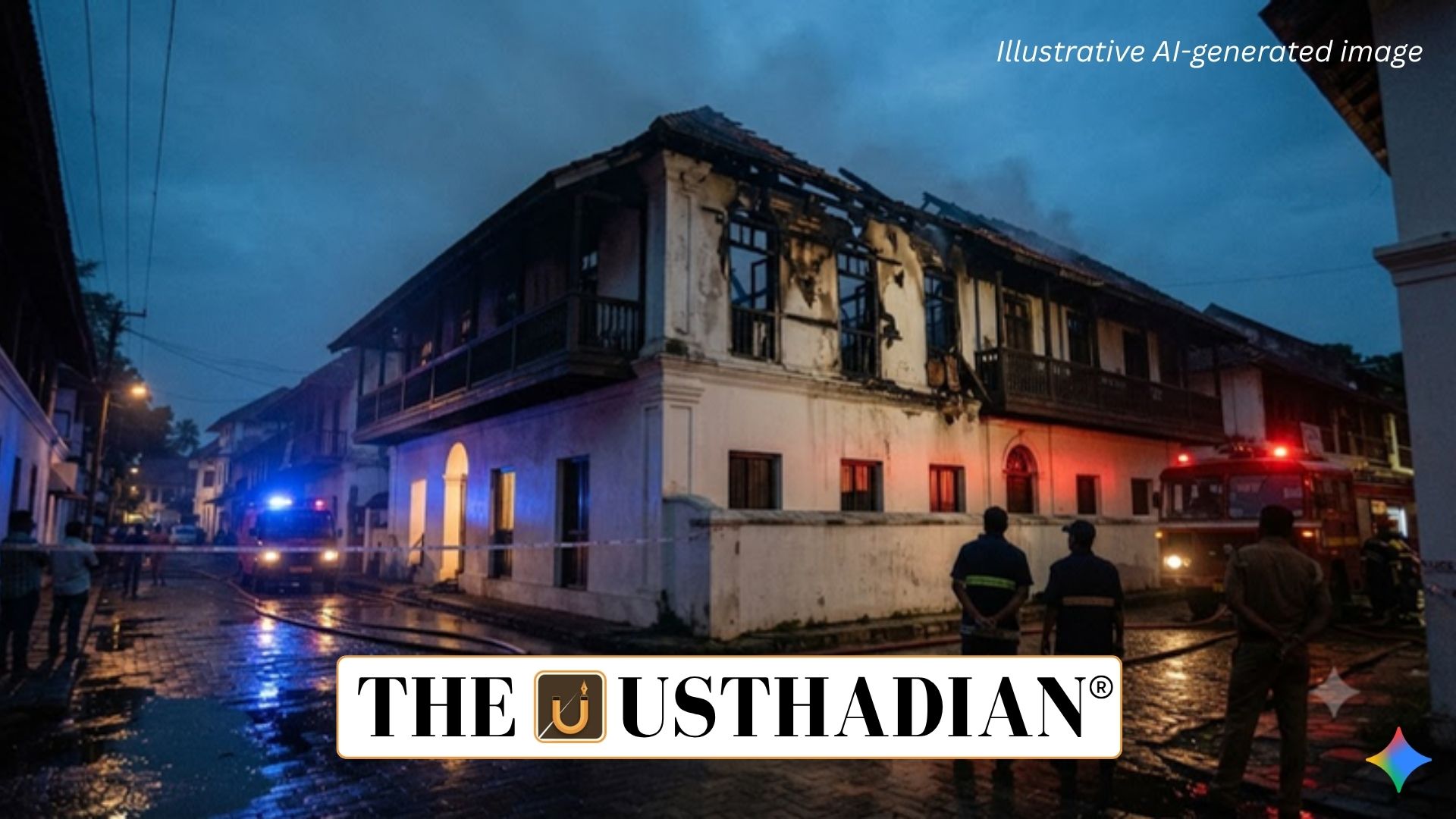
Koder House Fire Threatens Fort Kochi’s Jewish Heritage: The historic Koder House in Fort Kochi, Kerala, suffered extensive damage in a major fire. The building, which had been functioning as a heritage luxury hotel, lost much of its upper-floor structure and several historically valuable interiors.
The fire particularly damaged the top floor, including its old roof and columns. Photographs, paintings, furniture and tapestries associated with the Koder family were also destroyed.
A Building With Dutch Period Links
The exact construction date of Koder House remains uncertain because reliable historical documentation is limited. Heritage experts generally consider the structure to be at least two centuries old, while some assessments suggest that elements of the building may reflect around three centuries of history.
Contrary to an earlier description on the hotel’s website, heritage specialists have associated the original structure with the Dutch period of Kochi, rather than the Portuguese period. The Dutch controlled Kochi from 1663 to 1795.
Static GK fact: The Dutch captured Kochi from the Portuguese in 1663. Kochi subsequently came under British control in 1795, with a brief French occupation in 1795–96.
The Koder Family of Fort Kochi
The property was later acquired and renovated by SS Koder, a prominent member of the Koder family. The family became an influential commercial and civic presence in Fort Kochi.
Members of the family were involved in trade and municipal affairs. Samuel Koder served as the Cochin princely state’s Honorary Consul to the Netherlands and later held the position of municipal chairman of Fort Kochi.
The Koders also played a role in the development of electricity in the region through the Cochin Electric Company, which generated electricity using coal and supplied power to parts of Fort Kochi and Mattancherry.
Jewish Heritage and the Mikvah
The Koder family is associated with the Paradesi Jewish community of Kochi, although historians differ on the family’s precise geographic origins. Some accounts connect the family with Jewish migration from Europe, while others trace its roots to West Asia.
A particularly important feature of the property is its rear guest house, which is connected to the main building by a wooden bridge. The guest house contains a courtyard with a small Mikvah, a Jewish ritual bath.
Static GK Tip: A Mikvah is a Jewish ritual immersion facility used for religious purification. Its presence gives the Koder House complex importance beyond its architectural value.
What Survived the Fire
According to the reported fire-service assessment, the flames were contained before spreading to the historic guest house, Mikvah and connecting wooden bridge. This means that important elements of the complex’s architectural and religious heritage remain intact.
However, the destruction of the upper-floor roof, columns and historical interiors represents a substantial loss. Family photographs and paintings provided visual records of the Koder family’s history, while imported furniture and tapestries reflected the family’s international commercial connections.
Significance for Heritage Conservation
Koder House illustrates the layered history of Fort Kochi, where European colonial influences, Indian communities and the long-standing Jewish presence developed alongside one another.
The incident also highlights the vulnerability of privately held heritage buildings. Preserving such properties requires documentation, fire-safety preparedness, structural conservation and careful restoration so that surviving architectural and cultural elements are not lost.
Static GK fact: Fort Kochi is part of the historic Kochi urban landscape known for its Portuguese, Dutch, British, Indian and Jewish cultural influences.
Static Usthadian Current Affairs Table
Koder House Fire Threatens Fort Kochi’s Jewish Heritage:
| Fact | Detail |
| Heritage site | Koder House |
| Location | Fort Kochi, Kerala |
| Fire damage | Mainly top floor of the main building |
| Major losses | Roof, columns, photographs, paintings and furnishings |
| Historic association | Dutch period of Kochi |
| Dutch control of Kochi | 1663–1795 |
| Associated family | Koder family |
| Community connection | Paradesi Jewish heritage |
| Guest house | Survived the fire |
| Mikvah | Survived the fire |
| Mikvah significance | Jewish ritual bath |
| Electricity connection | Cochin Electric Company |
| Heritage significance | Colonial, Jewish and commercial history of Fort Kochi |