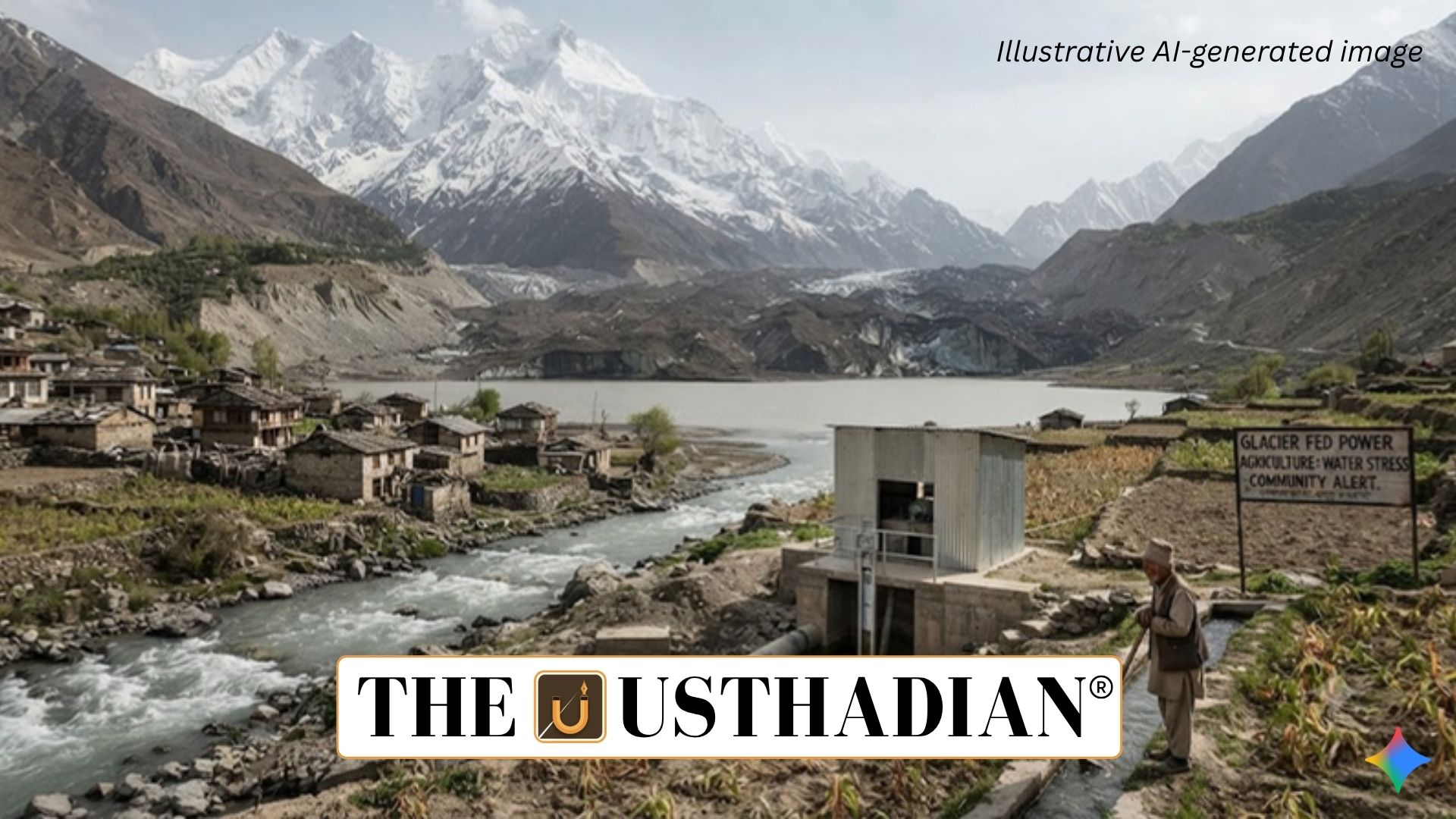
Himalayas and India’s Economy
Himalayan Glaciers Become a Growing Economic Security Concern: The Himalayas are not only a major ecological system but also an important foundation of India’s economy. A recent report estimates that economic activity worth ₹64.8 lakh crore, equivalent to 21.5% of India’s FY24 GDP, depends on the Himalayan region.
The report, A Resilient Himalaya: Protecting a Region at Risk and Securing Future Prosperity, was prepared by Systemiq with the Integrated Mountain Initiative, with support from ICIMOD and the GB Pant National Institute of Himalayan Environment.
The 21.5% figure does not mean that glacier loss would directly eliminate this proportion of GDP. Instead, it represents economic activity connected to Himalayan resources, particularly water.
How the Economic Dependence Is Measured
The assessment considers three levels of economic dependence. The direct component covers the Gross State Domestic Product of Himalayan states.
The indirect component includes downstream agriculture, manufacturing, hydropower and services dependent on Himalayan-fed rivers and groundwater recharge. The induced component captures supply-chain and income-spending effects extending beyond the Himalayan region.
Static GK fact: The Hindu Kush Himalaya (HKH) extends across eight countries and is often described as the “Third Pole” because of its extensive snow and ice reserves.
Glaciers as Natural Water Storage
Glaciers function as natural reservoirs by storing precipitation as ice and releasing meltwater into rivers. This seasonal release becomes particularly important during periods when rainfall is limited.
The Himalayan river systems feed the Indus, Ganga and Brahmaputra, supporting agriculture across the Indo-Gangetic plains, tea cultivation in eastern India, hydropower projects and numerous downstream settlements.
The Gangotri Glacier, for example, is a major source of the Bhagirathi, one of the principal headstreams of the Ganga.
The Peak Water Challenge
Climate warming initially accelerates glacier melting and can temporarily increase river discharge. However, this additional supply cannot continue indefinitely.
Peak Water refers to the point at which glacier meltwater contribution to a river reaches its maximum before declining as the ice reserve becomes progressively smaller. Himalayan river basins are projected to approach this stage around the middle of the century.
Under current trajectories, the Hindu Kush Himalaya could lose up to 80% of its present glacier volume by 2100, creating long-term risks for water availability.
Static GK Tip: Peak Water is different from a temporary flood. It describes a long-term transition from increasing glacier meltwater contribution to declining contribution as glaciers shrink.
Himalayas as a Disaster Hotspot
The Himalayas account for around 18% of India’s land area but are associated with approximately 35% of its disasters, according to the report. Floods, landslides and other hazards can disrupt food supplies, infrastructure and regional supply chains.
Repeated disasters can also increase displacement, reconstruction expenditure and wider macroeconomic pressures.
Black Carbon Accelerates Glacier Loss
Alongside global warming, black carbon provides an important local climate lever. Produced through incomplete combustion, soot deposited on snow and ice darkens the surface and reduces its ability to reflect sunlight.
Recent modelling cited in the report attributes around one-third of Himalayan glacier mass loss to South Asian black-carbon deposition. The resulting snow-darkening effect adds significant surface heating during spring.
Static GK fact: Black carbon is a short-lived climate pollutant, but its deposition on snow and ice can have a strong regional warming effect.
Brick Kilns Offer a Policy Opportunity
The report identifies brick kilns as a major contributor to South Asian black-carbon emissions. Zigzag kiln technology can reduce black-carbon and particulate emissions by roughly 70% while lowering fuel consumption by around 20–30%.
Punjab and Haryana have completed the transition, whereas Uttar Pradesh, India’s largest brick-producing state, has reached about 56% adoption.
However, glacier protection requires action beyond kilns. Cleaner cookstoves, transport, crop-residue management and coordinated airshed-level pollution control are also necessary.
Building Himalayan Resilience
The Himalayan challenge combines water security, climate adaptation, disaster management and economic resilience. Global reductions in greenhouse-gas emissions remain essential, but controlling locally generated black carbon can provide more immediate benefits.
For India, protecting Himalayan ecosystems is therefore closely linked with safeguarding agriculture, energy production, livelihoods and long-term economic stability.
Static Usthadian Current Affairs Table
Himalayan Glaciers Become a Growing Economic Security Concern:
| Fact | Detail |
| Economic dependence | ₹64.8 lakh crore or 21.5% of FY24 GDP |
| Report | A Resilient Himalaya |
| Key river systems | Indus, Ganga and Brahmaputra |
| Peak Water | Maximum glacier meltwater contribution before long-term decline |
| Projected glacier loss | Up to 80% of present HKH glacier volume by 2100 |
| India’s Himalayan land share | About 18% |
| Disaster share | About 35% of India’s disasters |
| Major black-carbon source | Brick kilns among significant contributors |
| Zigzag kiln benefit | About 70% lower black-carbon and particulate emissions |
| Policy priorities | Glacier protection, pollution control, water security and climate resilience |