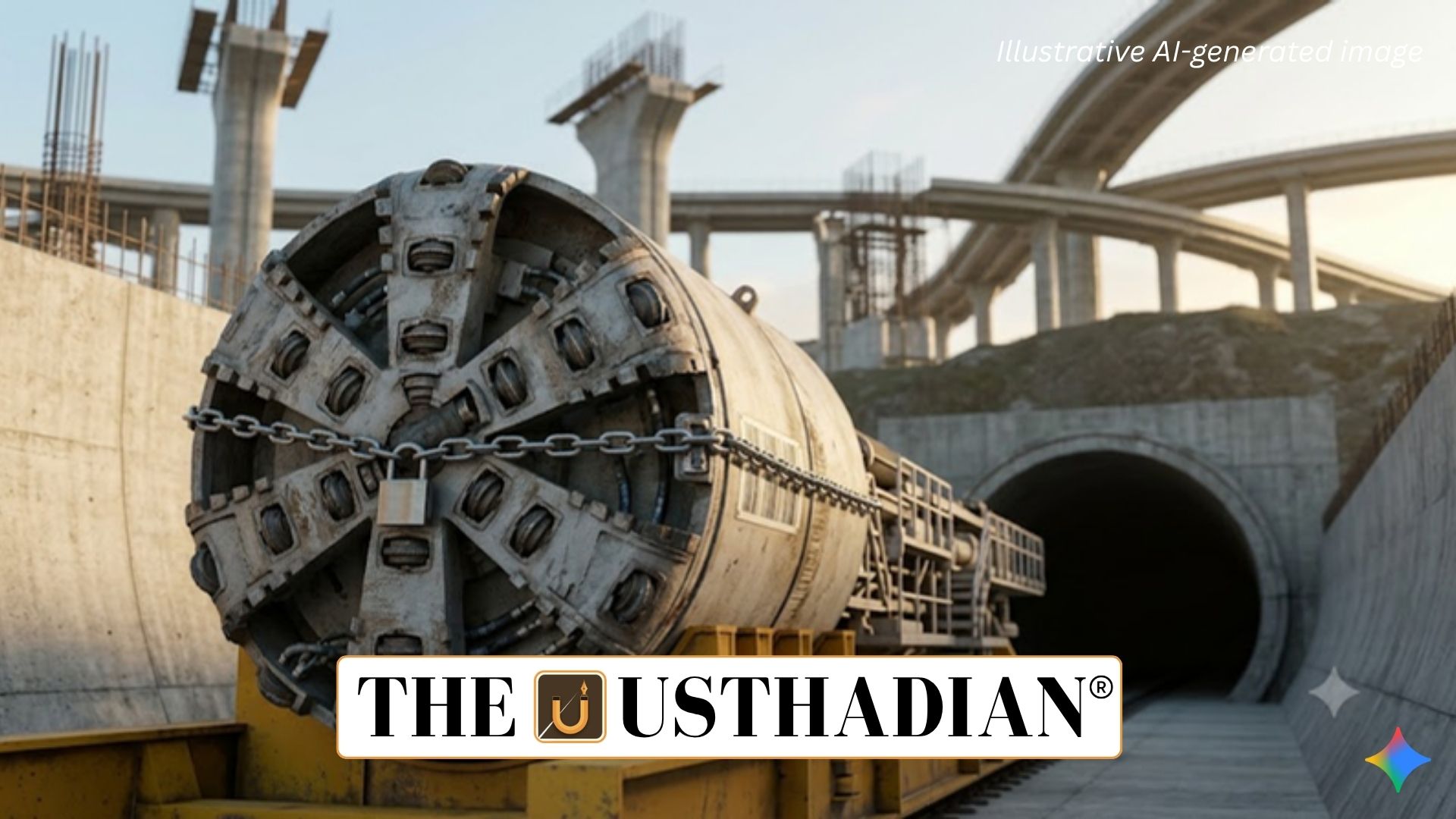
China Introduces TBM Export Licensing
China’s TBM Export Curbs Raise Concerns for India’s Infrastructure: China has announced new export restrictions on Tunnel Boring Machines (TBMs), equipment widely used in underground construction. According to the supplied report, the new rules will take effect on 18 November 2026 and require exporters to obtain licences under China’s export-control framework governing dual-use items.
The restrictions could affect infrastructure projects that depend on Chinese-manufactured or China-routed machinery, including India’s Mumbai–Ahmedabad High-Speed Rail Corridor. The actual impact will depend on how the licensing system is implemented and whether particular exports face delays or denial.
Static GK fact: A dual-use item is a product, technology or piece of equipment that can have both civilian and military applications.
Why Tunnel Boring Machines Matter
TBMs are specialised machines designed to excavate tunnels through soil and rock while supporting the surrounding ground. They are used in metro systems, railway tunnels, road projects, water infrastructure and other underground construction.
Their controlled excavation process can reduce surface disruption and certain risks associated with conventional excavation methods. This is particularly important in densely populated urban areas and complex geological conditions.
India’s 508-km Mumbai–Ahmedabad High-Speed Rail Corridor is a major infrastructure project that includes a reported 7-km undersea tunnel. Delays in obtaining suitable TBMs could affect construction schedules, equipment deployment and project costs.
Static GK Tip: TBMs are also called tunnel-boring machines or tunnel boring systems. Their design varies according to ground conditions, including hard rock, soft soil and mixed geological formations.
India’s Previous TBM Import Challenges
The supplied report states that India experienced TBM import delays from 2024, with shipments resuming in March 2026. It also describes a 2024 diplomatic discussion involving India and Germany over Chinese-made machines associated with Herrenknecht, a German tunnel-boring technology company.
Such episodes illustrate how international manufacturing networks can create supply-chain vulnerabilities. Even when equipment is sourced through a foreign company, manufacturing locations, export permissions and cross-border logistics may influence delivery.
India–China Trade Relations and Strategic Risks
The export restrictions come amid broader concerns about India’s trade imbalance with China. According to the supplied report, India’s trade deficit with China reached US$69 billion in the first half of financial year 2026–27, an increase of 27% compared with the corresponding period a year earlier.
India has pursued multiple approaches to managing this relationship, including selective engagement with Chinese investment and anti-dumping or anti-subsidy investigations into imported goods.
China’s TBM licensing mechanism could provide greater control over the timing and approval of equipment exports. However, a licensing requirement does not automatically mean that all Indian-bound TBMs will be prohibited.
Static GK fact: A trade deficit occurs when the value of a country’s imports exceeds the value of its exports over a specified period. Anti-dumping measures are trade remedies used when imported goods are found to be dumped and the applicable legal conditions are met.
Global Trade Implications
The restrictions also come amid wider trade negotiations involving China, the United States and the European Union. Competition over advanced manufacturing, critical materials and industrial exports has increased attention to economic security and supply-chain resilience.
The supplied report cites a September 2026 Rhodium Group analysis projecting changes in global trade shares by 2030. Such projections are estimates rather than guaranteed outcomes and depend on trade policies, industrial investment and market conditions.
Way Forward for India
The situation highlights the importance of diversifying equipment suppliers, strengthening domestic engineering capabilities and developing indigenous TBM manufacturing. Alternative sourcing, strategic procurement planning and technology partnerships could help reduce the risk of infrastructure delays.
India must also balance economic engagement with China against the need to protect critical projects from excessive dependence on a limited number of suppliers.
Static Usthadian Current Affairs Table
China’s TBM Export Curbs Raise Concerns for India’s Infrastructure:
| Fact | Detail |
| Equipment | Tunnel Boring Machine (TBM) |
| Reported effective date of Chinese restrictions | 18 November 2026 |
| Main regulatory mechanism | Export licensing for covered dual-use items |
| Major Indian project at risk | Mumbai–Ahmedabad High-Speed Rail Corridor |
| Corridor length | 508 km |
| Reported undersea tunnel length | 7 km |
| German TBM company mentioned | Herrenknecht |
| Reported India–China trade deficit | US$69 billion, first half of FY 2026–27 |
| Trade remedy | Anti-dumping and anti-subsidy measures |
| Key strategic concern | Dependence on foreign critical construction equipment |
| Potential response | Supplier diversification and indigenous TBM capacity |