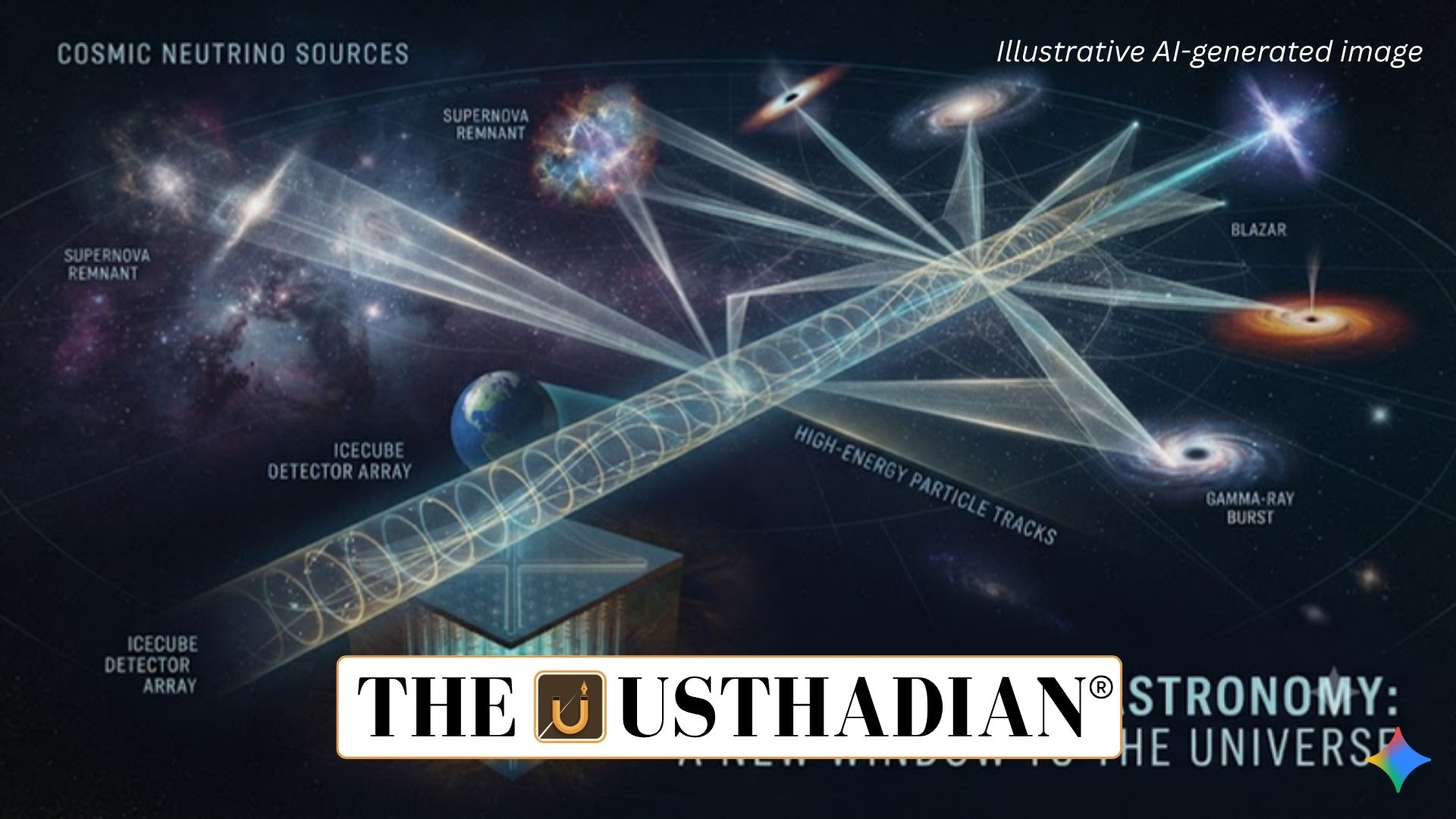
2026 Nobel Prize Recognises Neutrino Astronomy
Neutrinos Open a New Window to the Universe: The 2026 Nobel Prize in Physics has been awarded to Francis Halzen, a Belgian-American scientist, for his pioneering work behind the IceCube Neutrino Observatory in Antarctica. The facility transformed a huge volume of Antarctic ice into a detector capable of identifying extremely high-energy neutrinos arriving from beyond the Milky Way.
Neutrinos are often called “ghost particles” because they interact extraordinarily weakly with matter. Their detection therefore requires enormous observatories capable of capturing the rare interactions that do occur.
Static GK fact: Neutrinos were theoretically proposed in the 1930s and were experimentally detected for the first time in the 1950s.
Why Neutrinos Are Difficult to Detect
Neutrinos are electrically neutral and interact only very weakly with matter. As a result, enormous numbers pass through Earth and living organisms without producing any detectable effect.
Around 65 billion neutrinos can pass through an area comparable to a human fingernail every second. Their weak interaction, however, becomes a scientific advantage because neutrinos can travel through extremely dense cosmic environments that can block or scatter electromagnetic radiation.
This allows scientists to investigate regions of the universe that conventional telescopes cannot observe directly.
How IceCube Detects Neutrinos
The IceCube Observatory is embedded deep inside approximately one cubic kilometre of Antarctic ice near the South Pole. It contains more than 5,000 optical sensors installed on long cables beneath the surface.
When a neutrino occasionally collides with an atom in the ice, it can produce a charged particle. If this particle moves faster than the speed of light in ice, it generates a faint flash known as Cherenkov radiation.
Scientists analyse the direction, timing and characteristics of this light to estimate the original neutrino’s energy and direction.
Static GK Tip: Cherenkov radiation occurs when a charged particle travels faster than the phase velocity of light in a medium; it is different from exceeding the speed of light in a vacuum.
IceCube and Extra-Galactic Neutrinos
IceCube became fully operational in 2011, while important evidence for very high-energy neutrinos emerged in 2013. Subsequent observations strengthened the evidence for neutrinos originating from sources far beyond our galaxy.
This was a major advance because earlier neutrino observations were dominated by comparatively nearby sources, including nuclear reactions occurring inside the Sun.
High-energy extra-galactic neutrinos can carry information from violent cosmic environments across enormous distances.
Multi-Messenger Astronomy
Modern astronomy no longer depends only on visible light. Scientists now observe the universe using different forms of electromagnetic radiation, cosmic rays, gravitational waves and neutrinos.
Gravitational waves, first directly detected in 2015, opened another observational window. Neutrino astronomy adds a further channel because these particles can escape dense regions that may be opaque to light.
The combined study of different signals from cosmic events is known as multi-messenger astronomy.
India’s Neutrino Observatory Challenge
India has also pursued neutrino research through the proposed India-based Neutrino Observatory (INO). The project was initially associated with Kerala and was later proposed at a site in Tamil Nadu.
However, the project has faced opposition and environmental and land-related concerns, leaving its implementation unresolved. INO remains significant for India’s participation in fundamental particle physics and neutrino research.
Why the IceCube Discovery Matters
Neutrinos provide scientists with a new method of studying the universe beyond conventional electromagnetic astronomy. Their ability to travel through dense matter with minimal interaction makes them valuable messengers from distant and energetic cosmic environments.
The IceCube experiment therefore represents more than a detector beneath Antarctic ice. It demonstrates how fundamental particle physics can expand humanity’s ability to investigate the origin, structure and most extreme phenomena of the universe.
Static Usthadian Current Affairs Table
Neutrinos Open a New Window to the Universe:
| Fact | Detail |
| 2026 Nobel Prize in Physics | Awarded to Francis Halzen for pioneering neutrino detection through IceCube |
| IceCube Location | Deep beneath the Antarctic ice near the South Pole |
| Detector Volume | Approximately 1 cubic kilometre of ice |
| Optical Sensors | More than 5,000 |
| Important Evidence | Very high-energy neutrinos identified in 2013 |
| Detection Principle | Cherenkov radiation from charged particles |
| Astronomy Concept | Multi-messenger astronomy |
| Gravitational Waves | First directly detected in 2015 |
| Indian Project | India-based Neutrino Observatory (INO) |
| INO Context | Proposed neutrino research facility associated with Tamil Nadu |