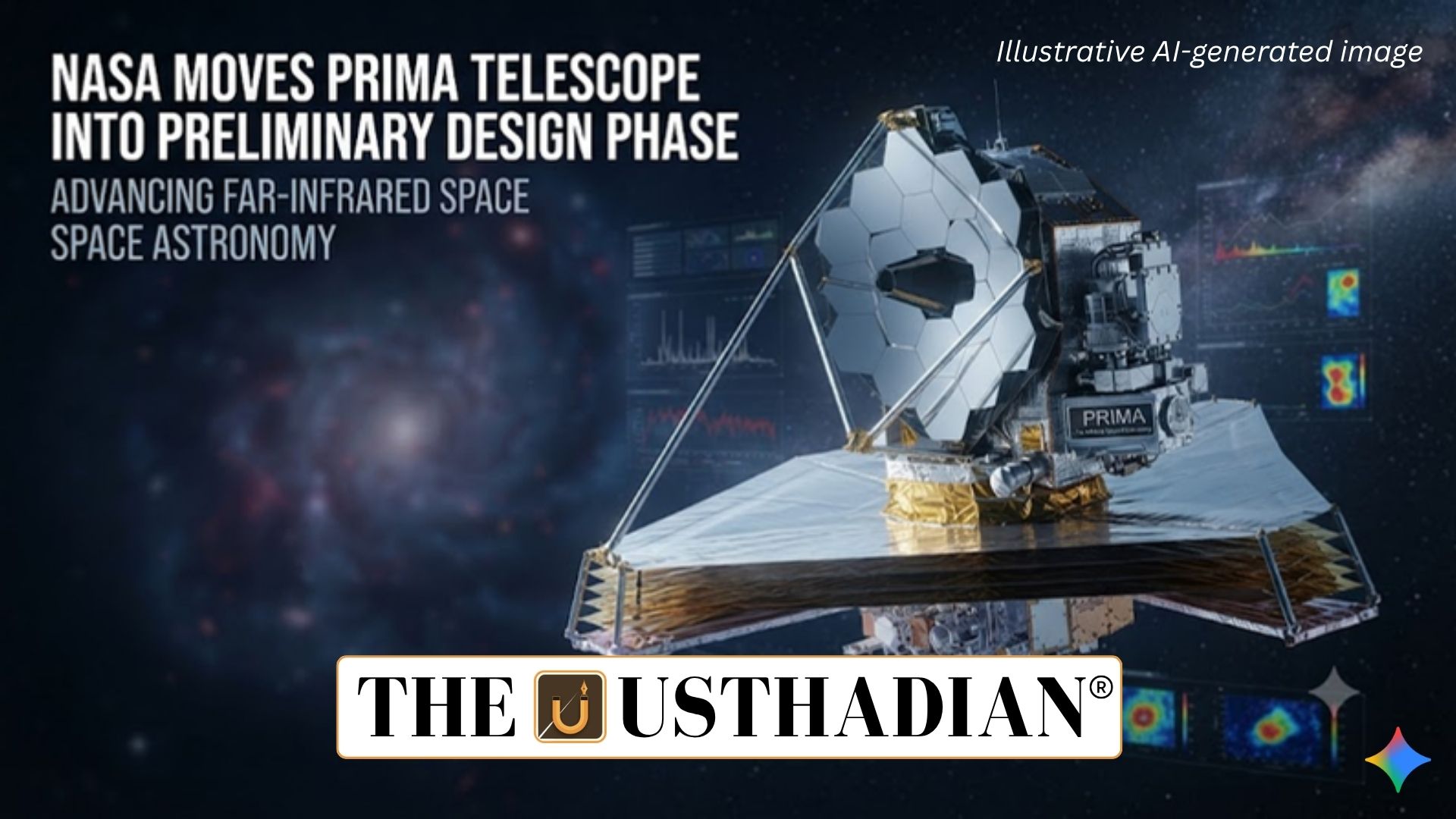
PRIMA Enters Phase B
NASA Moves PRIMA Telescope Into Preliminary Design Phase: NASA has advanced the PRobe far-Infrared Mission for Astrophysics (PRIMA) to Phase B, beginning its preliminary design and technology-development work. The decision was announced on 23 September 2026 and represents a significant step toward developing a new class of medium-cost astrophysics missions.
PRIMA is the first mission selected under NASA’s Probe Explorers concept within the broader Explorers Program. The proposed observatory is designed around a 5.9-foot (1.8-metre) telescope and is currently targeted for launch in 2033.
Static GK fact: NASA’s Explorers Program supports space science missions designed to investigate focused scientific questions with comparatively smaller budgets and shorter development periods than flagship missions.
What Phase B Means
Phase B covers the preliminary design of the spacecraft and its scientific instruments, along with further technology development. PRIMA will still require a confirmation review before moving into Phase C, the implementation stage.
The review will examine the mission’s technical readiness, programme performance and projected costs. Only after successful confirmation would PRIMA proceed toward full implementation.
The mission has a stated project-cost cap of $1.2 billion, excluding launch and other non-project expenses. Therefore, describing $1.2 billion as the complete mission cost would not accurately reflect the stated cost structure.
PRIMA’s Far-Infrared Window
PRIMA will observe the universe in the far-infrared portion of the electromagnetic spectrum, occupying an important observational region between mid-infrared astronomy and longer-wavelength submillimetre observations.
This will complement observations from the James Webb Space Telescope (JWST) and radio facilities such as ALMA in Chile. PRIMA is expected to conduct deep surveys of faint and cold astronomical material that is difficult to study at shorter wavelengths.
Static GK Tip: The Herschel Space Observatory, operated by the European Space Agency from 2009 to 2013, was the last space observatory capable of observing some of these longer far-infrared wavelengths.
Major Scientific Objectives
PRIMA is expected to investigate several major questions in astrophysics. These include the formation of planets, particularly through observations of cold gas and dust surrounding young planetary systems.
The telescope will also study the evolution of galaxies and their central black holes, while examining how dust and heavy elements accumulated throughout cosmic history.
Another objective is understanding the distribution of water in the universe and the processes that may have contributed to water reaching Earth.
Probe Explorers and the Decadal Survey
NASA selected PRIMA after assessing competing Probe Explorer concepts on scientific value, technical feasibility, cost and schedule considerations. The programme follows recommendations from the 2020 Decadal Survey, which supported the development of a mid-cost class of astrophysics missions.
PRIMA was one of two concepts selected for detailed consideration, with the final choice involving either a far-infrared or X-ray observatory.
The mission’s principal investigator is Jason Glenn of NASA’s Goddard Space Flight Center. NASA’s Jet Propulsion Laboratory (JPL) will manage the mission, while Caltech’s IPAC will serve as the science centre responsible for data processing, archiving and observation scheduling.
Static Usthadian Current Affairs Table
NASA Moves PRIMA Telescope Into Preliminary Design Phase:
| Fact | Detail |
| Mission | PRIMA |
| Full form | PRobe far-Infrared Mission for Astrophysics |
| Current stage | Phase B |
| Telescope size | 5.9 feet or 1.8 metres |
| Target launch | 2033 |
| Planned mission duration | Five years |
| Project-cost cap | $1.2 billion, excluding launch and other non-project costs |
| Managing centre | NASA Jet Propulsion Laboratory |
| Science centre | Caltech IPAC |
| Principal Investigator | Jason Glenn |
| Major wavelength region | Far-infrared |
| Key scientific areas | Planet formation, galaxies, black holes, cosmic dust and water |