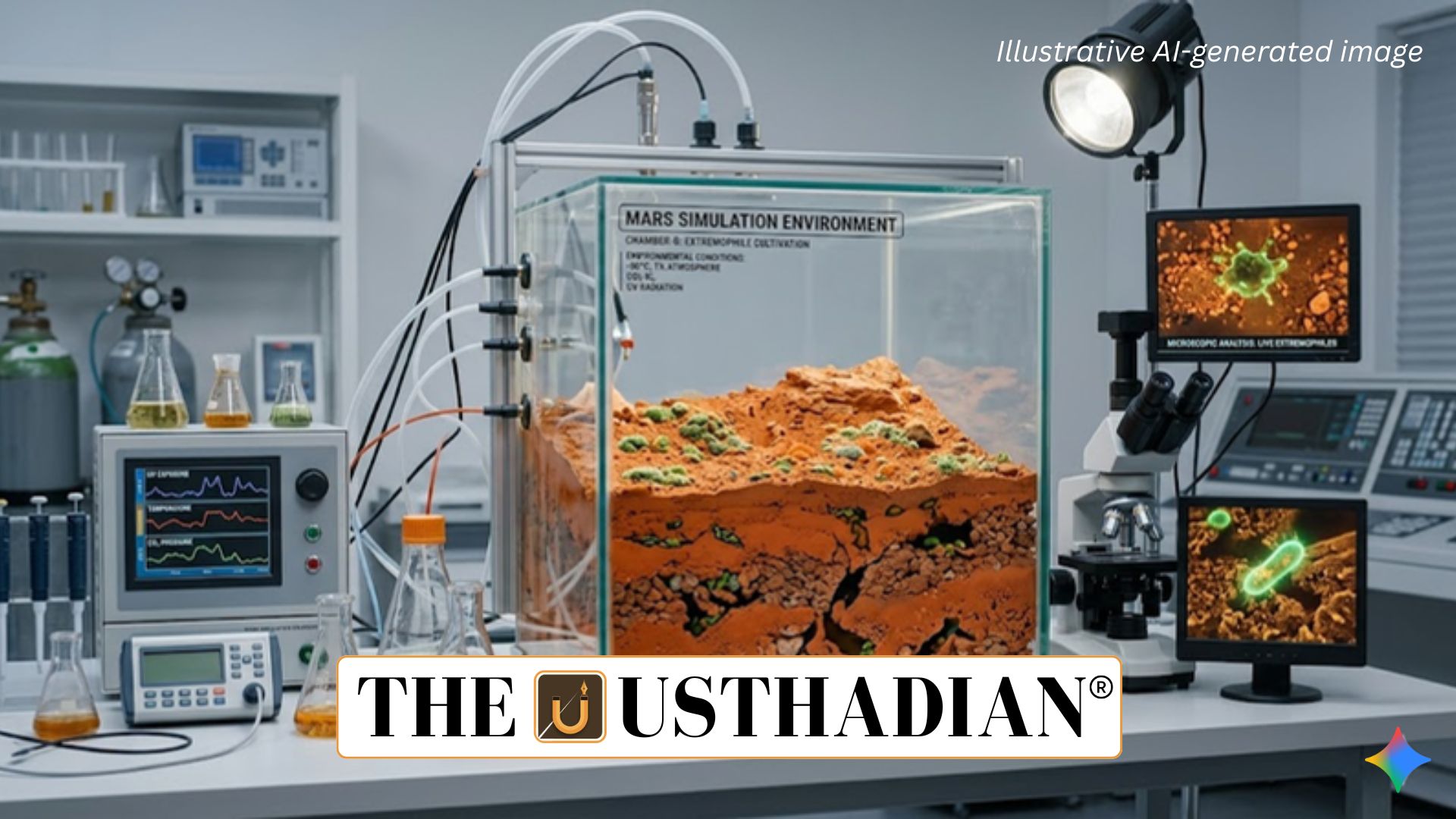
Experiment on Mars conditions
Microbial Survival Under Mars Like Conditions: Scientists recently recreated harsh conditions similar to Mars in controlled laboratory settings. The study, published in PNAS Nexus, tested whether life could survive extreme environments previously considered uninhabitable.
Researchers simulated meteorite impact shocks and toxic soil conditions to understand survival limits. Surprisingly, simple yeast cells showed resilience under these combined stresses.
Static GK fact: Mars is often called the “Red Planet” due to iron oxide dust on its surface.
Simulation of extreme environments
Two major hostile features were recreated during the experiment. These included high-pressure shockwaves similar to meteorite impacts and the presence of perchlorate salts, which are toxic chemicals found in Martian soil.
Earlier assumptions suggested that such conditions would destroy all forms of life. However, experimental observations revealed that certain microorganisms can tolerate these extreme factors.
Survival mechanisms of cells
The survival of these cells is linked to their ability to form protective molecular structures. These structures act as shields, maintaining essential cellular functions even under intense stress.
Such adaptations are also seen in extremophiles, organisms that thrive in harsh environments like deep oceans and polar regions. These organisms can withstand radiation, freezing temperatures, and oxygen scarcity.
Static GK Tip: Extremophiles are commonly found in environments such as hydrothermal vents and Antarctic ice.
Significance for astrobiology
The findings hold major importance in the field of astrobiology, which studies the origin and existence of life beyond Earth. If microorganisms can survive Mars-like conditions, it increases the possibility of past or present microbial life on Mars.
This also expands the concept of the habitable zone, suggesting that life can exist in more extreme conditions than previously believed. It challenges traditional definitions of planetary habitability.
Scientific and exploration impact
The research strengthens the scientific basis for future Mars missions and exploration programs. It encourages deeper investigation into Martian soil and subsurface environments.
However, scientists clarify that survival does not mean active growth or reproduction. Thriving in such harsh conditions remains highly unlikely, but survival itself is a major discovery.
Static GK fact: Mars has the largest volcano in the solar system, Olympus Mons.
Expanding limits of life
This study highlights the adaptability and resilience of life forms. It reshapes our understanding of biological limits and opens new directions for space exploration.
Each discovery brings scientists closer to answering fundamental questions about life beyond Earth. It also supports continued missions aimed at detecting biosignatures on other planets.
Static Usthadian Current Affairs Table
Microbial Survival Under Mars Like Conditions:
| Topic | Detail |
| Study Focus | Survival of microorganisms in Mars-like conditions |
| Planet Referenced | Mars |
| Journal Name | PNAS Nexus |
| Key Chemicals | Perchlorate salts in Martian soil |
| Organism Tested | Yeast cells |
| Scientific Field | Astrobiology |
| Key Concept | Extremophiles and survival mechanisms |
| Major Finding | Cells can survive extreme shock and toxicity |
| Limitation | Survival does not ensure growth |
| Exploration Impact | Supports future Mars research missions |