Rare View From Orbit
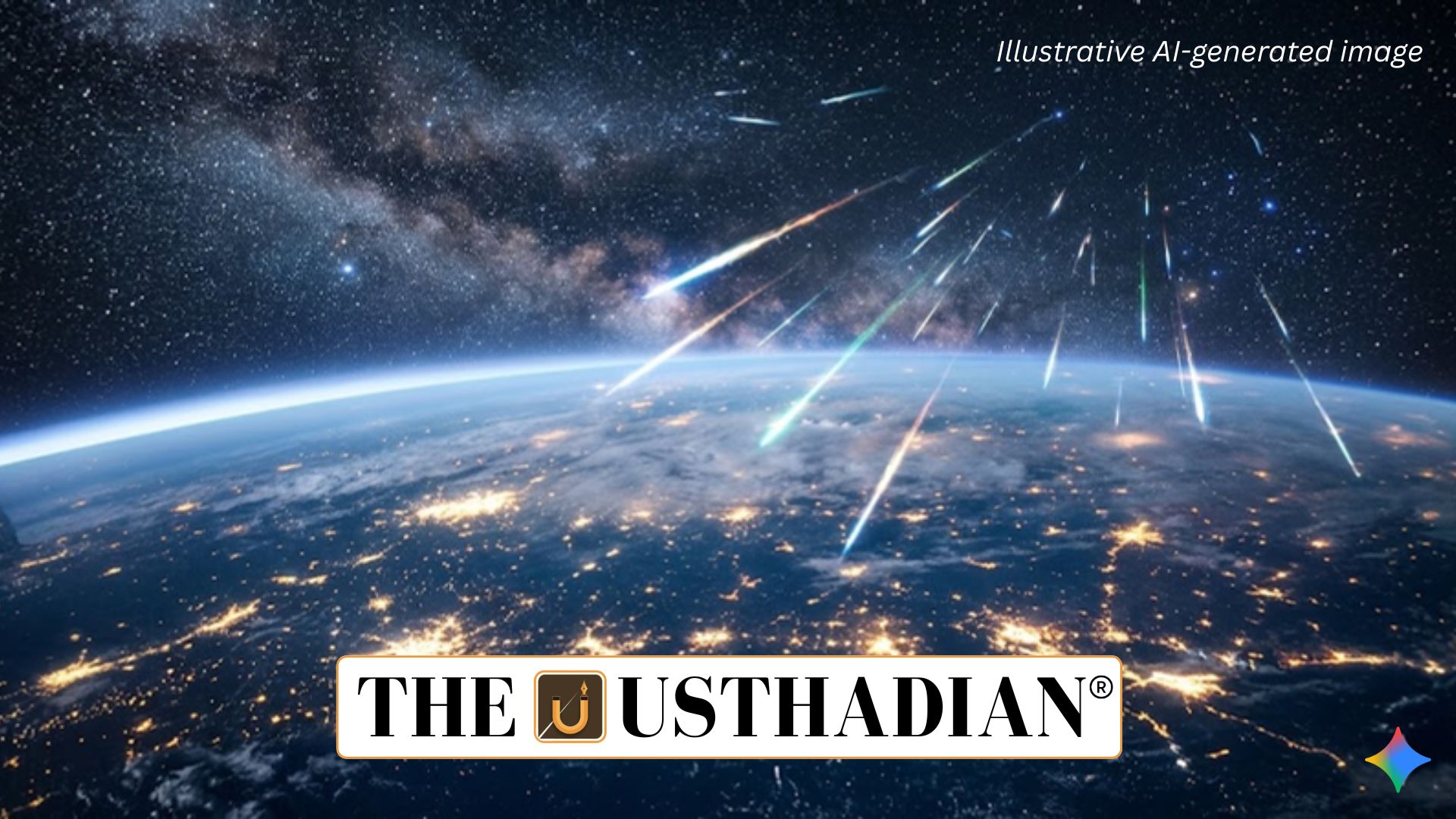
Lyrid Meteor Shower Captured From Space: A stunning image of the Lyrid Meteor Shower was captured from space by Jessica Meir, a NASA astronaut aboard the International Space Station. The photograph was taken through the station’s cupola module, offering a rare orbital perspective of meteors entering Earth’s atmosphere.
This image has gained global attention as it shows meteors streaking across the atmosphere from above. Such visuals are uncommon because most meteor observations occur from Earth’s surface.
Static GK fact: The ISS orbits Earth at an altitude of about 400 km, completing one orbit roughly every 90 minutes.
About Lyrid Meteor Shower
The Lyrid Meteor Shower is one of the oldest recorded meteor showers, with observations dating back over 2,700 years. It occurs every year in April when Earth passes through debris left by Comet C/1861 G1 Thatcher.
As these particles enter Earth’s atmosphere, they burn due to friction and produce bright streaks called shooting stars. The shower typically peaks around April 21–22 each year.
Static GK Tip: Meteor showers are named after the constellation from which they appear to originate, known as the radiant.
Unique Photography From ISS
Jessica Meir captured the image using a three-second exposure, allowing both Earth’s city lights and meteors to appear as streaks. The cupola, a dome-shaped observation deck, is specially designed for Earth observation and photography.
The image shows a meteor as a distinct streak near the horizon, separate from the light trails caused by Earth’s rotation. This technique highlights the contrast between natural celestial events and human-made illumination.
Static GK fact: The ISS cupola has seven windows, making it one of the best observation points in space.
Skywatching From Earth
The Lyrids are best viewed in the Northern Hemisphere, especially during late-night and early morning hours. Observers are advised to look toward the constellation Lyra, where the meteors appear to originate.
Clear skies and minimal light pollution improve visibility. Occasionally, observers may also spot the ISS passing overhead, appearing as a bright moving object in the sky.
Static GK Tip: The constellation Lyra contains the bright star Vega, one of the most luminous stars visible from Earth.
Scientific and Public Importance
Such images play a crucial role in promoting astronomy awareness and public engagement. They demonstrate how astronauts contribute beyond research by sharing unique perspectives of natural phenomena.
The event also highlights the thin atmospheric layer protecting Earth from space debris. Meteor showers like the Lyrids provide insights into cometary material and space environment dynamics.
Static Usthadian Current Affairs Table
Lyrid Meteor Shower Captured From Space:
| Topic | Detail |
| Event | Lyrid Meteor Shower observed from space |
| Astronaut | Jessica Meir |
| Spacecraft | International Space Station |
| Origin of Lyrids | Comet C/1861 G1 Thatcher |
| Peak Period | April 21–22 annually |
| Observation Tool | Cupola module of ISS |
| Key Feature | Meteors appear as streaks of light |
| Best Viewing Region | Northern Hemisphere |
| Scientific Value | Helps study atmospheric and comet debris |