Women’s Social Indicators in Tamil Nadu
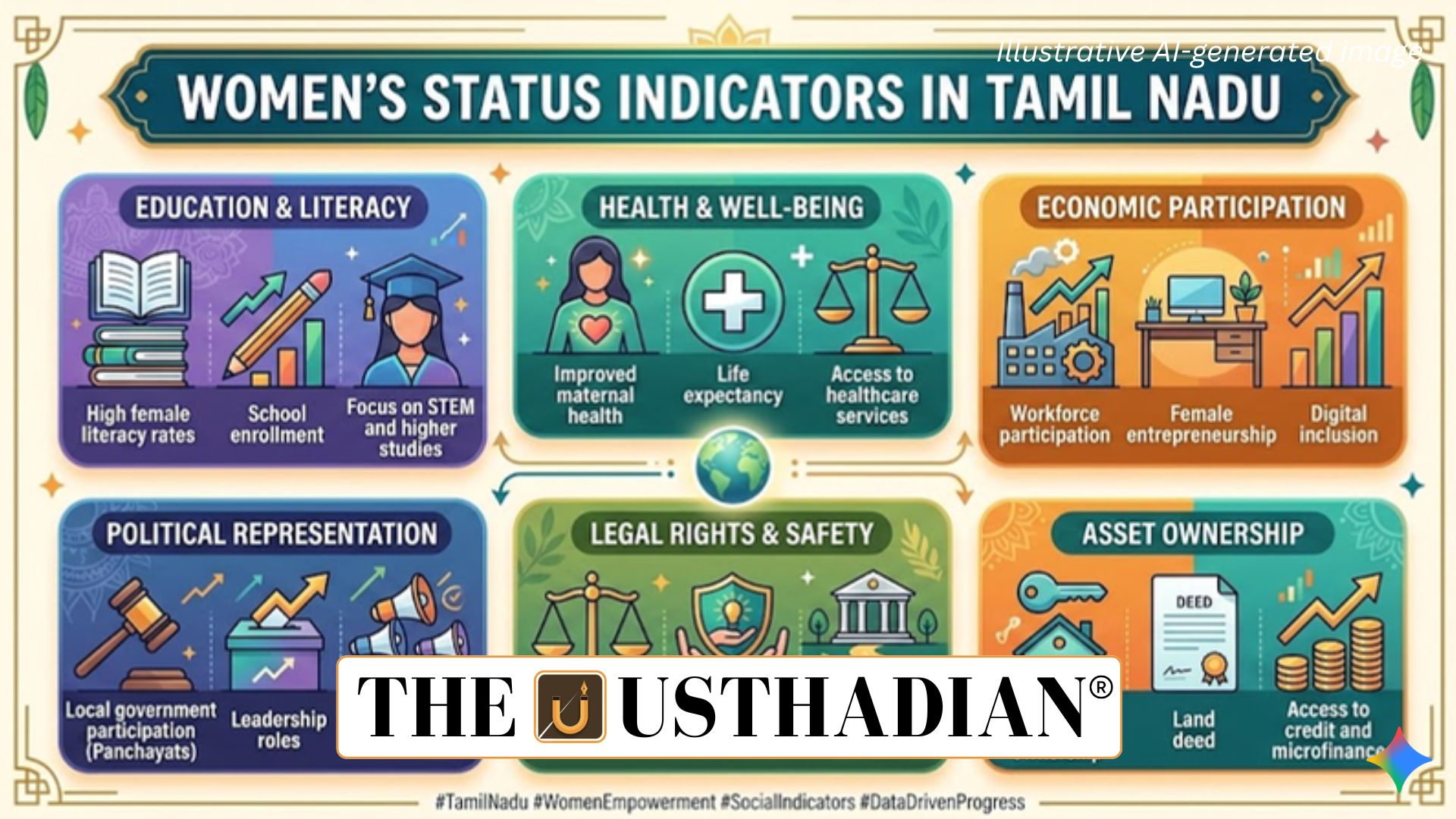
Women’s Status Indicators in Tamil Nadu: The Economic Survey 2025–26 released by the State Planning Commission (SPC) presents key data on the social and economic status of women in Tamil Nadu. The report highlights improvements in education, financial inclusion, and marriage age, while also pointing out certain demographic and social challenges.
Tamil Nadu performs better than the national average in several gender indicators, including literacy rates, financial inclusion, and delayed age at marriage. These improvements are largely linked to long-standing welfare schemes, education policies, and social development programmes in the State.
Static GK fact: Tamil Nadu is one of India’s most urbanised States, with an urban population of about 48%, which contributes to improved social indicators such as education and healthcare access.
Consanguineous Marriage Patterns
Tamil Nadu records the highest prevalence of consanguineous marriages among peer States at 28%, according to estimates based on the National Family Health Survey-5 (NFHS-5). Such marriages occur between close relatives, typically within extended families.
This percentage is significantly higher than the all-India average of 10.8%. Among other States, Karnataka records 26.6%, Maharashtra 14.8%, Gujarat 6.4%, and Kerala 4.4%. Cultural practices and traditional family structures are often cited as reasons for the higher prevalence in southern States.
Static GK Tip: The National Family Health Survey (NFHS) is conducted by the Ministry of Health and Family Welfare and provides nationwide data on health, nutrition, and demographic indicators.
Child Marriage and Age at Marriage
Child marriage refers to any marriage where one or both individuals are below the age of 18 years. Tamil Nadu reports 15.2% child marriage prevalence in rural areas and 10.4% in urban areas, resulting in a State average of 12.8%.
This figure is significantly lower than the all-India average of 23.3%, indicating better awareness and enforcement of laws against early marriage.
The median age at first marriage for women aged 25–29 in Tamil Nadu is 22 years, compared to 19.7 years nationally. This suggests that women in the State are marrying later, often after completing higher education or entering the workforce.
Static GK fact: The Prohibition of Child Marriage Act, 2006 sets the legal minimum marriage age at 18 years for women and 21 years for men in India.
Education and Literacy Levels
Women’s education indicators in Tamil Nadu remain relatively strong. Female literacy among women aged 15–49 stands at 84%, while 24.3% of women have completed at least 12 years of schooling.
Among peer States, Kerala leads with 97% female literacy and 30.4% higher schooling completion. Maharashtra follows Tamil Nadu with 82.3% literacy and 20.9% schooling levels. The national averages are 71.5% literacy and 16.6% schooling, placing Tamil Nadu well above the national benchmark.
Higher literacy levels have contributed to better employment participation, health awareness, and social empowerment of women in the State.
Financial Inclusion and Media Access
Financial inclusion among women is particularly high in Tamil Nadu. About 92% of women have their own bank or savings account, which is significantly higher than the national average and most comparable States.
Awareness of microcredit programmes is around 74%, while 18% of women have availed loans through such programmes. These initiatives have helped many women start small businesses and self-employment ventures, particularly in rural areas.
Tamil Nadu also reports 83.4% television viewership among women, the highest among peer States. However, print media readership remains low at only 14.5%, indicating a shift toward electronic media consumption.
Digital Access and Health Indicators
Digital access among women is gradually improving in Tamil Nadu. Around 47% of women use the internet, though a rural–urban digital divide remains evident.
Nearly 69% of rural women own mobile phones, yet only 39% use the internet, suggesting gaps in digital literacy and connectivity.
The State also reports 9.9% of pregnancies ending in non-live births, which is higher compared to 6.5% in Kerala. Health experts note that improved maternal healthcare services and monitoring could further reduce this indicator.
Static GK Tip: Tamil Nadu has one of the most extensive primary healthcare networks in India, including over 1,800 Primary Health Centres (PHCs) that support maternal and child health services.
Static Usthadian Current Affairs Table
Women’s Status Indicators in Tamil Nadu:
| Topic | Detail |
| Economic Survey 2025–26 | Highlights women’s social and economic indicators in Tamil Nadu |
| Consanguineous marriage | 28% in Tamil Nadu, highest among peer States |
| Child marriage rate | State average 12.8%, lower than national average of 23.3% |
| Median marriage age | 22 years for women aged 25–29 |
| Female literacy | 84% in Tamil Nadu compared to 71.5% national average |
| Higher schooling completion | 24.3% of women completed 12 or more years of schooling |
| Financial inclusion | 92% of women possess bank or savings accounts |
| Microcredit awareness | 74% awareness and 18% participation among women |
| Digital access | 47% of women use the internet |
| Non-live births | 9.9% pregnancies ending in non-live births in Tamil Nadu |