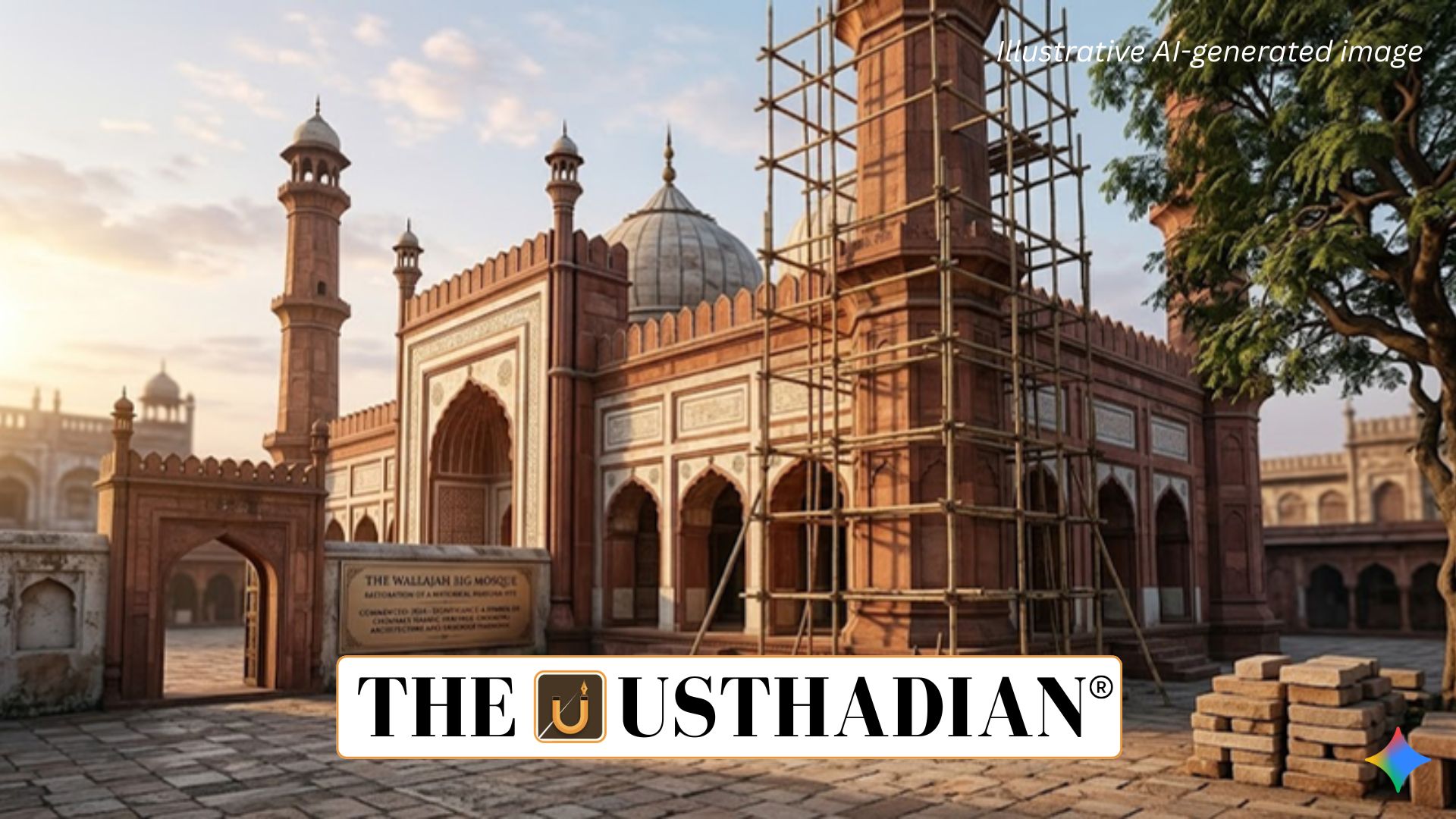
Historic mosque reopens after renovation
Wallajah Big Mosque Restoration and Historical Significance: The Wallajah Big Mosque in Triplicane, Chennai has reopened after months of renovation. The restoration was carried out by the Prince of Arcot Endowments, ensuring preservation of its heritage value.
The mosque is one of the oldest Islamic structures in South India and continues to be an important religious and cultural site. The renovation has improved structural stability while maintaining its original architectural features.
Static GK fact: Triplicane is one of the oldest residential localities in Chennai and is known for its cultural and religious landmarks.
Construction and architectural features
The mosque was built in 1795 by Muhammad Ali Wallajah, the Nawab of the Carnatic. It is uniquely constructed entirely of granite, without using wood or steel, showcasing advanced engineering for its time.
The structure reflects elements of Mughal architecture, including two prominent minarets. However, it does not strictly follow a single architectural pattern, making it distinct among Indian mosques.
Static GK Tip: Mughal architecture is known for domes, minarets, and symmetrical layouts, prominently seen in monuments like the Taj Mahal.
Historical significance of the Nawab
Muhammad Ali Khan Wallajah declared himself Nawab in 1749, though his authority faced challenges from Chanda Sahib. The rivalry led to multiple conflicts during the Carnatic Wars.
In 1752, forces of Chanda Sahib, supported by the French, were defeated and expelled from Arcot. Later, on 26 August 1765, Wallajah was officially recognized as Nawab by Mughal Emperor Shah Alam II.
He maintained a strong alliance with the British East India Company, supporting them in regional conflicts, which significantly influenced South Indian political history.
Static GK fact: The Carnatic Wars were a series of conflicts in the 18th century involving the British and French East India Companies for dominance in South India.
Cultural and memorial importance
The mosque also holds significance due to the presence of the grave of Qaid-e-Millat M. Muhammad Ismail Sahib, a prominent political leader. His resting place is situated in front of the mosque, attracting visitors and followers.
The mosque continues to serve as a center for religious gatherings and community activities. Its reopening marks a renewed commitment to preserving historical and cultural identity.
Preservation and future relevance
The restoration of the mosque highlights the importance of conserving historical monuments in urban areas. It reflects efforts to maintain architectural heritage amid rapid urbanization.
Such initiatives ensure that future generations can connect with historical narratives and cultural traditions. The mosque stands as a symbol of architectural excellence and historical legacy in Chennai.
Static Usthadian Current Affairs Table
Wallajah Big Mosque Restoration and Historical Significance:
| Topic | Detail |
| Location | Triplicane, Chennai |
| Built by | Muhammad Ali Wallajah |
| Year of construction | 1795 |
| Architectural style | Mughal style with granite construction |
| Key feature | Built without wood or steel |
| Historical context | Linked to Carnatic Wars |
| Important personality | Qaid-e-Millat M. Muhammad Ismail Sahib |
| Renovation authority | Prince of Arcot Endowments |