Formation of the Committee
Tamil Nadu Committee on Union State Relations: The Tamil Nadu Government constituted the Committee on Union–State Relations in April 2025 to study issues affecting Indian federalism and the balance of power between the Union and the States. The initiative was designed as a non-partisan academic and policy exercise aimed at strengthening federal governance.
The committee formally commenced its work on 1 June 2025. It was tasked with analysing legal, administrative, and constitutional issues that influence the functioning of Centre–State relations in India.
Static GK fact: Articles 245 to 263 of the Indian Constitution deal with the distribution of legislative and administrative powers between the Union and the States.
Submission of the First Report
The committee submitted Part I of its report on 16 February 2026 to Chief Minister M.K. Stalin. The report was subsequently tabled in the Tamil Nadu Legislative Assembly, ensuring legislative discussion and transparency.
Both Tamil and English versions of the report were released to facilitate accessibility for policymakers and the public. The report forms part of a multi-stage review process aimed at examining long-standing concerns regarding federal governance.
Static GK Tip: The Tamil Nadu Legislative Assembly is a unicameral legislature with 234 elected members, making it one of the largest state assemblies in India.
Key Issues Covered in Part I
Part I of the report examined ten major policy areas affecting the relationship between the Union Government and State Governments. Among the most significant topics were language policy, the role of the Governor, education, health governance, delimitation of constituencies, election mechanisms, and the GST framework.
These issues have often been debated in India’s federal structure because they involve shared responsibilities or overlapping powers between the Centre and the states. The committee analysed constitutional provisions, administrative practices, and emerging governance challenges.
Particular attention was given to the role of the Governor in state administration, which has been the subject of legal and political debate in several states.
Static GK fact: The Governor of a state is appointed by the President under Article 155 of the Constitution and acts as the constitutional head of the state.
Multilingual Accessibility Initiative
The Tamil version of Part I has been released as an open-access document, allowing researchers, policymakers, and citizens to freely access the report.
To promote wider public engagement, the Tamil Nadu government has proposed translations into multiple Indian languages, including Assamese, Bengali, Gujarati, Hindi, Kannada, Malayalam, Marathi, Odia, Punjabi, and Telugu. These translations will also be made available as open-access documents.
This initiative reflects an attempt to promote national dialogue on federal governance and to ensure that debates on Union–State relations are accessible to a broader audience across India.
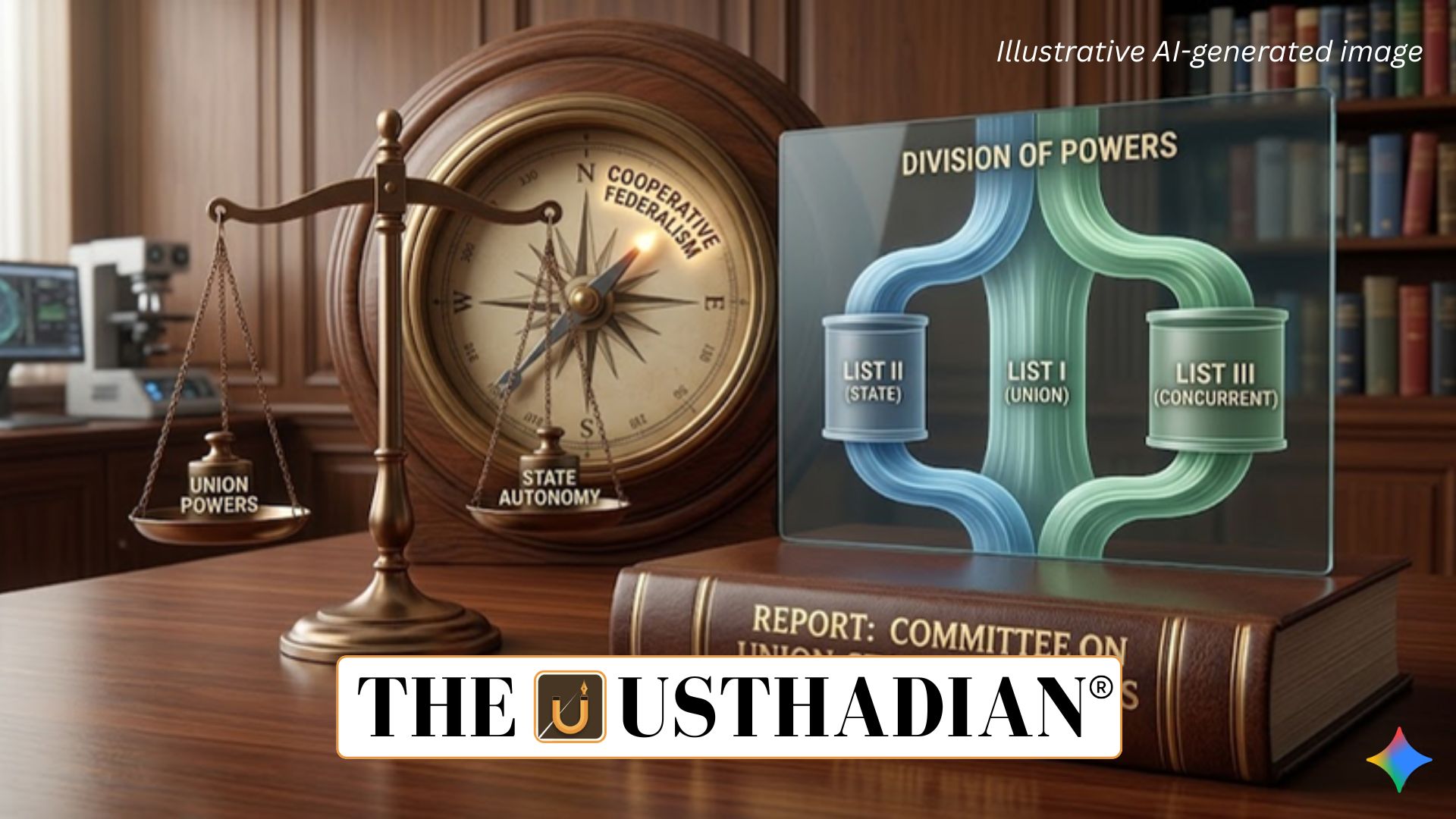
Static GK Tip: India follows a federal system with a strong central bias, where powers are divided through the Union List, State List, and Concurrent List under the Seventh Schedule of the Constitution.
Committee Deliberations in New Delhi
The committee recently convened in New Delhi to deliberate on Part II of its report. This stage of the study aims to further analyse unresolved issues in the Centre–State power balance, administrative coordination, and fiscal relations.
Such reviews are significant because India’s governance model requires continuous evaluation to maintain cooperative federalism. Committees and commissions play an important role in suggesting reforms that improve the efficiency and accountability of federal institutions.
Static GK fact: Important commissions on Union–State relations in India include the Sarkaria Commission (1983) and the Punchhi Commission (2007).
Static Usthadian Current Affairs Table
Tamil Nadu Committee on Union State Relations:
| Topic | Detail |
| Committee Name | Tamil Nadu Committee on Union–State Relations |
| Constituted By | Government of Tamil Nadu |
| Formation Date | April 2025 |
| Work Commenced | 1 June 2025 |
| Report Submitted | Part I submitted on 16 February 2026 |
| Submitted To | Chief Minister M.K. Stalin |
| Major Issues Covered | Language policy, Governor’s role, education, health, delimitation, elections, GST |
| Accessibility | Tamil and English versions released; open access |
| Translation Initiative | Proposed translations into 10 Indian languages |
| Current Development | Committee met in New Delhi to discuss Part II of the report |