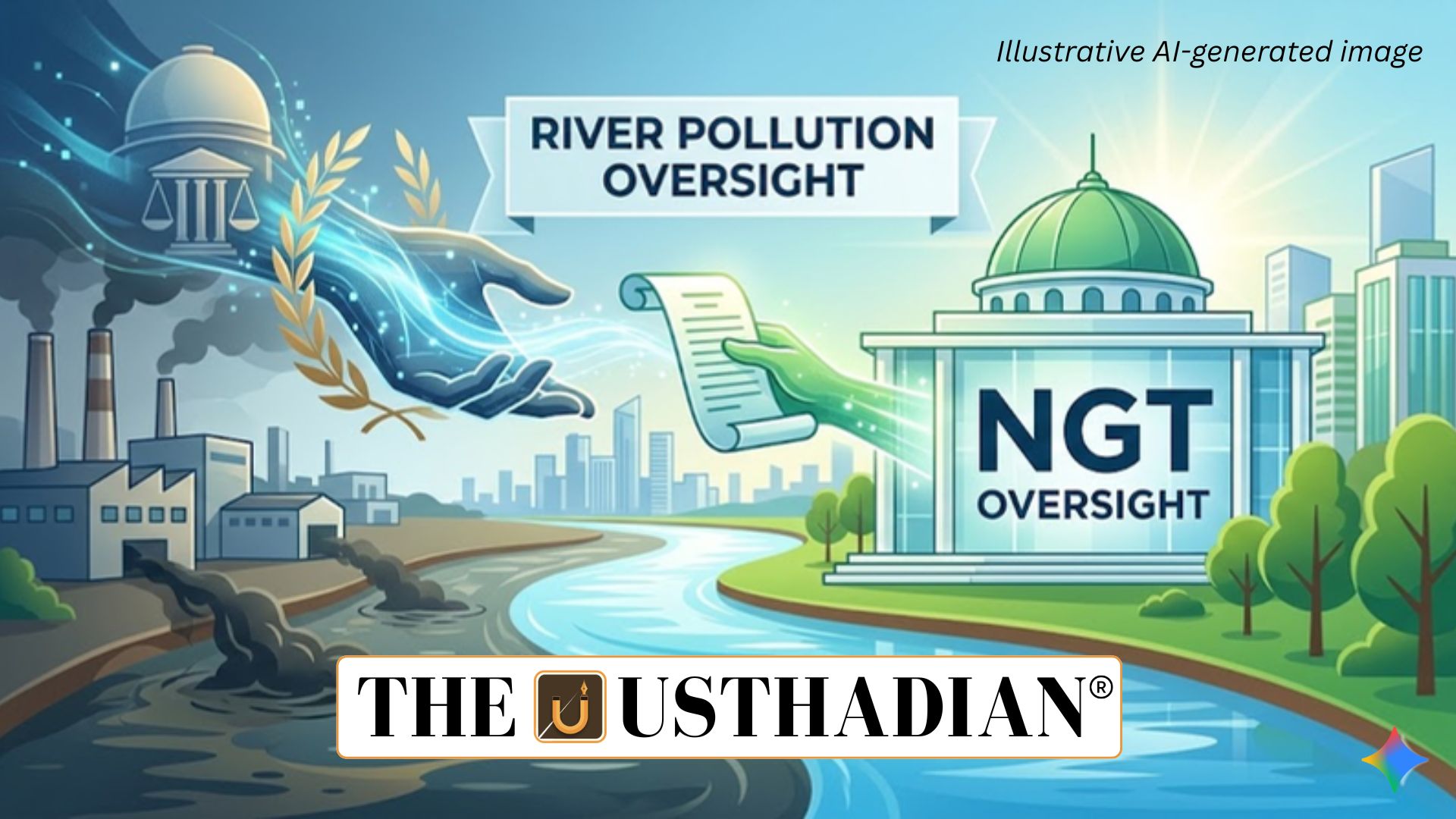
Shift in judicial oversight
Supreme Court hands river pollution oversight to NGT: The Supreme Court has closed its 2021 suo motu proceedings on polluted rivers and transferred primary monitoring responsibility to the National Green Tribunal (NGT). The Court noted that after five years of limited progress, continuous supervision must now be institutionalised under the environmental adjudicatory framework.
The Court reaffirmed that the right to live in hygienic conditions with human dignity and a clean environment is part of Article 21 of the Constitution. This interpretation strengthens environmental protection as a fundamental right.
Static GK fact: The National Green Tribunal was established in 2010 under the National Green Tribunal Act for effective and expeditious disposal of environmental cases.
Status of river pollution in India
According to the CPCB 2025 Report, 296 polluted river stretches were identified across 271 rivers out of 645 assessed rivers. These stretches are spread across 32 States and Union Territories.
A Polluted River Stretch (PRS) is defined where Biochemical Oxygen Demand (BOD) exceeds 3 mg/L. BOD measures the oxygen required by microorganisms to decompose organic matter in water and is a key indicator of water quality.
Maharashtra recorded the highest number of polluted stretches at 54. Major affected rivers include Yamuna in Delhi, Sabarmati in Ahmedabad, Chambal in Madhya Pradesh, Tungabhadra in Karnataka, and Sarabanga in Tamil Nadu.
Static GK Tip: The Central Pollution Control Board (CPCB) functions under the Ministry of Environment, Forest and Climate Change and was constituted in 1974 under the Water (Prevention and Control of Pollution) Act.
Major sources of pollution
Untreated sewage remains the largest contributor. As per CPCB data, more than 60% of untreated sewage is discharged into rivers daily, increasing organic load and reducing dissolved oxygen.
Industrial effluents from chemical, sugar, paper, and tannery units also contaminate river systems. These discharges often contain hazardous substances affecting aquatic ecosystems.
Other factors include municipal solid waste dumping, agricultural runoff carrying fertilizers and pesticides, illegal sand mining, and riverbank encroachment.
Government initiatives and technology
The Namami Gange Programme, launched in 2014, focuses on wastewater treatment, solid waste management, riverfront development, and biodiversity conservation in the Ganga basin.
The Yamuna Action Plan, initiated in 1993, aims at pollution abatement in the Yamuna river. The National River Conservation Plan (NRCP) addresses polluted stretches outside the Ganga basin under a centrally sponsored framework.
Technology plays a growing role. LiDAR mapping and drone surveys help identify drains discharging untreated waste into rivers. This enables real-time monitoring and targeted enforcement.
Static GK fact: The Ganga is the longest river in India, while the Godavari is known as the “Dakshin Ganga” due to its length and cultural importance in peninsular India.
The Supreme Court’s move signals a transition from episodic judicial intervention to structured environmental governance. Effective enforcement by the NGT will determine the future trajectory of river rejuvenation in India.
Static Usthadian Current Affairs Table
Supreme Court hands river pollution oversight to NGT:
| Topic | Detail |
| Judicial Development | Supreme Court shifted river pollution monitoring to NGT in 2026 |
| Constitutional Basis | Clean environment linked to Article 21 Right to Life |
| CPCB 2025 Data | 296 polluted stretches across 271 rivers |
| PRS Criteria | BOD level exceeding 3 mg/L |
| Highest Affected State | Maharashtra (54 polluted stretches) |
| Major Scheme 1 | Namami Gange Programme (2014) |
| Major Scheme 2 | Yamuna Action Plan (1993) |
| Monitoring Technology | LiDAR and drone-based drainage mapping |