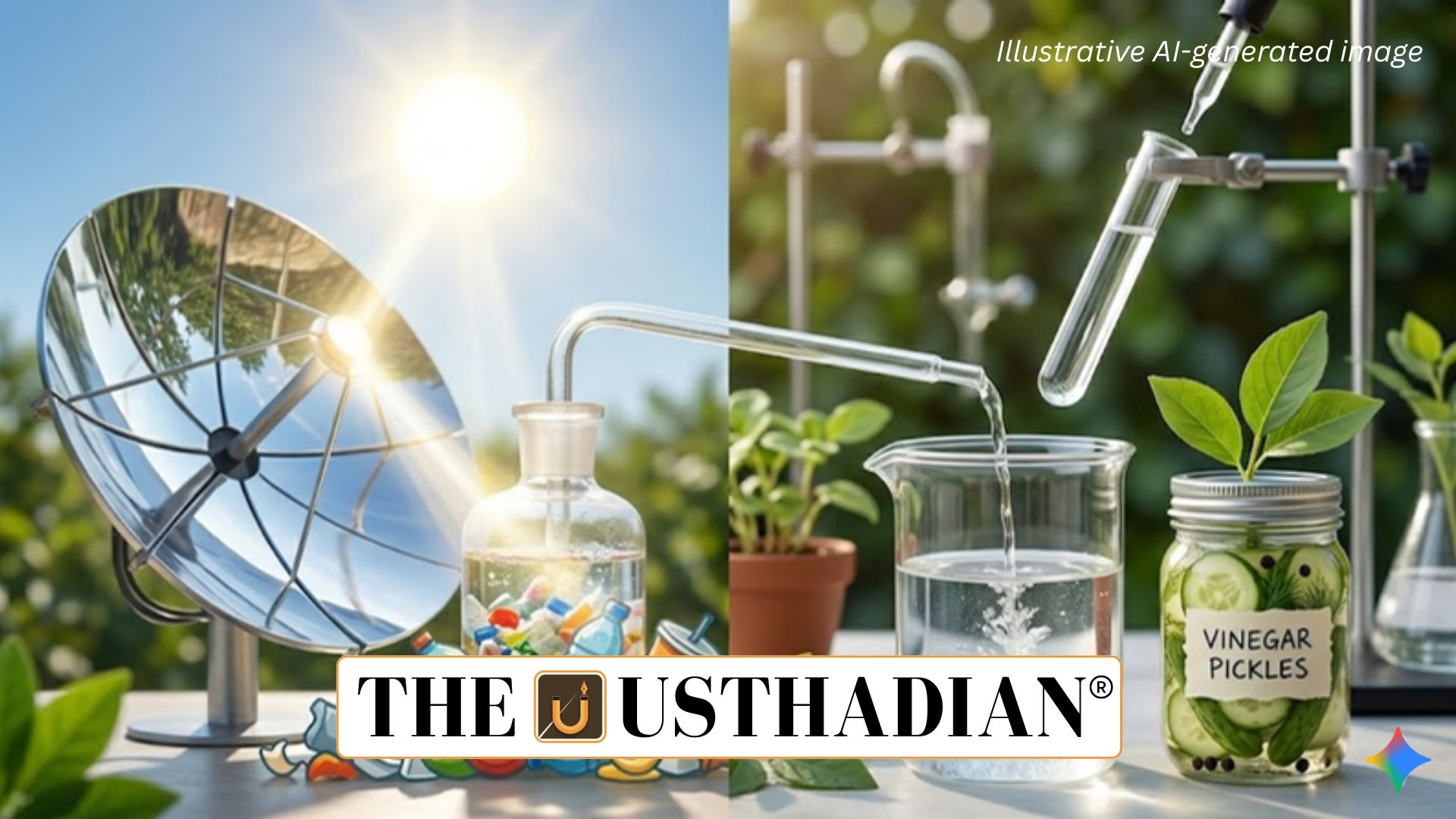
Scientific Breakthrough In Plastic Recycling
Sunlight Method Turns Plastic Waste Into Vinegar: Researchers at the University of Waterloo in Canada have developed a new technique to convert plastic waste into acetic acid, the key chemical present in vinegar. The discovery uses sunlight as the main energy source to break down plastic materials into useful compounds.
The research team was led by Professor Yimin Wu, who designed a light-driven chemical system capable of transforming plastic polymers into valuable chemicals. The method helps address the global problem of plastic pollution while also producing an industrially important substance.
Static GK fact: Acetic acid (CH₃COOH) is the primary component responsible for the sour taste and smell of vinegar.
Role Of Photocatalysis In The Process
The technology works through a process known as photocatalysis, where light energy activates a catalyst to trigger chemical reactions. In this experiment, sunlight initiates the breakdown of plastic molecules into smaller components.
Unlike traditional plastic recycling methods that require high temperatures and energy-intensive equipment, this process works at room temperature. This makes the technique more energy-efficient and environmentally friendly.
Another advantage is that the method does not release additional carbon dioxide emissions, which makes it a cleaner alternative for plastic waste management.
Static GK Tip: Photocatalysis is widely used in water purification, air cleaning, and solar fuel production.
Inspiration From Natural Biological Processes
Scientists designed the reaction based on the natural decomposition processes used by fungi. Certain fungi naturally break down organic materials using enzymes and environmental energy sources.
Similarly, when sunlight activates the photocatalyst, plastic polymers slowly degrade into smaller chemical fragments. These fragments eventually convert into acetic acid through a controlled chemical transformation.
This step-by-step breakdown helps ensure that the plastic waste is recycled safely and efficiently, rather than simply burned or dumped in landfills.
Testing On Common Plastic Materials
The research team tested the technology on several commonly used plastic types. The plastics successfully converted into acetic acid included:
- Polyethylene (PE)
- Polyethylene terephthalate (PET)
- Polypropylene (PP)
- Polyvinyl chloride (PVC)
Among these, PVC produced the highest yield of acetic acid, while polyethylene, widely used in plastic bags and packaging, also showed promising results.
The method also worked effectively when mixed plastic waste streams were used. This is important because real-world plastic waste usually contains multiple plastic types mixed together.
Static GK fact: Polyethylene (PE) is the most widely produced plastic in the world, commonly used in packaging materials and plastic bags.
Economic And Environmental Significance
The global demand for acetic acid exceeds 17 million tonnes annually, and it is mainly produced using fossil fuels such as coal and natural gas. These traditional methods contribute to industrial carbon emissions.
The new sunlight-driven approach provides a sustainable alternative, converting waste plastic into a valuable chemical product.
Acetic acid has wide industrial uses including food preservation, pharmaceuticals, solvents, textile manufacturing, and plastics production. Therefore, this technology could create a circular economy model, where plastic waste becomes a resource instead of an environmental burden.
If scaled successfully, the innovation could play a major role in reducing plastic pollution while producing green industrial chemicals.
Static Usthadian Current Affairs Table
Sunlight Method Turns Plastic Waste Into Vinegar:
| Topic | Detail |
| Research Institution | University of Waterloo, Canada |
| Lead Scientist | Professor Yimin Wu |
| Key Discovery | Conversion of plastic waste into acetic acid using sunlight |
| Scientific Process | Photocatalysis using a light-activated catalyst |
| Main Product | Acetic acid (primary component of vinegar) |
| Plastics Tested | Polyethylene (PE), PET, Polypropylene (PP), PVC |
| Highest Yield Plastic | Polyvinyl chloride (PVC) |
| Global Acetic Acid Demand | More than 17 million tonnes annually |
| Major Uses Of Acetic Acid | Food preservation, pharmaceuticals, solvents, manufacturing |
| Environmental Benefit | Reduces plastic pollution and fossil fuel dependence |