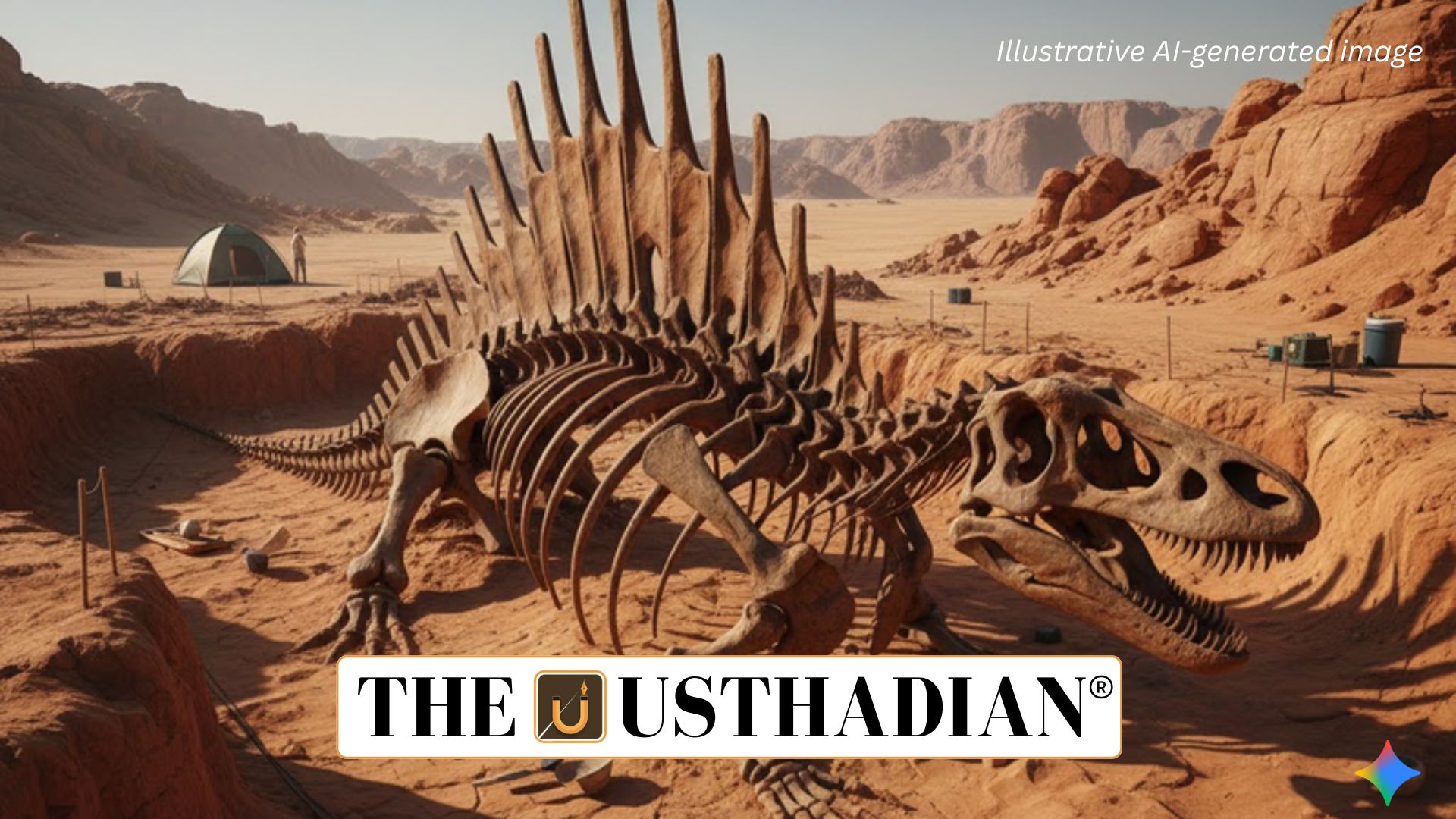
Discovery in the Sahara
Spinosaurus mirabilis Unearthed from Niger Sahara Basin: Palaeontologists have identified a new dinosaur species, Spinosaurus mirabilis, from the remote Jenguebi site in Niger. The fossils date back nearly 95 million years, placing the species in the mid-Cretaceous Period. This discovery expands knowledge about Africa’s prehistoric river ecosystems.
The expedition faced harsh desert terrain before recovering three skulls and associated skeletal remains. Detailed anatomical analysis confirmed this was a distinct species within the Spinosaurus lineage, separate from previously known fossils.
Static GK fact: The Cretaceous Period (145–66 million years ago) was the final era of the Mesozoic Age and ended with the mass extinction event that wiped out non-avian dinosaurs.
A Giant Riverine Predator
Spinosaurus mirabilis measured about 12 metres in length and weighed nearly seven tonnes. Though similar in size to other giant theropods, its skeletal features reveal strong adaptation to freshwater hunting.
The species earned the nickname “hell heron” due to its likely wading behaviour. Its nostrils were positioned high and far back on the skull, allowing partial submersion while breathing. The presence of interlocking conical teeth indicates specialization in catching fish, including large coelacanths.
Static GK Tip: Theropods were bipedal carnivorous dinosaurs; famous examples include Tyrannosaurus and spinosaurids.
Unique Skull Crest
A defining characteristic of this species is its 20-inch blade-like crest on the skull. Researchers believe the crest was likely covered in keratin and possibly brightly coloured. It may have served for display, mate attraction, or territorial signalling, rather than combat.
Compared to Spinosaurus aegyptiacus, first described in 1915 from Egyptian fossils, the new species had a more elongated snout and proportionally longer hind limbs. These features suggest ecological diversification within the spinosaurid family.
The crest structure indicates advanced social behaviour and visual communication, adding depth to understanding dinosaur behavioural evolution.
Rethinking Spinosaur Ecology
Earlier theories suggested that Spinosaurus species were fully aquatic and ocean-going predators. However, the inland fossil location in Niger’s Sahara region challenges this assumption. The evidence now supports a semi-aquatic wading lifestyle within freshwater river systems.
Geological data indicate that the present-day Sahara was once covered by rivers and forested landscapes. Such environments would have supported diverse fish populations and large predators.
Static GK fact: The Sahara Desert is currently the world’s largest hot desert, but during the Cretaceous it supported riverine ecosystems.
Scientific Significance
The discovery of Spinosaurus mirabilis reshapes understanding of predator diversity in prehistoric Africa. It demonstrates that multiple spinosaur species coexisted with varied anatomical adaptations.
By revealing extreme piscivorous traits and specialised ecological roles, the finding enhances insight into evolutionary experimentation during the Cretaceous era. It also highlights North Africa as a major fossil-rich region for dinosaur research.
Static Usthadian Current Affairs Table
Spinosaurus mirabilis Unearthed from Niger Sahara Basin:
| Topic | Detail |
| New Species | Spinosaurus mirabilis |
| Location | Jenguebi site, Niger, Sahara Desert |
| Geological Age | Around 95 million years ago |
| Era | Cretaceous Period |
| Length | Approximately 12 metres |
| Weight | Around seven tonnes |
| Distinct Feature | 20-inch blade-like skull crest |
| Diet | Fish including coelacanths |
| Ecological Role | Semi-aquatic riverine predator |
| Scientific Importance | Expands understanding of spinosaur diversity |