Understanding solar radio bursts
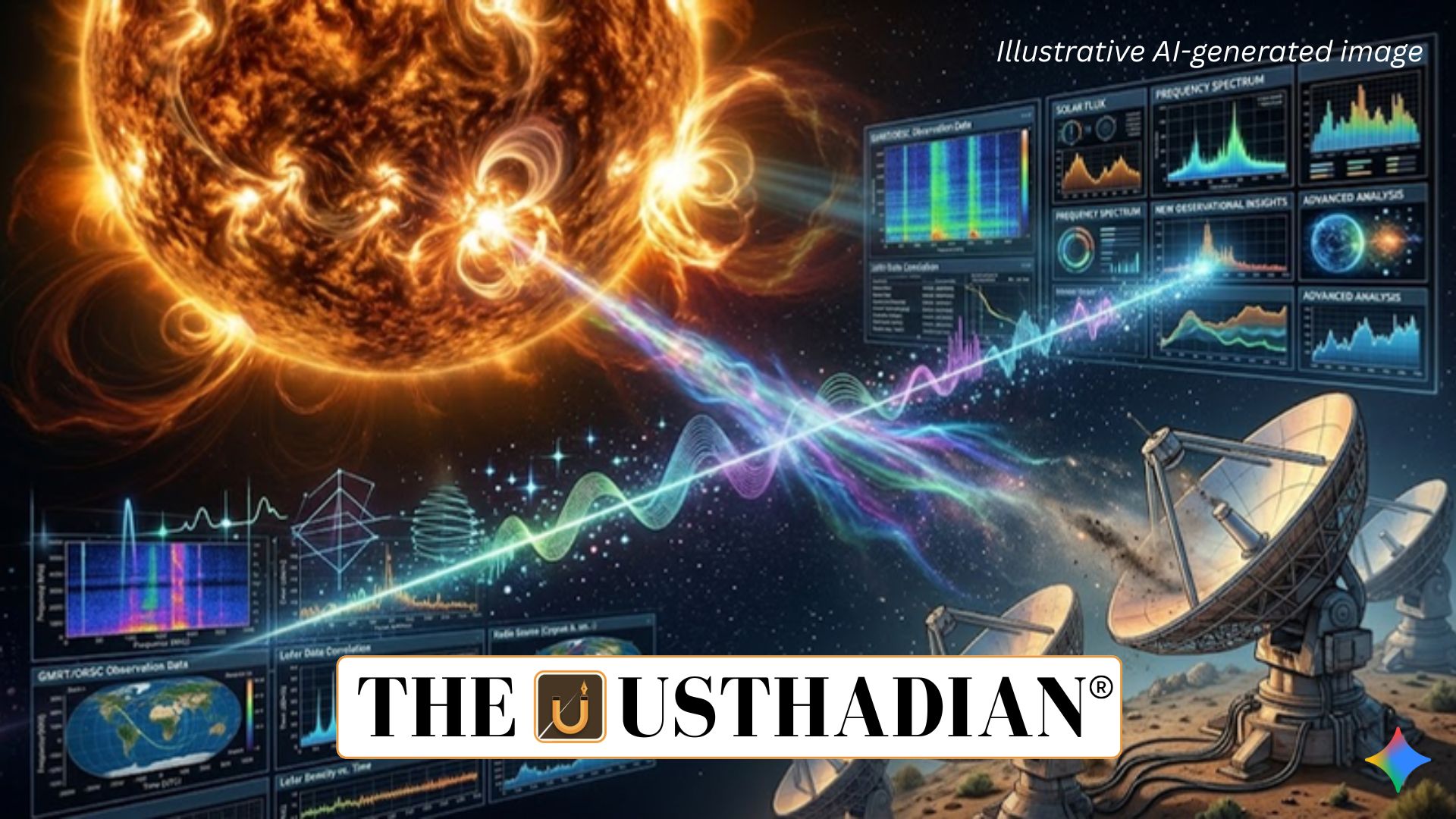
Solar Radio Burst and New Insights from Indian Research: A solar radio burst is an intense and short-lived emission of radio waves from the Sun. These bursts are usually associated with explosive solar events such as solar flares and coronal mass ejections (CMEs).
They occur when highly energetic electrons are accelerated during such events. These electrons interact with the Sun’s surrounding plasma, converting kinetic energy into electromagnetic radiation in the radio frequency range.
Static GK fact: The Sun is a G-type main-sequence star located about 150 million km from Earth, forming the center of the solar system.
Breakthrough by Indian Institute of Astrophysics
Researchers from the Indian Institute of Astrophysics (IIA) have provided new insights into the origin and behavior of solar radio bursts. Their work helps explain a long-standing mystery about how these radio emissions are generated and propagated.
The findings improve understanding of how shock waves in the solar corona accelerate particles. This contributes to better modelling of solar activity and enhances predictive capabilities.
Static GK Tip: The Indian Institute of Astrophysics is an autonomous institute under the Department of Science and Technology (DST).
Mechanism behind solar radio emissions
Solar radio bursts are produced when energetic electrons move through plasma at high speeds. This interaction generates plasma oscillations that convert into radio waves detectable from Earth.
These emissions are classified into different types based on their frequency and duration. Each type provides clues about the underlying solar processes and energy transfer mechanisms.
Static GK fact: Plasma is often called the fourth state of matter, consisting of ionized particles found abundantly in stars.
Impact on Earth systems
Solar radio bursts can significantly affect modern communication systems. They interfere with GNSS (Global Navigation Satellite Systems) such as GPS, leading to navigation errors.
They also disrupt radio communications, especially in aviation and maritime sectors. In extreme cases, they can affect satellite operations and ground-based technologies.
Understanding these impacts is crucial for protecting critical infrastructure and ensuring reliable communication networks.
Importance in space weather prediction
Solar radio bursts serve as important indicators of space weather conditions. They help scientists track shock waves in the solar corona, which are linked to solar storms reaching Earth.
Accurate monitoring of these bursts allows early warnings for geomagnetic disturbances. This is essential for safeguarding satellites, power grids, and communication systems.
India’s research contribution strengthens global efforts to improve space weather forecasting and enhances scientific understanding of solar dynamics.
Static Usthadian Current Affairs Table
Solar Radio Burst and New Insights from Indian Research:
| Topic | Detail |
| Solar Radio Burst | Short-lived radio emission from solar eruptions |
| Key Institution | Indian Institute of Astrophysics |
| Origin Mechanism | Energetic electrons interacting with plasma |
| Associated Events | Solar flares and coronal mass ejections |
| Impact on Earth | Disrupts GNSS navigation and radio communication |
| Scientific Importance | Helps track shock waves in solar corona |
| Broader Relevance | Enhances space weather prediction |
| Governing Body | Department of Science and Technology |